Home » Posts tagged 'Integrity' (Page 14)

Tag Archives: Integrity

Illuminating the Days of Darkness

3184543T.S. Eliot may have denounced April as the cruelest month, but most of us are far more likely to feel pangs of depression beginning to stir sometime around December.

As the days grow short and gray, and the nights turn cold and dark, that is the time we find our spirits truly starting to wither. We mourn the passing of those slow, sticky summer afternoons, long buried beneath the frost. As the threat of snow looms, we reflect sadly that winter will only grow crueler before we can begin to hope for the thaw.

It may be natural to attribute our mood to the inexorable cycle of nature and the change of seasons. But in this, as with all things, Jewish tradition offers a deeper insight into the spiritual torpor that descends upon us each year with the onset of winter.

The Talmud describes how, after eating from the forbidden fruit, Adam noticed that the days began growing shorter and the nights longer. Adam despaired. “On account of my sin,” he conjectured, “the Creator is gradually returning the world to the state of Primordial Darkness.”

With the passing of the winter solstice, however, the days began to lengthen once again, and Adam realized that the changing of the seasons was just part of the natural pattern of creation. He rejoiced, inaugurating a festival of eight days to celebrate the renewal of the world.

In this same season, 2,180 years ago, the Jewish people inaugurated the eighth-day festival of Chanukah, celebrating the victory of light over darkness.

CULTURE OF THE GREEKS

The number seven symbolizes perfection in nature, the complete, ordered system brought into existence through the seven days of creation. As such, it also symbolizes the culture of the Greeks, which then weighed heavily on the backs of the Jewish nation.

Greek culture worshipped physical perfection, artistic expression, and unblemished aestheticism. It exalted the physical form and physical prowess in their art and their architecture, in their Olympics and in their philosophy. It honored and revered all that the physical world represented.

In their aspiration for aesthetic idealism, however, the Greeks denied the transcendence of the human spirit and rejected the notion of any metaphysical reality. It should, therefore, come as no surprise that we find the gods of Greek mythology to be mere caricatures of men, with exaggerated human desires arid contemptible human shortcomings.

Neither should it surprise us that the Greeks fought so desperately to uproot the Torah, the spiritual compass that has kept the Jewish people pointed toward the light through the darkness of exile.

Judaism teaches that the potential for human greatness is achieved not through the ascendancy of the physical, but by subjugation of the physical to the spiritual. The symbol for this spiritual transcendence is the number eight, representing that which breaks through the bounds of physical limitation (symbolized by seven) and aspires for a higher reality, one that lies beyond materialism, beyond superficiality.

EIGHT DAYS

For this reason do we circumcise a Jewish boy on the eighth day after birth, to signify the covenant charges him with conquering his physical desires and redirecting them in the pursuit of spiritual goals.

bigstock-hanukkah-candles-copyFor this reason did Adam celebrate for eight days, in recognition that the spiritual design behind the workings of nature is even more complex and wondrous than nature itself.

And for this reason do we light the Chanukah lights for eight days: to push off the dark and cold of winter and to remember that we must all see ourselves as lights amidst the spiritual darkness of the physical world, no less than the stars scattered across the heavens.

Only by igniting our own cultural enthusiasm with the flame of our tradition and our heritage will we inspire ourselves and our children to strive toward achieving the spiritual greatness that lies within every one of us.

Originally published in 2002 by Aish.com

What are Ethics? Part 2: Blurring the Lines

Beyond the Stars — A tribute to John Glenn

188545_600If I have seen further than others, it is by standing upon the shoulders of giants.

~Sir Isaac Newton

There are two kinds of visionaries.

The first type sees farther, like Sir Isaac Newton. They possess a special gift of brilliance, genius, or perception. They see what others cannot, recognize mysteries that hide in plain sight, uncover beauty and order where the rest of us see only chaos. For the most part, they are born, not made.

Then there are those who are blessed not so much with the ability to see, but with the ability to bestow vision, to illuminate the world not with new insights but by giving the gift of insight to others. It is not their acumen, but rather their irrepressible pursuit of transcendence that inspires us to do as much with our lives as they have done with theirs.

Thirty-six years after becoming the first man in orbit, John Glenn became the oldest man in space, not as an ego trip or publicity stunt but to observe the effects of weightlessness on his 77-year-old body. As with his first trip, he showed that the limits upon human beings are mostly self-imposed.

Most of all, he showed us not only what a person can do, but what a person should be.

Click here to read the whole tribute.

President Evil

5790fbf54aa21822d5000009On 10 December, the St. Louis Post-Dispatch ran an editorial suggesting that Donald Trump was largely responsible for the gunman who attacked a Washington pizza parlor and the deranged woman who made death threats against the mother of a Sandy Hook massacre victim.  

I submitted the following letter to the editor in response.  Inexplicably, the paper chose not to print it.

Dear Editor,

Your editorial was absolutely correct.  Donald Trump’s irresponsible rhetoric definitely has contributed to the corrosion of our culture and our safety.  But please explain why you limit your indictment to Mr. Trump alone.

Why don’t you lay equal blame in the lap of Hillary Clinton for her amoral campaign of distortion, deception, and corruption?  The former next-president-of-the-United-States racked up 24 pinocchios last year from the Washington Post, and has lied about everything from her emails to her foundation, from her fictitious ducking under Bosnian sniper fire to the origins of her own name.

Why don’t you assign equal guilt to Barack Obama, who denied calling ISIS “the JV team,” who misrepresented Republican filibustering by a factor of ten, and whose misinformation about Obamacare could fill a government website?

And why don’t you admit your own complicity as part of the injudicious media that perpetuated the big lie of “Hands up, don’t shoot,” continues to indulge the wicked moral equivalence that excuses and enables radical terrorism, and — oh, the irony — provided Donald Trump with millions of dollars in free column space and air time, helping catapult him to primary and ultimately national election victory.

By all means, blame Donald Trump for all of society’s ills.  But first show the moral fortitude of placing the blame everywhere it belongs, including on your own shoulders.

What are Ethics? It’s all about appearances

Video — What are Ethics? Black, White, and Gray

The Gift of Gratitude

johnfkennedy105511If I were to say, ‘God, why me?’ about the bad things, then I should have said, ‘God, why me?’ about the good things that happened in my life.

— Arthur Ashe

There’s no arguing that tennis legend Arthur Ashe had good reason to complain. His mother died when he was four years old. His brilliant tennis career was cut short at age 36 by a heart attack, followed by two open-heart bypass operations and one brain surgery, only to discover that he had contracted AIDS via blood transfusion. He died at age 49.

It’s extraordinary that a person could suffer so much and not cry out against his fate with anger and bitterness. But the explanation used to be obvious, before it became increasingly rare:

Gratitude.

Click here to read the whole article.

Donald Trump has finally gone too far

media-frenzyPerhaps we can forgive the president-elect for his crassness, his coarseness, his ultra-nationalist rhetoric, his mockingly superior tone, and for dragging the electoral process deeper into the mud than anytime in the last century.


But now he has officially gone too far.

Donald Trump has committed the unpardonable sin of not telling the press where he went for dinner last Tuesday evening.

By doing so, reports the Washington Post, Mr. Trump has “dispensed with generations-old traditions and formalities,” adopting a “combative approach to press relations” in a way that shows “he clearly doesn’t respect the media.”

Gee, is this the same media that rallied all its collective forces to discredit Donald Trump as a candidate and convince the country that a humiliating electoral defeat to Hillary Clinton awaited him come November 8?  Might that have something to do with his perceived lack of respect?

But that’s not even the real issue.

More significant is the sense of entitlement the media feels to invade the private lives of every public figure, and the selective metric they apply when they do so.  They grudgingly accord scant airtime and column space to stories that don’t fit their ideological agenda, then cry foul when they’re denied access to the not-yet-president’s family meal and frame the perceived offense as a threat to national security.

If the election results taught us anything, it’s that the media has become so skewed in its reporting that it can’t even trust itself.  Maybe if reporters learn that lesson they’ll find themselves more welcome beside the presidential dinner table.

Six Recalibrations to get Success Back on Track

image-back-on-trackIn an earlier post, I outlined six misconceptions that stifle success.  They are:

  • Pleasure equals happiness
  • Opinion equals fact
  • Winning equals success
  • Autonomy equals freedom
  • Convenience equals peace of mind
  • Legal equals ethical

When we use words without concern for their meaning, we deprive ourselves of the ability to think clearly.  We confuse goals with side-effects, assets with obstructions, and benefits with pitfalls.  We sabotage our own success because we aren’t clear about where we’re going or how we’re going to get there.

When we mistake happiness for pleasure, we end up chasing after instant gratification, which is emotional junk food.  When we don’t consider ourselves winners unless someone else is losing, we drive away potential allies and advocates.  When we refuse to reexamine our opinions, we are often denying reality.

The belief that freedom means no restrictions destroys discipline and makes us slaves to our bad habits.  The notion that convenience leads to tranquility leaves us unable to cope with life’s difficulties and disappointments.  And exploiting legal loopholes makes us untrustworthy and untrusted.

So let’s get down to definitions.

Click here to read the whole article.

Down with Democracy?

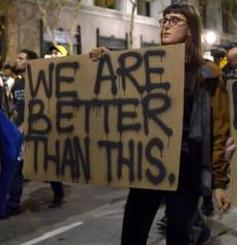
anti-trump-protests-1114AMERICANS AGAINST HATRED AND BIGOTRY.

DUMP TRUMP.

NOT MY PRESIDENT.

[EXPLETIVE] UR WALL.

WE WON’T GIVE UP.  WE WON’T GIVE IN.

UNITED WE’RE STRONGER (you have to love the irony).

These are just a few of the slogans that bedecked the nation-wide protests against Donald Trump’s electoral victory, i.e., against the American democratic system.  Accompanying images included swastikas and pictures of Adolf Hitler.

Of course, protest is a fundamental part of our democracy, guaranteed by the First Amendment (which, incidentally, many Yale students petitioned to repeal).  But protest is only productive when it advocates a viable solution to a problem.  When protest is nothing more than collective whining, it easily turns into mob violence —  indeed, as it did in several instances.

So what do the protesters actually want?  To repeal the democratic process?  To overthrow a legally elected chief executive?  Public lynching?

If they want to advocate dismantling the electoral college, they might find support on both sides of the aisle… but only for the next election cycle.  And they could make their point without vandalism, arson, or public obstruction.

On the other extreme, you have college students so traumatized by the election results they have requested exemptions from classwork and midterm exams.  Such fragility does not bode well for the future leadership of the country.

It’s a pity we can’t conjure up an alternative reality portal; it would be amusing to get a glimpse of how the anti-Trump contingent would be reacting — had the election gone the other way — to disgruntled Trump supporters protesting the “rigged” election that stole victory from their candidate.

But one does have to acknowledge that sometimes the left is right.  One protest sign manages to say it all:

aptopix-election-protests-california