Home » Posts tagged 'Moral Compass' (Page 30)
Tag Archives: Moral Compass

Heading over the cliff
 Not following the usual conservative line, Bernie Goldberg articulates the train-wreck of Donald Trump, and Glenn Beck explains how we got here.

That Thou art Mindful of Him
Yes, they’re at it again. According to the New York Law Journal:
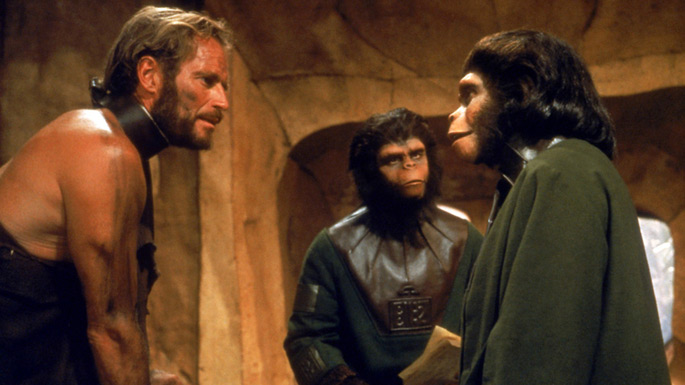 “A group seeking release of chimpanzees in captivity in New York through habeas corpus petitions has renewed its request to free a chimp held at a farm in Fulton County, near Albany.
“This time, the Nonhuman Rights Project said the materials supporting the petition it filed in Manhattan Supreme Court for the release of “Tommy” contain new statements from experts, including an affidavit from anthropologist Jane Goodall, supporting its arguments that chimpanzees possess enough human qualities to make their extended confinement cruel and unusual punishment.
“The group’s previous attempts to have Tommy released failed when an Appellate Division, Third Department, panel ruled that since chimps cannot bear the legal responsibilities and duties of humans, they are not entitled to habeas corpus or other legal protections accorded to people. The state Court of Appeals declined to hear the case [emphasis added].”
Socrates gave up his life for the ideal of pure wisdom. Galileo was threatened with torture for his commitment to scientific truth. Nelson Mandela spent 27 years in prison for his campaign to end apartheid.
And now, attorney Steven Wise is seeking to be the next torchbearer for virtue and justice by seeking legal personhood for two chimpanzees currently deprived of their primatial integrity by incarceration in the anatomy department of New York’s Stony Brook University. Mr. Wise has even found a judge willing to hear his case.
This is a natural outgrowth of our collective obsession with rights and entitlement which has, proportionally, shrouded our notion of personal responsibility. A healthy culture recognizes that it has a moral obligation to show compassion to all living creatures. But as the very concept of morality flickers and fades from social consciousness, only the assertion of rights prevents the rapid disintegration of society.
And as we lose our sense of responsibility, the distinction between man and animals grows harder to define until, ultimately, it all but disappears. In California, the “rights” of a little fish trump the welfare of humans: crops wither in arid fields during the worst drought on record as the state dumps trillions of gallons of fresh water into the ocean.
It’s worth noting that in 1933, two years before the Nuremberg Laws stripped German Jews of both civil and human rights, the Nazi government passed some of history’s most progressive laws for the protection of animals, legislation considered emblematic of the highest moral values of a people.
Elevating animals to the level of human beings inevitably results in human beings acting worse than animals.
Hat tip: Syd Chase

Why Jews are Liberals
After primary candidates addressed the Republican Jewish Coalition last week, it’s worth revisiting these thoughts from 2010 examining the overwhelming support by Jews of Democrat candidates year after year after year:
 Now that even the New York Times has acknowledged Barack Obama’s confrontational stance toward the State of Israel, one might wonder why American Jews have yet to demonstrate even a hint of buyer’s remorse over their ardent support for the president in the last general election. Long-time Commentary Magazine editor Norman Podhoretz wondered the same thing in a Wall Street Journal editorial last September, in which he posed the title question, “Why are Jews Liberals?”
The article — then a teaser for the author’s new book by the same name — never got around to answering its own question. Indeed, Mr. Podhoretz seemed distinctly less interested in contemplating why Jews are liberal than in pontificating about why they should be more conservative.
He has a point. For over three thousand years, Jewish society has promoted what today are called “traditional values,” those social mores that came to define “tradition” precisely because they were universally held by so many for so long. The sanctity of life, of family, of sexuality, of charity, and of prayer — all these find their origins in Torah Judaism. Moreover, throughout the Biblical and Talmudic eras the structure of the Jewish socioeconomic community was essentially capitalistic, with the free market determining business activity and the social safety net for the poor and the weak provided (successfully) by individual responsibility within a framework of communal obligation
Why then, asked Mr. Podhoretz, have American Jews indulged their love affair with liberalism since Franklin Roosevelt (who demurred from even a token act of intervention on behalf of the 6 million Jews murdered by the Nazis)? Why did American Jews disregard John McCain’s long record of support for Israel and Barack Obama’s open association with known anti-Semites to vote for Mr. Obama by a margin of almost four-to-one? (And why, I might add, if the vote were held today, would the likely results be just about the same?)
Good questions. And although Mr. Podhoretz sidestepped any effort to answer them, there is an answer.
STRANGE BEDFELLOWS
As much as all conservative values trace their origins to Jewish tradition, liberal values trace their origins to the same source — to exactly the same degree.
No one has articulated this better than the non-Jewish historian Paul Johnson: “To [the Jews] we owe the idea of equality before the law, both divine and human; of the sanctity of life and the dignity of human person; of the individual conscience and so a personal redemption; of collective conscience and so of social responsibility; of peace as an abstract ideal and love as the foundation of justice, and many other items which constitute the basic moral furniture of the human mind.” In other words, Judaism is an ideology devoted to the betterment of the human condition based upon values and goals that are fundamentally liberal.
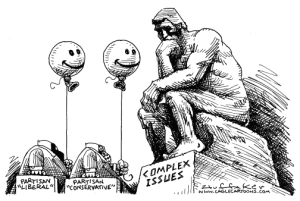 That being said, it may be the greatest misconception of the modern ideological divide that conservatism and liberalism must be mutually exclusive. Conservative traditionalism emphasizes the necessity of building upon the past, while liberal idealism focuses upon the responsibility to shape the future. Conservatism without forward thinking becomes calcified and reactionary. Liberalism without respect for tradition mutates into caricature and absurdity.
The corruption of modern liberalism is evident across the spectrum of political ideology. The sanctity of life has devolved into the rejection of capital punishment while simultaneously negating both the value and the rights of the unborn. The dignity of human person has been distorted to support euthanasia for both unwanted infants and the elderly infirm. Equality before the law has become a bludgeon in the hands of criminals and a straightjacket to constrain victims. Collective conscience has become the underpinning of nonjudgmentalism, whereby every form of perversion gains acceptance as an “alternative lifestyle.” The notion of divinity has vanished altogether, replaced by the self-worship of secular humanism.
Oblivious to these resounding contradictions, secular Jews have rallied to modern liberalism under the banner of tikkun olam, literally “the rectification of the world.” In its new, common usage, however, tikkun olam means something very different from what it meant when the concept was first articulated over 32 centuries ago.
TO REPAIR THE WORLD
Advocacy for saving the rainforests and for saving the whales, for developing renewable resources and for leaving a smaller carbon footprint — these are just some of the enterprises gathered by pop-Jewish philosophy under the umbrella of tikkun olam. According to the ancient wisdom of the Torah, however, every human being is a microcosm of Creation, a world — or olam — unto himself. Yes, it is important for human beings to act as responsible custodians of the Almighty’s world, but the rectification of the universe is a process that ultimately begins and ends within oneself.
How does an individual repair himself and thereby bring his world a step closer to perfection? By cultivating moral behavior and spiritual sensitivity based upon traditional values through acts of kindness, charity, and spiritual self-discipline. When I change myself, I change the world around me, and I do so far more substantially than by trying to change others while I remain the same. My own mandate to repair the world rests upon me alone and can be delegated to no one else.
Modern liberalism has adopted the belief that change depends upon governmental and judicial activism. Ironically, by shifting responsibility for social justice from the individual to the state, modern liberals have abdicated their own responsibility to address the very injustices they yearn to change. And with the abdication of social responsibility, it requires only a short step before even the most basic moral and spiritual axioms are similarly discarded. Finally, with no moral compass to guide it, modern liberalism has embraced the amorality of ancient Greece and the bacchanalia of ancient Rome not only as lifestyles but as models in the image of which contemporary society should be remade.
In truth, the liberal impulse is not only healthy but integral to human existence in general and to the mission of the Jewish people in particular. That impulse proves beneficial, however, only when guided by fealty toward the traditional values that have become associated with conservatism. By cutting themselves off from their spiritual moorings, secular Jews have indeed become the most exuberant seekers of causes for social and environmental justice as they seek any available ism to replace the calling of their ancestral heritage. But their headlong stampede toward utopianism more often resembles the frantic race of lemmings to the sea than an effective campaign for global reconstruction.
Mr. Podhoretz wonders at the alliance of American Jews with the liberal apologists who level every imaginable indictment against the country that granted them the freedom to achieve unprecedented prosperity. In the aftermath of the Passover holiday, it is worth reflecting upon the Jewish concept of freedom. To be truly free, we have to define morality not according to passing fads and fancies but according to the precepts that determine who we are and from where we have come. Only when we fully understand and commit ourselves to the principles that have sustained us since the dawn of civilization can we truly repair the world.
Originally published by Jewish World Review

Creating a Culture of Violence
 I wish there was no reason to repost this essay. But with “random” violence becoming a cultural norm, we can’t run away from the root causes of radicalization, whether Muslim or otherwise. President Obama may not be totally off the mark in his belief that the West created this problem — but our contribution is not what he thinks, and his policies are only adding fuel to the fire.
Read the whole article here:
http://yonasongoldson.com/2015/05/18/remembering-the-boston-bombing/

Spiritual Gridlock

With congress increasing paralyzed by gridlock and our president usurping monarchic power by executive fiat, it seems appropriate to revisit this essay from 2008, originally published by Jewish World Review and adapted in my book Proverbial Beauty.
New York Mayor Michael Bloomberg wants to end traffic congestion in Manhattan. However, as sympathetic as New Yorkers may be to Mr. Bloomberg’s vision, his proposed method is most likely to produce madness.
To curb the number of vehicles entering downtown (which has grown annually by an average of 8000 per day since the 1920s, according to U. S. News and World Report), the proposed law would encourage (or coerce) commuters to rely on public transportation by imposing a daytime tax of $8 per car and $21 per truck traveling onto the island. City officials believe that this “congestion pricing” would reduce traffic by as much as 12 ½ percent.
Whether or not commuters can be persuaded to practice even occasional abstinence in their love affairs with their cars makes for interesting speculation. However, the concept itself is sound. In fact, it has been used for some time on a much larger scale, implemented throughout every borough of the world by the Mayor of the Universe.
EXPRESS LANES TO FREEDOM
The most the dramatic experiment in mass transit came over 3300 years ago when the Almighty split the Sea of Reeds, allowing the Jews to pass through and escape their Egyptian pursuers. In contrast to Cecil B. DeMille’s famous recreation, the sages teach that the sea opened up into twelve distinct passageways, one for each of the Tribes of Israel. As they passed through, the water separating the passages turned clear like glass, so that each tribe could see its fellow tribesmen traveling alongside them.
The design of this miracle teaches three lessons. First, the division of the sea into separate passageways demonstrates that there is more than one way to have a relationship with G-d. The Almighty does not want us to be automatons or clones, sheepishly following whoever is in front of us. Each individual is unique, and his divine service should be tailored to the nature of his singular soul.
Second, the water turning clear like glass reveals the lengths to which we must go to master the human ego. Had the walls of each passageway remained opaque, each tribe would have thought that it alone had discovered the correct avenue to reach the other side, and that it alone was traveling in the right direction to serve G-d. When they saw the other tribes traveling along side them, the Jews of each tribe recognized that they were not the only ones who had discerned the proper path.
 The final lesson can be learned from recognizing that there were a limited number of paths. Anyone who did not follow one of the twelve passageways was, literally and figuratively, under water. Every spiritual movement does not become legitimate simply because it declares itself so, no matter how sincere its leaders or followers may be. Every self-proclaimed “holy man” is not genuine simply because he hangs out his shingle or attracts parishioners. Natural laws govern the operation of the spiritual universe just as they govern the workings of the physical world. One cannot render those rules null and void simply by wishing them out of existence or declaring them defunct, any more than congress can annul the force of gravity.
THE PRICE OF PRIDE
There is yet one more insight to be gained from the illustration of the Jews’ passage through the sea, one that is echoed by the New York mayor’s effort to cure his city’s traffic woes.
Consider the car as an allegory for personal autonomy. In a very real sense, we are all control freaks. We want to control our destiny, to chart our own heading, to have our hands on the wheel. Often the greatest demonstration of inner strength comes through humbling ourselves, giving up control and placing our fate in the hands of another. Often this is a concession we are either unwilling or unable to make.
But do we consider the cost? For car owners, the cost is rolled up in the price of the vehicle itself, of gas, insurance, repairs, parking fees, tolls and, perhaps, congestion tax. Public transportation is far cheaper and often more efficient. But still we refuse to relinquish control.
In business, the most efficient workers are those who work as part of a team, who coordinate their efforts with the efforts of others and trust their coworkers to get their own jobs done. Those who try to do everything themselves, or to micromanage others at their work, create confusion, inefficiency, and frustration.
Our relationships, marriages, and families function best when the individuals within them tend to their own responsibilities and allow others to look after theirs. Hovering, ordering, or criticizing before a spouse or child has even had a chance to complete an assigned task breeds resentment and destroys trust.
Spirituality is much the same. We like to think that we are in control of defining our own relationship with the Almighty. We strike out in whatever direction seems right to us, often without any roadmap or compass to guide us in distinguishing good from bad, right from wrong, moral from immoral. We believe that intuition alone will get us to our goal, when we have only the faintest notion of where we are trying to get.
Worst of all, there is available transportation ready to take us to our final destination in the most efficient way. By keeping G-d’s laws and following in His ways, we guarantee ourselves the smoothest possible journey through this world until we arrive at the World to Come.
THE FAST TRACK
 But still many of us won’t give up control. So the Almighty levies His “taxes,” creating obstacles that make the paths of personal autonomy increasingly difficult. We feel stifled in our jobs, unhappy with our families, and discontented with the direction of our lives. So we seek out “detours,” looking for fulfillment in the least likely places: alcohol, drugs, gambling, or extramarital affairs. We think change will make us feel better, but we usually find ourselves worse off than before.
Rabbi Elyahu Dessler explains that we find ourselves in emotional or spiritual darkness at those times when we have cut ourselves off from the source of spirituality in the world. But when we “look into the darkness,” when we recognize that we have created the darkness for ourselves by distancing ourselves from the ways of the Creator, then and only then will we begin to find our way back to the light. By giving up control over our destiny, we regain mastery over our soul.
Whether taxing drivers will solve New York’s traffic problems remains a mystery. But it is in our hands to solve the mysteries of the spirit by following the well-trodden path of the generations that have gone before us. By retracing their steps, we can have confidence that we are not solely dependent upon our own devices to chart our way out of the darkness of confusion, but that we have a clearly marked path to follow toward the light of true meaning.

The Boundaries of the World
 This week, the world observed the 100th anniversary of Albert Einstein publishing his General Theory of Relativity. The effects of his revelation extend far beyond what most of us imagine, as I outline in this excerpt from my book Proverbial Beauty: Secrets for Success and Happiness from the Wisdom of the Ages.
Do not remove the boundaries of eternity, which were set in place by your forefathers (Proverbs 22:28).
Writing for Environmental Health Perspectives, Ron Chepesiuk cites research that exposure to artificial light can prevent trees from adjusting to seasonal variation, affecting the behaviors, foraging areas, and breeding cycles of insects, bats, turtles, birds, fish, rodents, and reptiles even in rural settings. Urban light has caused disorientation in migrating birds, accounting for avian deaths estimated between 98 million and one billion each year.
The 24-hour day/night cycle, known as the circadian clock, affects physiologic processes in almost all organisms. These processes include brain wave patterns, hormone production, cell regulation, and other biologic activities. Disruption of the circadian clock is linked to several medical disorders in humans, including depression, insomnia, cardiovascular disease, and cancer, says Paolo Sassone-Corsi, chairman of the Pharmacology Department at the University of California, Irvine, who has done extensive research on the circadian clock. “Studies show that the circadian cycle controls from ten to fifteen percent of our genes,” he explains. “So the disruption of the circadian cycle can cause a lot of health problems.”
A meeting sponsored by the National Institute of Environmental Health Sciences (NIEHS) concluded that, although there is still no conclusive evidence, the correlation between altered patterns of light and dark in the modern world and dramatic increases in the risk of breast and prostate cancers, obesity, and early-onset diabetes appears more than coincidental.
And, of course, we can no longer see the stars.
Breaches in natural boundaries have taken many other forms as well:
- In 1884, a farmer visiting the Cotton States Exposition in Louisiana brought back a few Venezuelan water hyacinths to decorate the fountain outside his home in Florida. Today, the aggressive purple flowers choke 126,000 acres of waterways.
- Kudzu, a Japanese vine imported in 1876 to prevent erosion, is currently spreading through the southern United States and expanding at a rate of 150,000 acres a year.
- The European rabbit, introduced to Australia in 1859, has reached a population of over 200 million, necessitating the construction of a 2000 mile long rabbit-proof-fence to prevent the wholesale destruction of farmlands.
- In 1956, African bees brought over by Brazilian scientists to breed for honey production escaped their quarantine and gave rise to the noted “killer bee” scare.
The list goes on and on. In the United States alone, containment costs of invasive species are estimated at $138 billion annually.
But the violation of natural boundaries has even more broad-reaching consequences, affecting not only the stability of our physical world but the integrity of the moral universe as well. In his book Modern Times: the world from the twenties to the nineties, historian Paul Johnson analyzes the impact of Albert Einstein’s theory of relativity upon the way Western society began to look at the established values of the ages:
All at once, nothing seemed certain in the movements of the spheres… It was as though the spinning globe had been taken off its axis and cast adrift in a universe which no longer conformed to accustomed standards and measurement. At the beginning of the 1920s the belief began to circulate, for the first time at a popular level, that there were no longer any absolutes: of time and space, of good and evil, of knowledge, above all of value. Mistakenly but perhaps inevitably, relativity became confused with relativism.
No one was more distressed than Einstein by this public misapprehension. He was bewildered by the relentless publicity and error which his work seemed to promote…
Einstein was not a practicing Jew, but he acknowledged a God. He believed passionately in absolute standards of right and wrong… He wrote to [colleague Max] Born: “You believe in a God who plays dice, and I in complete law and order in a world which objectively exists and which I, in a wildly speculative way, am trying to capture. I firmly believe, but I hope that someone will discover a more realistic way or rather a more tangible basis than it has been my lot to find.”
But Einstein failed to produce a unified theory, either in the 1920s or thereafter. He lived to see moral relativism, to him a disease, become a social pandemic, just as he lived to see his fatal equation bring into existence nuclear warfare. There were times, he said at the end of his life, when he wished he had been a simple watchmaker…
[T]he public response to relativity was one of the principal formative influences on the course of twentieth-century history. It formed a knife, inadvertently wielded by its author, to help cut society adrift from its traditional moorings in the faith and morals of Judeo-Christian culture.
It’s hard not to be impressed by the prescience of King Solomon. When civilization depended upon candlelight to hold back the darkness, the inexorable cycle of day and night forced us to conform to the natural order. True, our lives have become more convenient and more comfortable, but once electric lighting pushes away the darkness of night, once central air conditioning and heating insulate us from the changing of the seasons, once cars and planes shrink the distance between faraway places, once electronic communication eliminates all delay in correspondence and information and, indeed, once science itself seems to provide justification that all boundaries are negotiable, is it not inevitable that society will begin to challenge moral boundaries as well?
There are no absolutes when every established norm is threatened by the inertia of change for the sake of change and an idealized vision of unrestricted freedom. Once change becomes the new normal, human society has little hope of curbing the headlong rush into chaos and social disintegration into moral anarchy.
In the same way that we have to defend the integrity of natural and moral boundaries as a society, we have to guard the boundaries between ourselves and those around us when the order of society begins to crumble. But no matter how much we try, we can never completely seal ourselves off from the influences of the culture in which we live.
I discovered this frightening truth on a trip to southern Asia, where a popular joke is repeated only half-jokingly:
In America people drive on the right side of the road.
In England, people drive on the left side of the road.
In India, it’s optional.
Only when society as a whole preserves its respect for the traditions that have been handed down through the ages will the structure of that society endure. But if each generation believes that it can reject the standards of its forbears from a position of moral superiority, the next age of darkness can be found lurking right around the corner.

A Message to my Son

My oldest son enters the Israeli army this week, motivated by nothing other than a sense of commitment to the security of his people.
It seems fitting to revisit these thoughts, written on the occasion of his bar mitzvah ten years ago.
It’s not difficult to sympathize with the skeptics who questioned the ability of Avrohom Mordechai Altar, then still a teenager, to succeed his father as leader of the Gerrer Chassidim, possibly the most influential Torah community in Poland at the end of the 19th century. But the young scholar, who would grow up to become a great rabbi and author of the Imrei Emes, answered his critics with the following parable.
A small town in an isolated land rested at the foot of a great mountain, a peak so high and steep that all reasonable people considered it unconquerable. From time to time, however, some impetuous youth would set out to climb the mountain. Some of these returned admitting defeat. The rest were never heard from again.
Despite the warnings and prophesies of doom, a certain young man decided to challenge the mountain. Many times he nearly turned back, and many times he nearly met his end, but through sheer persistence he finally reached the mountain top. But he was utterly unprepared for what he found there.
A thriving city of people lived upon a great plateau at the mountain¹s summit. There were houses and farms — an entire community living where everyone believed that no one had ever set foot.
The inhabitants of the mountain top laughed at him when he expressed his astonishment. “Do you think you¹re the first one to climb the mountain?” they chided. “We also reached the top and, having done so, chose to build this town and make our lives here.”
Not yet recovered from his dismay, the young man noticed a small boy, only six or seven years old. This was more than he could believe. “Did you climb all the way up here, too?!” the young man exclaimed.
“No,” replied the boy. “I was born here.”
The youthful rabbi explained to his followers that indeed he was young. But he had been born into a dynasty of great Torah leaders, raised by and taught by the greatest sages of his generation who had in turn been taught and raised by the greatest sages of their generation. True, he was young; but he had been born on a mountain, and from his place atop the shoulders of the spiritual giants who preceded him he would build upon their greatness. In this way would he succeed as a leader of his people.
And so he did.
 Every year, on the sixth day of the Jewish month of Sivan, Jews around the world celebrate the revelation at Sinai, over 3300 years ago, when the Almighty gave us the Torah. It was the Torah that provided the moral and legal foundation that has enabled the Jewish people to build a nation devoted to spiritual ideals, a nation that endured for nearly 1,500 years in its land and nearly 2,000 years scattered across the globe. It was the Torah that introduced the concepts of peace, of charity, of justice, and of collective responsibility to a world that knew no value other than “might makes right.” It was the Torah that formed the basis of Christianity and Islam, spreading monotheism throughout the world and fashioning the attitudes of modern progressivism.
It all began on that mountain called Sinai, and from that point on the Jewish people have labored to climb the mountain of morality and virtue, sometimes succeeding, sometimes failing, sometimes wondering whether our efforts are worthwhile, but always persevering in our mission to attain the summit of spiritual and moral perfection.
Had our mission demanded completion within a single generation, we would never have held out hope of success. But every generation climbs a little higher, building on the accomplishments of their parents and grandparents, fighting for every handhold, struggling for every foothold, occasionally slipping back but never surrendering.
The mission that defines us as a people began 33 centuries ago; it continues today as we recommit ourselves to the study and observance of Torah, and celebrate it on the holiday of Shavuos.
And it was two weeks after Shavuos that I celebrated what happens only once in a lifetime — the bar mitzvah of my eldest son. In his first 13 years of life I did my utmost to teach him that he was born on the mountain, that he has the accomplishments of generations beneath his feet to support him, and that future generations will depend upon him for their support just as he depends on those who went before.
And so it is with every Jewish child. Each has his own contribution to make in the eternal mission of our eternal people. It is the Torah that defines us, the Torah that guides us, the Torah that sustains us, and the Torah that will ultimately bring us to the fulfillment of the spiritual goals for which the Almighty created us.
Climb, my son. Climb and keep climbing toward the top of the mountain.
Originally published by Aish.com.
Pollard and Nuremberg
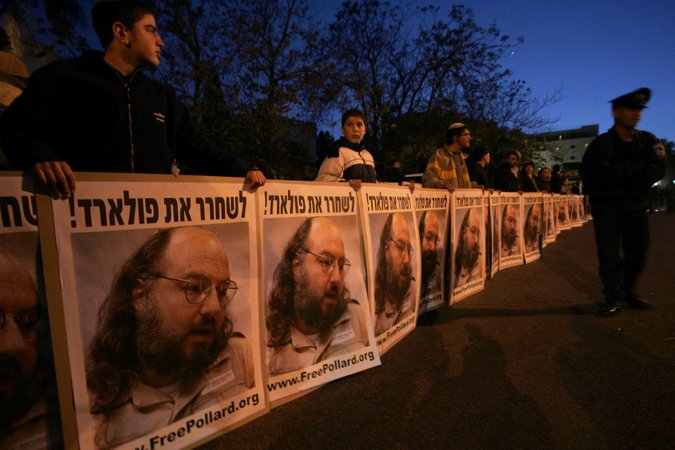 The case of Jonathan Pollard was more complicated than most people understood. His actions may have placed others in danger, and may have contributed to the death of agents he compromised. But almost everyone agrees that his punishment was disproportionate to his crime, and the sense of joy upon his release is more than justified.
The real take-away is this: whether one agrees with or disagrees with what Mr. Pollard did, he followed his conscience, and he was prepared to accept the consequences of his actions. If only more of our fellow citizens and more of our political leaders demonstrated the same courage and conviction.
Of course, not everyone’s moral compass is adequately calibrated. Edward Snowden also believed that he was following his conscience, and the morality of his actions is far more questionable for his having caused more damage by far than did Jonathan Pollard.
The Nuremberg trials after WW II changed forever the interrelationship between civil and moral law. No longer would it be legitimate to claim “I was only following orders” as a defense for crimes against man. A soldier has an obligation to refuse to carry out an immoral order, even if by doing so he puts himself in danger of court martial.
We should all consider ourselves foot-soldiers in the culture wars that threaten our society. But moral obligation implies more than just following our conscience. It means investing the effort, energy, and thought necessary to understand the decisions we will have to make and their consequences. Otherwise, our claim to the moral high ground can become a smokescreen to hide our moral irresponsibility.
That’s what makes Jonathan Pollard a hero in the eyes of so many, and Edward Snowden, perhaps, something very different indeed.

The Ostrich Mentality
 More unprovoked murders today in Israel: this time the victims included men in the act of prayer.
The approach taken by the Obama administration and much of European leadership, differentiating between terrorism and Islam so not to further alienate the Muslim world, might sound plausible. But the incontrovertible evidence from Paris, Beirut, and Tel Aviv is that it’s not working. Ayaan Hirsi Ali makes a case no thinking person can refute.
But, of course, that’s the point: people aren’t thinking; they’re feeling. If only the rich and powerful Western nations would humble themselves before the oppressed peoples of the third world, then there would be peace. If only the intransigent Israelis would stop their illegal occupation, then there would be peace. If only the culture of white supremacy in America would confess and atone for its evil ways, then there would be peace.
From the United Nations to the European Union to the White House to many of the elite universities around the country, Utopian ideologues bury their heads in the sand and ignore reality so they can persist in their chants of kumbaya and we are the world, reaching out to embrace people who want nothing but to watch the world burn.
In every aspect of our lives we are becoming more confused: we alienate our friends while we appease enemies who want to kill us; we disdain the blessings we have while chasing shadows in pursuit of happiness; we preach tolerance while attempting to silence all who disagree with us; we dream of a perfect world while we stand idly by and let madmen tear down the world our fathers and grandfathers worked so hard to build.
The chaos of our times didn’t start this week in Paris. It won’t end there, either, unless we open our eyes and start confronting the moral anarchy that is eating away at the heart of civilization.

Thank You
PROVERBIAL BEAUTY
Secrets for Success and Happiness from the Wisdom of the Ages
Available at Amazon.com
Thanks to all those who participated in my launch event this week at Subterranean Books. The crowd was standing room only and the responses were enthusiastic and encouraging.
Thanks also to Kelly, Alex, and Jenna at Subterranean Books for hosting the event.
If you weren’t able to make it, please take a look on my landing page or at Amazon.com and see what you’re missing.
If you’d like a signed copy, please send $20 and your inscription request to me at this address:
POB 11504
St. Louis, MO 63105
 Yonason Goldson