Home » Posts tagged 'Personal Development' (Page 4)

Tag Archives: Personal Development

Excuses

excusesIf I were a tadpole, and you were a fish,

If the South China sea were a licorice dish,

If the King of Siam staged an off-Broadway play,
If the Man in the Moon weren’t afraid of the day,

If phones were not busy and lines never long,
If Fay Wray were a dozen times tall as King Kong,

If gators wore shirts with men stitched on the breast,
If the head of the pack could escape from the rest,

If the dark could be pierced by a single white flame,
If Professor Bob Knoll could remember my name,

If the sea didn’t swell and the ship didn’t rock,
If naive good intentions could turn back the clock,

If each moment could stretch to the end of our lives,
If bees came in gaggles and geese lived in hives,

If the hare beat the tortoise by less than a mile,
If the face in the mirror would give me a smile,

If the northern lights migrated south with the birds,
If my fluttering heart could be calmed by your words,

If I’d show you my heart, and you’d show me yours, too,
We’d have no more excuses.
Then what would we do?

From this month’s issue of The Wagon Magazine.

It’s about time

hqdefaultAre you feeling more rested this week?  Do you notice your watch running a smidgen fast?  Maybe it’s because of the leap-second added by the National Institute of Standards and Technology on New Year’s Eve.


A few of us may take comfort knowing that our clocks are back in sync with the earth’s relative positive to the sun, and find it reassuring that all the cosmic gears and cogs are once again in perfect alignment.  The rest of us couldn’t care less.

Does it really matter?

Well, yes; it just might.

There are two ways to look at time.  First, as a convenient touchstone for organizing our lives.  Without some universal standard for tracking our days and our hours, imagine the trouble we would have arranging our affairs and interactions.

But you can also make the case that time really does mean something.

Click here to read the whole article.

What are Ethics? Part 3: Where credit isn’t due

When bubbles burst

champagne-1600x1200Raise your glass of champagne to toast the new year.  And then, before you take your first sip, ask yourself this question:  where do the bubbles come from?

You see them, don’t you – those strings of tiny bubbles rising steadily from the bottom of your fluted goblet?  They seem to appear out of nothing and come from nowhere.  And yet they keep coming, like refugees from some parallel universe escaping through an inter-dimensional portal, yearning to be free.

The explanation is quite simple.  What is more compelling is how the mystery of champagne bubbles can lead us to victory in the modern culture wars.

It can also provide a deeper insight into history’s first culture war, which culminated in the miracle of Chanukah.

TRAPPED IN THE DEPTHS

An average glass of champagne contains about 20 million microscopic bubbles, produced when fermentation under pressure forces carbon gas into wine.  The relatively few bubbles that rise to the surface burst and release their CO2.  As for the rest, the even distribution of internal pressure across the surface of each bubble keeps the gas trapped within.

Along the interior surface of the glass, however, are tiny imperfections.  When bubbles come in contact with any such imperfection, the slightest change in pressure at the point of contact is enough to cause them to burst.  Once released, the gas inside streams upward to the surface in a race for freedom.

Now think of champagne as an allegory for life.

A WORLD OF BUBBLE-DWELLERS

Never in history has a society been more comfortable than in this generation. Our homes are climate controlled within a two-degree range. Our cars have automatic entry, heated leather seats, and full entertainment centers. We buy our groceries and holiday gifts with the click of a mouse and wait for them to be delivered by bonded messenger or drone. We text people in the same room and find it too burdensome to open our email.

And what do we have to show for it? We have lost all ability to cope with inconvenience, delay, and change. A website refusing to load, a text not returned in 15 seconds, or our favorite TV show preempted by an amber alert — these are the crises of our times, the insufferable challenges of our era. It’s both laughable and tragic to imagine how we would manage had we to face the hardships of the crossing of the Mayflower, the Great Depression, or the Battle of the Bulge — let alone Auschwitz or the Soviet gulag. The plight of Syrian refugees right now across the sea is too horrific for us to even contemplate.

So we don’t. We’re too comfortable inside our bubbles, insulated from the cold, hard realities that most humans have had to endure through the ages. We hide away from the rest of the word, until something pricks the surface to burst our bubbles — leaving us in pieces and gasping for breath.

But really, we should be grateful for those pinpricks, both great and small. Like the gas that remains trapped beneath the surface, our own potential for greatness remains dormant within us until we are forced to confront the sharp edges of life. Instead of trying to hide from them, we need to prepare ourselves for when they inevitably arrive.

HIGHS AND LOWS

This was the state of affairs in Judea under the rule of the Seleucid Empire 2180 years ago. The prevailing culture of Greek philosophy worshipped aesthetic idealism. Graceful lines, elegant syllogisms, and harmonic symmetry represented the highest expression of human civilization.

But it also represented the lowest. Where the ancient Greeks revered physical and intellectual beauty, they abandoned children with physical deformities or mental impairments and left them to die. They valued the philosophic sophistication of their greatest thinkers less for its content and more for the polished sophistry of its expression. They ruthlessly stamped out all dissonance – as they did by sentencing Socrates, the greatest among them, to death for the crime of exposing the logical contradictions of their philosophy.

Enamored with the cultural idealism of Greece, Jewish Hellenists believed they could blend their practice of Judaism with the prettified ways of their masters. But Jewish philosophy demands that we challenge the external status quo, that we push our personal boundaries outward even as we strive to refine our commitment to the traditions on which our nation is founded. It is a prickly discipline, one in which bubbles cannot long survive.

And so the culture of Greece tried to swallow the soul of Judaism. But in the end, the weak rose up against the strong and the few prevailed over the many. Instead of capitulating to the apparent inevitability of their defeat, the Jews fought for their physical and spiritual lives. By doing so, they broke through the boundaries of what anyone imagined possible, and they set free the potential that would have remained forever hidden if the Greeks had not tried to crush it into non-existence.

And when the hidden spark of determination inside them caught fire, it light up the darkness of exile, just like the tiny container of oil that burned miraculously for eight days – a sign of divine favor because they refused to exchange spiritual identity for the comfort of cultural superficiality.

When we reject comfortable confinement and fight our way out of the bubbles we live in, there is no limit to the miracles we can expect to see in our daily lives.

Published by Jewish World Review.

Lighting our way to the Palace of the King

ballroom-at-the-grand-palace-in-peterhofThere is a story of a prince, a true prodigal son, whose antics and excesses taxed his father’s patience until the king, with no other recourse, sent his son penniless into exile to learn responsibility and humility.
The prince wandered from place to place, half-starving, unqualified for any craft or labor, until he finally found work as a shepherd in a distant land. The job of shepherding was not overly difficult, but the sun burned the prince’s back by day, the wind froze him at night, and the rain soaked through his clothes in winter.

Other shepherds built little huts to protect them from the elements, but whenever the poor prince tried to build himself a hut it toppled over in the first strong breeze.

Years went by, until at last the prince heard that the king was coming to the province where he lived. There was a custom in the kingdom that people would write their wishes upon scraps of paper and throw them at the king’s carriage. Any requests that the king picked up a read would be granted immediately. So the prince positioned himself along the parade route and, as the king’s carriage passed, he took careful aim and tossed his note.

The paper fell at the king’s feet. He unrolled it and, recognizing his son’s handwriting, he began to weep. For the note asked if the king would give the prince a little hut to protect him from the sun and the wind and the rain.

“My son could have asked to return to the palace,” cried the king, “but he no longer knows he is a prince.”

So it was in the days of the Maccabees, when the Jewish people were so steeped in the physical aestheticism and indulgences of Greek culture that many of them forgot that they were in exile, forgot that they were inheritors of a priceless spiritual legacy, forgot that they were children of the King.

But a few didn’t forget. A few risked their lives to honor the Sabbath, to circumcise their sons, to study the Torah of their fathers and grandfathers, to preserve the divine spark that had guided their ancestors for a thousand years. And, when their moment came, those few took up arms against their oppressors and fought for the privilege of living as Jews. They recaptured the Holy Temple and, as they rekindled the menorah, divine light flooded the streets and courtyards of Jerusalem, pushing off the darkness of exile, waking the people from cultural forgetfulness, inspiring a generation to remember its ancient roots cast its aspirations once more toward the heavens.

Today, 2,180 years later, we too live in an age of spiritual darkness, when the loudest and most persistent voices in our surrounding culture cry out to expunge every mention of the divine, to condemn every moral judgment, to sanctify every perversion in the name of “tolerance.” We live in an era of unprecedented material comfort and convenience, tranquilizing our bodies and our minds so that we can easily stifle the yearning of our souls.

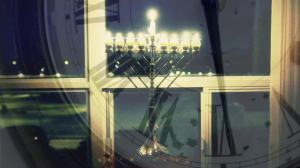
slvm5919016But when the days are shortest and the nights are coldest, just then can a little light shine forth and dispel much darkness. Like a lighthouse guiding a ship home, the lights of the Chanukah menorah can draw us back from the abyss of spiritual oblivion. And as we add candle upon candle and light upon light, the growing radiance of the menorah reminds us of the divine flame that has guided us through the darkness of exile and saved us from the darkness of assimilation for generation after generation.

If we, like the Hellenist Jews, allow the material values of contemporary culture to shape our thinking and guide our actions, then we have truly forgotten who we are. Like the prince whose soul longed for nothing but a little hut to protect him from the sun and the rain, we will be destined to live out our days in futility.

But if we cling to all that which is noble within us, if the values of our tradition drive us to perform acts of kindness and charity, to devote a few moments each day to heartfelt and meditative prayer, to treat neighbors and strangers alike with respect, to set an example of morality and character for our children — then we will have rekindled the spark of divinity inside us, and we will have earned the privilege to have our Father, the King, bring us home.

Originally published in 2003 by Jewish World Review

Illuminating the Days of Darkness

3184543T.S. Eliot may have denounced April as the cruelest month, but most of us are far more likely to feel pangs of depression beginning to stir sometime around December.

As the days grow short and gray, and the nights turn cold and dark, that is the time we find our spirits truly starting to wither. We mourn the passing of those slow, sticky summer afternoons, long buried beneath the frost. As the threat of snow looms, we reflect sadly that winter will only grow crueler before we can begin to hope for the thaw.

It may be natural to attribute our mood to the inexorable cycle of nature and the change of seasons. But in this, as with all things, Jewish tradition offers a deeper insight into the spiritual torpor that descends upon us each year with the onset of winter.

The Talmud describes how, after eating from the forbidden fruit, Adam noticed that the days began growing shorter and the nights longer. Adam despaired. “On account of my sin,” he conjectured, “the Creator is gradually returning the world to the state of Primordial Darkness.”

With the passing of the winter solstice, however, the days began to lengthen once again, and Adam realized that the changing of the seasons was just part of the natural pattern of creation. He rejoiced, inaugurating a festival of eight days to celebrate the renewal of the world.

In this same season, 2,180 years ago, the Jewish people inaugurated the eighth-day festival of Chanukah, celebrating the victory of light over darkness.

CULTURE OF THE GREEKS

The number seven symbolizes perfection in nature, the complete, ordered system brought into existence through the seven days of creation. As such, it also symbolizes the culture of the Greeks, which then weighed heavily on the backs of the Jewish nation.

Greek culture worshipped physical perfection, artistic expression, and unblemished aestheticism. It exalted the physical form and physical prowess in their art and their architecture, in their Olympics and in their philosophy. It honored and revered all that the physical world represented.

In their aspiration for aesthetic idealism, however, the Greeks denied the transcendence of the human spirit and rejected the notion of any metaphysical reality. It should, therefore, come as no surprise that we find the gods of Greek mythology to be mere caricatures of men, with exaggerated human desires arid contemptible human shortcomings.

Neither should it surprise us that the Greeks fought so desperately to uproot the Torah, the spiritual compass that has kept the Jewish people pointed toward the light through the darkness of exile.

Judaism teaches that the potential for human greatness is achieved not through the ascendancy of the physical, but by subjugation of the physical to the spiritual. The symbol for this spiritual transcendence is the number eight, representing that which breaks through the bounds of physical limitation (symbolized by seven) and aspires for a higher reality, one that lies beyond materialism, beyond superficiality.

EIGHT DAYS

For this reason do we circumcise a Jewish boy on the eighth day after birth, to signify the covenant charges him with conquering his physical desires and redirecting them in the pursuit of spiritual goals.

bigstock-hanukkah-candles-copyFor this reason did Adam celebrate for eight days, in recognition that the spiritual design behind the workings of nature is even more complex and wondrous than nature itself.

And for this reason do we light the Chanukah lights for eight days: to push off the dark and cold of winter and to remember that we must all see ourselves as lights amidst the spiritual darkness of the physical world, no less than the stars scattered across the heavens.

Only by igniting our own cultural enthusiasm with the flame of our tradition and our heritage will we inspire ourselves and our children to strive toward achieving the spiritual greatness that lies within every one of us.

Originally published in 2002 by Aish.com

What are Ethics? Part 2: Blurring the Lines

Beyond the Stars — A tribute to John Glenn

188545_600If I have seen further than others, it is by standing upon the shoulders of giants.

~Sir Isaac Newton

There are two kinds of visionaries.

The first type sees farther, like Sir Isaac Newton. They possess a special gift of brilliance, genius, or perception. They see what others cannot, recognize mysteries that hide in plain sight, uncover beauty and order where the rest of us see only chaos. For the most part, they are born, not made.

Then there are those who are blessed not so much with the ability to see, but with the ability to bestow vision, to illuminate the world not with new insights but by giving the gift of insight to others. It is not their acumen, but rather their irrepressible pursuit of transcendence that inspires us to do as much with our lives as they have done with theirs.

Thirty-six years after becoming the first man in orbit, John Glenn became the oldest man in space, not as an ego trip or publicity stunt but to observe the effects of weightlessness on his 77-year-old body. As with his first trip, he showed that the limits upon human beings are mostly self-imposed.

Most of all, he showed us not only what a person can do, but what a person should be.

Click here to read the whole tribute.

Of Doors and Windows

When the Lord closes a door, somewhere He opens a window.

1w

No, I didn’t make that up.  Julie Andrews says it in The Sound of Music.  Half a century later, it may sound trite, but with the drama and trauma of this American election cycle finally behind us, it sure feels appropriate.

With uncharacteristic unity, liberals and conservatives alike long ago attained consensus that the ideological pendulum was never going to swing back again.  The polling data had us all convinced that Hillary Clinton would continue the policies of our Visionary-In-Chief, opening up America’s borders, tearing down real and figurative walls, and redistributing wealth while running up debt toward the 15-figure mark.

Some welcomed this as advancement down the highway to Utopia.  Some lamented it as racing headlong toward the abyss.  But all that’s behind us now.  The door to the past is closed.  Where the window to the future will lead, only time will tell.

Be that as it may, a few thousand years before Julie Andrews, King Solomon offered his own observations about open doors.  With respect to wisdom, he said:

Fortunate is the one who listens for me, attentively waiting by my doors day by day, keeping watch by my doorposts and entryways.  For whoever finds me finds life…

From Solomon’s perspective, when a door closes, it likely means we have to work harder to find a way in.

After all, what is a door?

Click here to read the whole essay, from this month’s issue of The Wagon Magazine.

When Satan Calls

Businessman devilFew people set out wanting to do evil.  So how does evil happen?

Most evil begins with the desire to do good.  But when we don’t recognize where good ends and evil begins, then we’re bound to cross the line between them.

Something about a certain road paved with good intentions.

But the most insidious kind of evil is the kind that continues to masquerade as good long after we’ve crossed the line.  This is the favorite device of Satan, one that we usually recognize too late, after we have everything we wanted… and we’re stuck with it.

We’ve embraced the information revolution, which has so efficiently opened the floodgates of knowledge that we’re now drowning in a sea of pseudo-facts and misinformation.  We’ve embraced the communication revolution, which has so thoroughly created lines of connection that we are more deeply disconnected than ever from one another and from reality.

Now that correspondence is effortless, we often leave emails unopened and, even more often, unanswered.  Now that recorded messages are a click away, we’re too distracted to check our voice mail.  We think it’s rude to call without texting first, and we consider it rude to end a text with a period.

We click to the next page only halfway through the current page, and we escape exposure to ideas that make us uncomfortable because mysterious algorithms are filtering the information that reaches us.  And when unpleasant news does make it through the gauntlet of ideological censorship, we sink into a morass of emotional angst and cry out against a world that defies our comprehension.

Satan is laughing all the way to the motherboard.

But not everyone is deceived.  There’s a growing, grassroots movement to observe a technology Sabbath, to unplug in order to turn on and disconnect in order to reconnect.  No phones, no computers, no videos, no texting.

Does that sound horrifying?  Impossible?  Cruel and unusual?

Convince your friends and family to try it.  Pull a dusty book of the shelf and remember what it’s like to feel what you’re reading.  Go to the park, play softball, plan a progressive meal with friends and neighbors, enjoy a family game night.

Feel the technology toxins flow out of your body.  Once the shock wears off, you’ll wonder why you didn’t start it years ago.  And when you start the new week, you’ll be more rested, more relaxed, more focused, and the envy of your coworkers.

And then you’ll wonder how you will make it all the way to your next Sabbath.