Home » Posts tagged 'Psychology' (Page 15)
Tag Archives: Psychology

How we move forward
 Too many voters held their noses yesterday as they entered the polling booth to vote for the candidate they considered least toxic. A smaller number could only make peace with their conscience by voting for some unexceptional third-party candidate. Then there were those who couldn’t bring themselves to vote at all.
Will the country survive this winter of our discontent? Only time will tell. But the question that lingers in the aftermath of electoral acrimony is this: are we going to start this all over again in two more years?
Sadly, we just might. Back in January, David Gelertner proposed in the Weekly Standard that the problem with the political left is that liberalism has become their new religion. For most people, religion is not a rational but an emotional commitment that emerges from some amorphous inner voice or feeling. And when people cannot defend their religious beliefs intellectually, they lash out with disproportionate ferocity at anyone who challenges those beliefs. Mr. Gelertner argues that the irrational dogmatism of many liberals bears less resemblance to political discourse and more to the religious fervor of blind faith.
He’s right, of course. But he’s wrong when he contends that this is overwhelmingly a phenomenon of the left.

Of frogs legs and scorpion tails
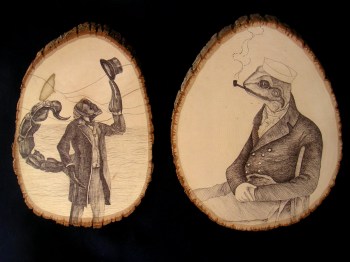
Indifferent to the specter of unleashed state-sponsored terrorism, France and China announced this week that they have joined forces to help Iran develop its natural gas fields. Apparently, an enriched and empowered radical theocracy is nothing to worry about — assuming the infamous Iran nuclear deal actually ensures any measure of global security.
It’s hard not to recall the parable of the frog and the scorpion:
A scorpion once asked to ride on the back of a frog to reach the other side of a river. At first, the frog refused, fearing for its life. But then the scorpion reasoned that the frog had nothing to worry about since, if it stung the frog, it would drown in the river as well. The frog could not argue with the scorpion’s logic and allowed it to climb aboard.
Midway across the river, the scorpion stung the frog. “Why did you do that?” cried the frog. “Now we will both die.”
“I couldn’t help it,” replied the scorpion. “It’s in my nature to sting, so I had to sting.”
The truth is that it’s easier to sympathize with the frog than with the French. The frog wanted to do a good deed and — albeit mistakenly — saw no cause for mistrusting the scorpion.
In contrast, the French and the Chinese want nothing but a larger slice of the world-economic pie, and they are willing to ignore the inevitable long-term dangers for short-term profit. The mild satisfaction of being able to tell them “we told you so” some years down the line will hardly supply adequate consolation for the precarious state the world will find itself in.
Of course, the allegory is imperfect for a different reason. France and China are scorpions, too. Dangerous, irresponsible, and unwilling to change their natures.
At the very least, however, their self-serving self-deception should make us ask ourselves: Are we frogs or scorpions? What about the candidates we vote into office?
And if we refuse to change our individual and collective natures, how far across the river can we expect to get?

Why people give up
 Anna Vital’s infographic reminds us of what we easily forget.
Hat tip: Joseph Lizio.

4 Lessons for Successful Leadership
(Expanded from a previous article.)

Tom Hanks’s recent movie “Sully” allows us to re-experience the dramatic events of January, 2009. Looking back, there are three great stories in the averted disaster of US Airways Flight 1549 that can change our outlook on life’s unexpected twists and turns.
First is the story of providence, which placed a pilot with precisely the right training, experience, and temperament at the helm of the crippled jetliner while placing the aircraft within reach of the only feasible landing strip — the Hudson River — for a safe, if chilly, touchdown.
Lesson 1: Even when things go wrong, look for an unexpected solution at hand to make them go right.
Second is the story of heroism. The pilot, Chesley Sullenberger, drew upon his experience with both military fighters and gliders to bring the passenger plane safely down from the sky. The flight crew quickly and efficiently instructed the people to prepare for impact and then hastened them off the sinking plane. The rescuers, both professional and private citizens, steered their craft to the crash site within minutes. Not one life was lost.
Lesson 2: With the right people ready and waiting, almost anything is possible.
But the third story is that of the passengers. For the most part untrained and unprepared, without exception the passengers on Flight 1549 did precisely what they needed to do in order to survive.
They followed instructions.

Rejecting the new Age of Inevitability
 Isn’t it great to live in an age when machines can do anything? Cars drive themselves, jetliners land themselves, and smartphones do just about everything but tuck us into bed.
Recognition software can read our moods and even catch us telling lies. (That’s a good thing, right?) Programs can analyze our handwriting and predict our likes, dislikes, and likely actions by tracking our digital footprints. Soon, Amazon may be filling orders for us that we haven’t even placed yet.
In the workplace, software programs may start deciding who gets hired or promoted based on models constructed from data gathered about the highest performing employees. This may include variables based on medical history, psychological markers, and virtual clues to everything about us including age, gender, political leanings, and sexual preference.
In a recent Ted Talk, Zeynep Tufekci acknowledges that these programs may make decisions more objectively than humans do. But she cautions that machines trained to infer and predict are only as good as their programming, and will of necessity reflect the biases of their programmers — which could mean compounding, not eliminating, bias.
What’s more, the algorithms that produce this kind of “machine learning” don’t allow for human insight and intuition. It’s all statistical analysis, which turns probabilities into absolutes with no assessment by human reasoning and without allowing room for appeal to a higher authority.
The more troubling issue is our willingness to abdicate the responsibility implicit in free choice. In a culture that has long conflated judgment with judgmentalism, it’s hardly surprising to find how eager people are to reduce every decision to a binary option and thereby eliminate all shades of gray from the mix. And if that’s not enough, we can simply block any information that doesn’t conform to our way of thinking.


How to End a Conversation
 A classic riddle asks: Using three periods (.), two commas (,), and one question mark (?), punctuate the following line to produce a logical and grammatically correct sentence:
That that is is that that is not is not is that it it is
If you know the answer, don’t text it to your friends. You might hurt their feelings.
However, just between us, here’s the solution:
That that is, is. That that is not, is not. Is that it? It is.
The beauty of a brainteaser like this one is not just that it gets us to think. More important, it gets us to think about thinking, to appreciate how communication is critical to critical thinking, and to think about how the same string of words can be fashioned into a cogent message or left as a meaningless hodgepodge of phonetic symbols.
But don’t say so out loud. You might offend someone.
That’s what Professor Celia Klin and researchers at Binghamton University found when they asked undergraduates to interpret text messages responding to an invitation. Their study revealed that students perceived responses properly punctuated with a period at the end as less sincere and, in some cases, psychologically combative.
In other words, it’s antisocial to be articulate, crass to follow convention, and reprobate to observe the rules.
Click here to read the whole essay.

Walking in Circles
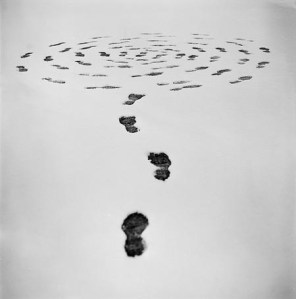 As the two contenders for the job of Leader of the Free World continue to confirm our worst fears about their competence and character, it’s worth revisiting these thoughts from 2010 about how we keep ending up in the same place.
“The whole world is a narrow bridge,” taught the great Chassidic master Rabbi Nachman of Breslav (1772 -1810), in one of his most famous aphorisms, “but the main thing is to have no fear at all.”
According to German scientist Jan Souman, however, it seems that we have good reason to be afraid. After exhaustive research devoted to the study of walking, Dr. Souman has amassed a mountain of evidence proving that human beings possess a natural inclination to travel in circles.
Like some impious prankster, Dr. Souman took his subjects out to empty parking lots and open fields, blindfolded them, and instructed them to walk in a straight line. Some of them managed to keep to a straight course for ten or twenty paces; a few lasted for 50 or a hundred. But all of them ended up circling back toward their points of origin.
Not many of them. Not most of them. Every last one of them.
“And they have no idea,” says Dr. Souman. “They were thinking that they were walking in a straight line all the time.”
Dr. Souman’s research team explored every imaginable explanation. Some people turned to the right while others turned to the left, but the researchers could find no discernable pattern. Neither left-handed nor right-handed subjects as a group demonstrated any propensity for turning one way over the other; nor did subjects tested for either right- or left-brain dominance. The team even tried gluing a rubber soul to the bottom of one shoe to make one leg longer than the other.
“It didn’t make any difference at all,” explains Dr. Souman. “So again, that is pretty random what people do.”
In fact, it isn’t even limited to walking. Ask people to swim blindfolded or drive a car blindfolded and, no matter how determined they may be to go straight, they quickly begin describing peculiar looping circles in one direction or the other.
And if, as the research indicates, human brains are hardwired to lead us in circles, why does Rabbi Nachman insist that “the main thing is to have no fear at all”?
 After all, a narrow bridge is a dangerous place to walk in circles.
Perhaps the answer lies in the words of King Solomon: G-d made man straight, but mankind sought many intrigues (Ecclesiastes 7:29).
The sages teach us that, in his original form, Adam towered above every other manner of creation and radiated a light of spiritual illumination. The inner purity of the First Man shone forth through the physical body that clothed his supernal soul, and the godliness that defined his essence drove him forward in unwavering pursuit of his divine purpose.
But Adam allowed his desire for spiritual elevation to confound his reason, rationalizing that by consuming the forbidden fruit he could internalize the influence of evil and thereby conquer it from within. Despite his noble intentions, by violating the divine word Adam strayed from his straight course and lost himself amidst the winding paths of a crooked world.
The history of Adam’s descendants testifies to the crookedness of man. The moral corruption of the generation of the Flood, followed by rebellion in the formof the Tower of Babel, marked mankind’s steady drift away from the path of Truth. The incipient Jewish nation, even before they had the opportunity to receive G-d’s Law at Sinai, twisted their spiritual yearning into worship of the Golden Calf and condemned themselves to wander directionless in the desert for 40 years.
Only upon entering their land did the Jews have another chance to find their way back to the straight and narrow. But again they lost their sense of purpose, refusing to accept upon themselves a leader who might steer them back on course toward a renewed national mission. And so the prophet declares that, “In those days there was no king; every man did what was upright (yashar) in his own eyes” (Judges 21:25).
The Hebrew word yashar, rendered here as upright, translates literally as straight. Indeed, no matter how much the Jews may have then convinced themselves of the straightness of their path, they were truly wandering in circles.

Dr. Souman explains what might otherwise seem obvious, that there is a simple solution to the circular inclinations of the internal human compass. With external clues, like a mountaintop or other promontory on the horizon, people have no trouble at all traveling a straight line.
Perhaps now we are ready to appreciate the meaning of Rabbi Nachman’s metaphor. We walk through life as if blindfolded, unable to see either the true nature of the world or the true purpose of our existence, bemused by all the material vanities that surround us and vie for our attention. The world is indeed a narrow bridge, with the winds of fad and fancy buffeting us on every side, relentlessly threatening to topple us into the abyss of spiritual oblivion if we place one foot off the path to either side.
But if we raise our eyes above the fray, if we pull the blindfold from our eyes and set our sights upon the mountaintop that beckons us across 3300 years of history, then we can march confidently into the future with no fear of straying from the true course that promises to lead us safely home.
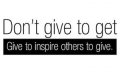
Give a little, get back a lot
 Remember what they taught you when you were a kid:
It’s better to give than to receive.
Sure, it sounds nice. But no one really believes it.
After all aren’t these our basic assumptions about human nature and the ways of the world?
- No good deed goes unpunished (Clair Boothe Luce).
- When a fellow says, “It is not the money but the principle of the thing,” it`s the money (Kin Hubbard).
- Where large sums of money are concerned, it is advisable to trust nobody (Agatha Christie).
- If you wish to be a success in the world, promise everything, deliver nothing (Napoleon).
- The end of the human race will be that it will eventually die of civilization (Ralph Waldo Emerson).
It may be a cynical way of looking at life, but we had better learn to live with it if we want to get ahead.
Or do we?

Political Correctness: the root of all evil

After last week’s wackiness at James Madison University, it’s time to revisit this post from last April. I fear there will be too many opportunities to do so.
A letter to the future president of the United States:
If you want to fix the country, you can start with the root cause of all that ails our country:
Political Correctness.
The truth is that political correctness is not a new idea at all; it is simply the new label for an old, established moral postulate once accepted by all.
The word civility shares its linguistic root with the word civilization. It means taking into consideration the comfort of others before expressing what I think or doing what I want. It means remembering that other people have rights before I assert my own. It means reflecting upon how my actions are going to affect my community and recognizing that I have a responsibility to a society that is more than the sum of autonomous individuals.
So what was wrong with the term civility that the concept needed rebranding as political correctness? Most likely, it was the connotation of political ideology that spawned this illegitimate offspring of cultural nobility.
 Yonason Goldson