Home » Posts tagged 'Psychology' (Page 18)

Tag Archives: Psychology

Falling Skies

Screen shot 2015-11-16 at 12_44_36 PMThe death of any young person is tragic, and all the more tragic when unnecessary.  In today’s world where sensory-gratification is king and accountability is unknown, few question the wisdom of jumping out of an airplane for kicks, especially when the chances of anything going awry are so small.

But those odds assert themselves eventually, as they did last month in Acampo, California.  The two young men who lost their lives were jumping about an hour’s drive from where I jumped myself almost four decades ago.  It seemed like a good idea at the time.  But I’ve come to reconsider, as I explain in this essay from 1999, originally published in the St. Louis Post-Dispatch.

“Middle age has finally arrived,” I said to myself as I confronted a life insurance application form for the first time ever. But as I filled in the blanks and checked off the boxes, I suddenly paused, suspended between youth and old age, as I read and reread one question midway through the form: Have you ever been skydiving?

I consider myself an honest person, so I found myself in the midst of a moral struggle as I contemplated how I should answer. The reasoning behind the question seemed obvious: why should any business gamble a quarter of a million dollars on the life of someone foolish enough to jump out of an airplane?

The way I figured it, however, there are three reasonable explanations why an otherwise sane person would do such a thing.

One, as in the case of former President George Bush, to save his life when his plane has been hit by enemy fire in WWII.

Two, also as in the case of George Bush celebrating his 75th birthday, when one is winding down his life and figures he hasn’t much of it left to lose anyway.

And three, as in my own case, when one is not yet sufficiently mature to appreciate that his life is far too precious a thing to be thrown casually out of an open hatch at 3000 feet.

Barring any of these three excuses, an insurer would be entirely justified in refusing coverage or inflating charges. But why, since I now regard jumping from an airplane as ample cause for mandatory psychiatric observation, should I be burdened with doubled insurance premiums because of a momentary lapse in good sense when I was half my present age?

As it turned out, I went with a different company, one whose application phrased the question this way: “Have you been skydiving in the last ten years?” That’s much more fair, I think.

Of course, insurance companies may just be looking for excuses to jack up their prices. After all, compared to BASE jumping, ice climbing, and other extreme sports, skydiving is positively run of the mill. Could George Bush, a former president of the United States, former director of the CIA, and former member of the NRA, be so completely off-the-wall? (Never mind that the poor former first lady could hardly bear to watch her husband’s escapades.)

Indeed, my diving instructor (whose name was also George) told us repeatedly: “Skydiving is no riskier than crossing the street!”

George isn’t alive any more. He wasn’t killed crossing the street, either.

Cool-Skydiving-Desktop-Wallpaper-With-Sunset-ViewAs a 19-year-old undergraduate still looking for a major course of study, life seemed to have little to offer me except cheap thrills. If something would go wrong, and I would splatter against the plowed earth of the Sacramento valley, well, what was the point of being alive if I didn’t experience all life had to offer?It goes without saying that children of all ages will be drawn like moths to the fire of every kind of sensory stimuli. It is our job as responsible adults to shield them from the flames of both real danger or virtual thrills, to gently prod them along the road to wisdom by exposing them to more rewarding and enduring highs than those brought on by adrenaline rush.

In the same way that chomping on spearmint gum deadens the palate to the subtle complexities of fine food and wine, the instant gratification of putting one’s life at risk may, in the end, kill off any hope of ever savoring the subtle joys of maturity, even if those dangerous pastimes do not themselves prove fatal.

The Talmud offers the following insight into human nature: “If someone says, ‘I struggled but did not achieve,’ don’t believe him; if he says, ‘I achieved without struggle,’ don’t believe him; but if he says, ‘I struggled and achieved,’ believe him.”

The Talmud goes beyond the simple axiom that there is no sense of accomplishment without exertion. It tells us that exertion and effort will inevitably produce a sense of accomplishment. And unlike the transient high produced by LSD, PCP, or any contrived brush with danger, the sense of accomplishment produced by struggle will not vanish into nothingness, leaving behind an emotional void or the anguish of physical or psychological withdrawal. It will endure, and spur us on to greater struggles and greater accomplishments.

Without intellectual effort, we would never graduate from Dr. Seuss to Shakespeare, from Marvel Comics to Monet, or from music videos to Mozart. Without psychological effort we would never learn the practical skills to succeed professionally or the interpersonal skills to succeed as spouses and parents and friends and neighbors. Without effort we would never learn to appreciate the small, subtle pleasures life has to offer because we would be ever waiting impatiently for the next emotional quick-fix.

Acquired taste is accessible to the young. As parents, we must not shy away from the challenge of inculcating patience and prudence in our children. Through persistent effort we can teach them that cultivating a taste for the more refined pleasures of life is not so hard, no harder really than falling out of an airplane.

The Zen of Tom Harmon

file_186975_0_Mark_HarmonPalmer:  So what do I do?

Gibbs:  Give her what she wants.

Palmer:  But I have no idea what that is.

Gibbs:  Say hello to the rest of your life, Jimmy.

Tony Soprano Redux

Trump_ProfileA good friend of mine, who is usually more clear-headed, sent me a slimy little video asserting that character doesn’t matter, since both FDR and Winston Churchill smoked and drank while Adolf Hitler was a teetotaler and a vegetarian.  His point was that Donald Trump’s crude, impulsive, petty, and narcissistic behavior has no bearing on his fitness for office.

While it is true that people are complicated, and that no one is completely virtuous or completely lacking in virtue, the indulgence in moral relativism is particularly galling when it comes from the right, after so many years of denouncing it as the Kool-Aid of choice among the left.

But the blurring of lines has been going on for a long time.  It particularly hit its stride about ten years ago with the success of the Sopranos, which prompted an op-ed that I revisit here.

Psychoanalyst Glen Gabbard, author of The Psychology of The Sopranos: Love, Death, Desire and Betrayal in America’s Favorite Gangster Family, has an interesting take on the phenomenon of Tony Soprano.

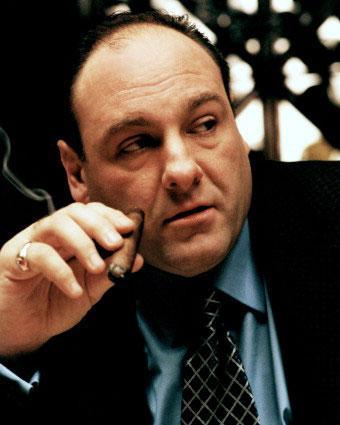
sopranoThe success of The Sopranos, it seems, depends not on Tony Soprano the mobster, but on Tony Soprano the psychoanalysis patient. Whereas in daily life, Tony is a crook, a thug, and a murderer, on the couch Tony is a regular guy, with the same hopes, dreams, problems, and anxieties as the rest of us.

Dr. Gabbard explains that people love to root for Tony the regular guy to prevail over Tony the violent criminal; they want more than anything to be able to find a noble everyman at the heart of the worst of the worst and the lowest of the low.

Simply stated, viewers don’t want to believe that anyone is really evil.

This is a remarkable turnabout from the early 80s when everyone’s favorite television creep was J.R. Ewing on Dallas. Back when “Who shot J.R.?” was on everybody’s lips, it wasn’t because we wanted to see the would-be assassin brought up on charges — we wanted to see him handed the key to the city. We didn’t want to understand J.R. — we wanted to hate him. We loved to hate him.

hqdefaultJ.R. never killed anybody, never even beat anyone up, yet we cheered from our couches when he got what was coming to him and hoped desperately that his every nasty scheme would fail. If so, why do viewers in record numbers forgive everything for Tony Soprano, the Godfather who terrorizes and murders for fun and profit, just because he worries about his marriage and his children? C’mon, even J.R. loved his daddy.

Perhaps there’s no better barometer for the moral pressure of society than our relationship with television’s most popular characters. When we cheer for the good guys and boo the bad guys, isn’t it because of our desire to see that justice is done?

But when we sympathize with a violent criminal, when we identify with him because he cares about his kids just as we do, isn’t it a sign of abandoning the commitment to differentiate between right and wrong?

The job of making moral decisions, of balancing right and wrong in complex circumstances, is no simple business. But instead of challenging us to recognize that Tony is a villain in spite of his human side, The Sopranos (and, more generally, the entertainment industry) manipulates us into identifying with Tony’s humanity so that we overlook his wickedness.

Based on Dr. Gabbard’s assessment, it seems that we yearn to deny that genuine evil walks this earth. Indeed, it may be admirable to look for the good in all people and give our neighbor the benefit of the doubt, but not to the exclusion of recognizing that sometimes there is no doubt, that what little good remains in some people has been hopelessly buried under a mountain of evil. The Hitlers, Stalins, and Ahmadinejads of the world may love their children and may have had troubled youths, but evil remains evil whether we choose to look it in the face or to bury our heads in the sand.

Too often, it seems, we avoid looking evil in the face at any cost. It should come as no surprise, therefore, that a growing element in our society blames the United States for Pearl Harbor, blames Israel for Palestinian suicide bombers, blames all of Western Civilization for September 11. But making excuses for evil does not make evil go away.

It just keeps coming back, each time bolder and more brazen than before.

The Talmud warns us to distance ourselves from a bad neighbor and not to associate with a wicked friend. Even if he loves his kids. Even if his name is Tony Soprano. Perhaps, especially if his name is Tony Soprano.

Originally published in 2007 by the St. Louis Post-Dispatch, Jewish World Review, and Aish.com.

The Continuing Culture of Violence

AP_Germany_Munich_Shooting_6_jt_160723y_31x13_1600I’ve had too many opportunities to repost this article.  Violence begets violence, and as chaos becomes the new normal we have to find a way to restore order and civility to our societies.  If we do, we can make Ft. Myers and Munich and Dallas and Boston nothing more than the names of cities once again.

Zebadiah Carter describes himself living in “an era when homicide kills more people than cancer and the favorite form of suicide is to take a rifle up some tower and keep shooting until the riot squad settles it.” In 1980, this remark by the main character in a Robert Heinlein novel sounded like the science fiction that it was. Now it echoes like a prophecy.

Near-death experience

1You’re ten years old and a sound sleeper, so it’s already unusual that something has woken you up in the middle of the night.  You go out into the hall to investigate.  There are strangers in the house and flashing lights out the window.  Your father tells you to go back to bed.

When you wake up the next morning, your mother has disappeared from your life.

It’s 1970, before school counselors or lettered conditions like PTSD.  Your father means well, but he’s not the communicative type, not one for expressing his feelings to others or eliciting others to share their feelings with him.  He’s from the Depression Era, and he barely saw his own father growing up during those desperate years.  He’s a veteran of the Second World War; difficulties are part of life.

He’s also dealing with his own trauma, as his wife lingers between life and death.

You get shipped off to stay with friends, or with your grandmother.  Very little is explained to you, and you understand even less.  Years later, there won’t be much that you remember, aside from the indelible images of that first night.

You won’t remember waking up the next morning to find your grandmother home with you instead of you parents.  You won’t remember when they took you to visit your mother one last time because no one thought she had much time left.  You won’t remember shouting at her for having abandoned you.  You won’t remember the outgoing, cheerful little boy you were before that cold, winter’s night.

You only remember how hard it was for you to talk to people from that moment forward.  You remember how easily you cried during the years that followed, and how much you hated yourself for crying so easily without understanding what made you that way.  You remember how you considered taking your own life, but always managed to convince yourself that you could do it tomorrow.

A decade passes before you really recover.  In some ways, you never recover at all.

Click here to read the whole essay.

Can I remain I after we become we?

63No man is an island, wrote John Donne. Neither is any nation, even if it’s the island nation of Great Britain.

This contradiction lies at the heart of the current political crisis facing British Prime Minister David Cameron. And as the British contemplate their future place in the world community, the rest of us should contemplate what the world will look like for our children and their children after them.

There are two legitimate, opposing arguments facing Britain in deciding whether or not to remain part of the European Union. To compete in the world marketplace as part of an economic powerhouse works to the advantage of every European country, Britain included. On the other hand, the threat to employment and security posed by unrestricted immigration may offset any benefits.

But whatever the British end up deciding for themselves in this month’s referendum, there is a deeper issue in play, one that has implications for all of us.

Click here to read the whole article.

The House

nad0-018“You’ll leave here after four years with an education few people have had access to in the history of mankind.  What are you planning to do with it?”

It was a good question, set forth by consumer advocate Ralph Nader as he spoke before an embarrassingly empty hall at our conservative university.  I was pretty conservative myself, and certainly no fan of the wildly liberal public avenger.  But I had found the opportunity to hear such an iconic figure irresistible, even if most of my fellow students felt otherwise.

“There’s a world out there filled with problems and suffering and injustice,” Mr. Nader continued.   “There’s a desperate need for crusaders, and you just want to get a job?”

The derision Mr. Nader injected into those last three words reverberated inside the echo chamber of my mind, etching upon my psyche an unequivocal contempt toward employment for the sake of mere employment.

It was 1981, during my junior year at the University of California, Davis, and I still had no idea what I wanted to do when I grew up.  But during those closing moments of his address, Mr. Nader awakened within me the passionate desire to do something – anything – as long as it might make a difference, as long as it would truly matter.

And so I left the lecture hall that evening feeling like Archimedes, looking for my fulcrum to move the world.  And my search led me to The House.

The HouseNo other name could have better described it:  here was an actual house – still thriving in the shadow of university office-buildings, lecture halls, and dormitories – with its modest front porch, unaffected wooden shingles, and single-pane windows opaque with dust around the corners.  Its official designation was Temporary Building-16.  But to everyone who worked there, and to anyone who patronized its services, TB-16 was simply called The House.

Fifteen or twenty years earlier, the thought had occurred to someone at Student Services to create an informal atmosphere where students could commiserate about the problems and stresses of college without having to endure the formality of an adviser, the social pressure of a dormitory, or the stigma of a psychologist.  In the course of its various incarnations, the project acquired a director, instituted a thorough course of preparatory and continuous training, and acquired TB-16.  The House opened its doors.

Karen was the House director, a position she had taken over from her husband, Kennebec.  His name was really Ken, but he had fallen in love with the Kennebec River and used its name as his own – at least in the company of friends and close acquaintances.  Student Services had brought him in to assume the directorship “after The House’s last nude retreat,” in hope of imposing greater structure upon the fledgling peer counseling facility.

Not that Ken was all that conventional himself.  His hobby was jumping freight trains, and he hadn’t thought it at all inappropriate to use this informal style of transportation for his own staff retreats.  I nagged Ken every time I saw him to take me train-jumping, but he was settling into the routine of responsible middle age, and never found time to take a weekend off to travel as undeclared baggage.

So Ken, it’s your fault that I later became a hitchhiker and not a hobo.

Click here to read the whole essay.

Profile of Terror

RacialProfilingWhether or not the cause of the EgyptAir disaster turns out to be terrorism — and regardless of whether Donald Trump was right or wrong to call it terrorism before any information was in — that was and is everyone’s first thought in these dangerous times.  We don’t believe in accidents anymore; experience has been too stern a teacher and the lessons of fanaticism have been too painful.

Presumably, such incidents will only make TSA lines move slower and slower.  Which wouldn’t matter if that actually made us safer and safer.

My neighbor told me recently that his son flew to Australia by way of Istanbul and Qatar.  Changing planes in Qatar’s Hamad International Airport, he was ushered through customs without even breaking stride — along with every other Caucasian on his flight — while every single Middle-Easterner was detained, searched, and questioned at length.

Interesting that the Qataris have no qualms about profiling their own people, while here in the open-minded West cling desperately to the illusion that every passenger poses an equal threat to our security.

Is it possible that the Qataris know something we haven’t figured out yet?

If terrorists were dressing up as Orthodox rabbis, I would want TSA to profile me and those who look like me.  Instead of taking it personally, I would be grateful for their common sense and conscientiousness.

But I guess that’s just me.

Spitting Image 3:3 — Never having to say you’re sorry

hqdefaultI can almost feel sorry for J. K. Rowling.  By age 40 she had published the most successful literature series in history, become the richest woman in England and, according to Forbes, was the first person ever to become a billionaire by writing books.

By any accounts, 40 is too young to retire.  So what does one do for a second act?

Ms. Rowling tried turning her hand to crime novel writing, but the glare of Harry Potter washes out anything else connected with her name.  After claiming she would never add to the series, now it seems that she is doing precisely that with a forthcoming sequel.

And why not?  Better than the sad attempts to stir up controversy with her post-publication commentaries, which seem aimed at no goal other that remaining relevant after her book sales ceased to make headlines.  First she told us that Albus Dumbledore is gay, an assessment that cooled the enthusiasm of many fans and met with incredulity from many others.

Then she began apologizing for killing off her characters, first Remus Lupin then, most recently, Fred Weasely.

960If Leo Tolstoy were still alive, would we expect him to apologize for killing off Anna Karenina?  Did William Shakespeare go too far by killing off Romeo and Juliet?   Should Arthur Miller have re-imagined the saga of Willy Loman as Life of a Salesman?  And is there anybody with more blood on his hands than Nicholas Sparks?

Ms. Rowling’s gift for making the fantastic seem believable depended upon lacing her stories with the kind of harsh and painful twists that are inevitable in the real world.  Without these, her novels would never have struck such a resonant chord with readers who could be captivated by impossible flights of fancy while finding within the narrative a wealth of down-to-earth lessons and insights for every day living.

Of course, maybe Ms. Rowling didn’t mean any of it, like the April Fool’s joke of Harry being a figment of Ron’s imagination.

We can hope, while suggesting that the author remember the words of King Solomon:  Do not say, “How is it that times gone by were better than these?”  For that is not a question prompted by wisdom.

With a talent for storytelling like yours, Ms. Rowling, no apologies are necessary.


Your dog doesn’t love you — get over it

dog-00033Okay, I’m guilty.

As a high school teacher, I strive to maintain a persona of impeccable professionalism every moment of every day. Almost.

On rare occasions, however, when I can no longer resist the impulse to really get under my students’ skin, I indulge a streak of sadism and utter those few words guaranteed to enrage even the most mild-mannered teenager.

Are you ready? This is what I say:

“Your dog doesn’t love you.”

And I don’t stop there. Pausing a few seconds to allow the full measure of indignation to begin boiling over, I follow up with:

“And you don’t love your dog.”

I have plenty of ammunition in my arsenal to defend my point. But in addition to the logic of my argument, I now have a current study that supports my claim.

Click here to read the whole article.