Home » Posts tagged 'Sociology' (Page 6)
Tag Archives: Sociology

Remembering the Boston Bombing
After the sentencing of Boston Marathon bomber Dzhokhar Tsarnaev last week, I’m revisiting some thoughts from the days after the 2013 bombing:
 Zebadiah Carter describes himself living in “an era when homicide kills more people than cancer and the favorite form of suicide is to take a rifle up some tower and keep shooting until the riot squad settles it.” In 1980, this remark by the main character in a Robert Heinlein novel sounded like the science fiction that it was. Now it echoes like a prophecy.
Random acts of mass violence in the United States still horrify us but no longer shock us. We’ve heard too many stories, seen too many pictures. And too many of them are depressingly the same:
- 20 students and 6 adults murdered at Sandy Hook Elementary School.
- 12 killed and 58 wounded at the Century Theater in Aurora, Colorado.
- 13 killed and 30 wounded at Fort Hood.
- 32 dead and 17 wounded in the Virginia Tech massacre.
And those are only the bloodiest atrocities going back to 2007. The Columbine school shooting in 1999 adds another 39 victims to the tally. And, of course, Timothy McVeigh’s bombing of the Federal Building in Oklahoma City in 1995 claimed 168 lives and injured nearly 700.
Now we have to try and make sense of this latest act of senselessness — the Boston Marathon bombings, which shattered an iconic American institution and shook our already precarious sense of order and security.
Amidst all the suffering and all the investigation, the question we most want answered is why?
We’ve asked the same question before. According to reports, Adam Lanza was bullied as a student at Sandy Hook; Eric Harris and Dylan Klebold were bullied at Columbine High School; so was Timothy McVeigh as a boy in Pendleton, New York. There were also histories of psychiatric problems, as there were with Seung-Hui Cho before his attack on Virginia Tech, James Eagan Holmes before Aurora, and Nidal Malik Hasan before Fort Hood.
But these explanations offer little in the way of real answers. Almost all of us were bullied when we were younger without seeking murderous retribution against our tormentors, and most of us can lay claim to at least some kind of neurosis. More to the point, why is random violence on the rise, if the root causes have been around for generations? According to data assembled by Mother Jones Magazine, nearly 40% of mass shootings since 1982 have taken place in the last seven years (excluding robberies and gang-related incidents). If so, what has changed? And can we expect it to get worse?
Ultimately, it may be all about control. “These kids often feel powerless,” psychiatrist Peter Langman told LiveScience. “The one way they can feel like they’re somebody is to get a gun and kill people.”
“Out of control” is a term that seems increasingly characteristic of the world we live in. On the one hand, technology provides us with the power of information, opportunity, and access at a level unimaginable barely a decade ago. But on the other hand, our inability to manipulate so much power leaves us feeling both frustrated and inadequate, while the triumphs of others make us feel like pawns in a game we can never win. With the world at our fingertips, success and happiness remain damnably elusive.
 And so we flail about with increasing desperation, constantly trying to push ourselves just a little harder and work just a little faster. Day by day, our sense of anger and resentment toward a society that promises so much and delivers so little builds within us until we feel ready to explode. In a world gone mad, what else can we do but get mad at the world?
The fallacy, however, is the world has not made sense since the beginning of time. So observed King Solomon, the wisest of all men, in his Book of Ecclesiastes, compiled over a lifetime spent searching for meaning and justice:
And I returned and saw under the sun that the race is not to the swift nor the battle to the strong, neither is there bread to the wise, nor riches to men of understanding, nor yet favor to men of knowledge; but time and death will overcome them all.
Really, all that has changed is our expectation. We have been taught to believe that anything we desire is within our grasp, that we are entitled to the love of poets, the wealth of kings, the pleasures and the power of the gods. Our culture has etched upon our collective consciousness the inalienable right to life, liberty, and the pursuit of happiness. And although Thomas Jefferson had the wisdom not to assert the right to happiness itself, that subtle distinction is lost on most of our generation.
Given the fantasy images of Pixar and Dreamworks, the superhero illusions of the silver screen, and the miracle gadgets that fit in the palm of our hands, what can we expect from a youth wholly unprepared for reaching the age of responsibility? And when they confront the seeming impossibility of leaving their mark on the world through any positive contribution, why should we be surprised when they choose violence as their final recourse to make the world take notice of their existence?
And yet, for all that, Solomon himself did not give in to despair and hopelessness, despite the words of lamentation with which he begins Ecclesiastes:
Futility of futilities — all is futile!
But it is not Solomon’s opening words that contain his ultimate message. It is the words he offers at the end, in sharp contrast to all the observations he offers before:
The sum of the matter, when all is heard: Fear the Divine and keep His commandments, for this is the entirety of Man.
Viewed superficially, this world is a place of chaos, without rhyme or reason, without justice or pity. Says Solomon: do not look at the outer trappings of creation, but search for the nobility of man. Recognize the greatness that compels a 27 year old first grade teacher, with scarcely a moment’s notice, to give up her life in the protection of her innocent charges. Admire the reflexive heroism of bystanders who rushed to help the injured at the finish line, without regard for whether another explosion might make them victims themselves. Do not lose hope in the face of wanton violence, but take inspiration from the lofty heights to which Man can rise.
In the marathon of life, some finish and some fall. But greatness is measured by perseverance, by pursuing the unique potential that resides within each of us us, by our determination to choose good over evil and show the world that the divine spark of the human spirit will never die.

Don Draper and the Illusion of Influence
Mad Men is coming to an end, concluding a luminescent seven-season run that began in 2007. But the show was into its third season before I first heard the name Don Draper.
I guess that proves hopelessly I’m out of touch with contemporary culture — a term that has increasingly become an oxymoron.
 Nonetheless, I can’t say that I was embarrassed in 2009 to have never heard of the personality voted Most Influential Man in America. What mortified me far more was to find myself living in a society that could consider a fictional character to be its most significant public figure.
I had to strain my memory to place that year’s first runner-up, track star Usain Bolt. I’m still straining my powers of reason to comprehend why a Jamaican sprinter should have been considered the most influential real person in United States.
Number three on the list was President Barack Obama. I had heard of him, and it’s hard to argue that the president is not supremely influential in his own country, no matter what one may think of his policies.
The rankings lay in the hands of readers polled annually by AskMen.com, a website (of which I had also never heard) devoted to men and their lifestyles. Topping the list as well were, in order: Facebook CEO Mark Zuckerberg, American Idol judge Simon Cowell, late pop star Michael Jackson, Apple CEO Steve Jobs, tennis champion Roger Federer, quarterback Peyton Manning, and Ultimate Fighting Championship president Dana White.
But grabbing the most votes was Don Draper, lead character in the Emmy-winning drama Mad Men. And for the first time in the poll’s history, the most influential man in American does not actually exist.
According to Reuters, AskMen.com editor-in-chief James Bassil explained the vote this way: “One of the big themes this year was that men really want to take on these traditional roles — as fathers, working men, provider at home, leader at the office. I think they are yearning for what is a solid past.”
That would be a comforting thought … if it were actually true. Indeed, one wonders if Mr. Bassil has watched the show or read his own magazine.
The AskMen.com website had this to say: “[Draper is] a postwar archetype, both a brilliant career man and a temptation-swayed philanderer who sincerely wants to be a family man… permanently conflicted over how to reconcile his morals and his desires.” The website for Mad Men describes the show as a “sexy, stylized and provocative drama [that] follows the lives of the ruthlessly competitive men and women of Madison Avenue advertising, an ego-driven world where key players make an art of the sell.”
Were that not enough to debunk Mr. Bassil’s rose-colored analysis, the list of the top ten winners is more than enough. Celebrities, athletes, billionaire businessmen, and an ideologically far-left president hardly reflect a trend back toward traditional values.
 In truth, the evidence suggests just the opposite, that Americans are increasingly obsessed with glitz and glamour, with power and wealth, with conquest and ego-gratification. The sad moral of the story was that the poll-winners are genuinely influential in steering our society toward superficial hopes and unrealistic dreams. How fitting that the most influential man was not only a fictional character, but a profoundly flawed and ambivalent one at that.
The bright side of the story, however, is that the poll revealed the attitudes and aspirations not of Americans as a whole but of AskMen.com readers. If the publication is anything like its forerunners, Playboy and GQ, it is hardly a fair representation of the country. Indeed, it would seem to say more about the inner conflict of testosterone-driven alpha males than those typical family men who may already be living — not merely yearning for — traditional values.
I never have watched the show, so I can’t comment on where the main character’s ambivalence has led him over the years. But it seems a good bet that those acolytes of Don Draper (and his real-world alter-egos) are likely to end up leading similarly conflicted lives, following him into the oblivion of the world of illusion.
Whereas those who live their lives according to traditional values understand that it is those very values that teach us the difference between good and evil, between truth and falsehood, between reality and illusion. Without the fantasy of Hollywood or the glamour of Madison Avenue, theirs are the lives of real substance and enduring reward.

When does encouragement turn deadly?
A New York Times article last month highlighted suicide clusters among Palo Alto high school students over the past few years. Many believe the reason lies in mixed messages from parents who tell their children to do their best and be happy, but who clearly won’t be happy themselves if their children’s best doesn’t get them into Ivy League universities.
Dr. Glenn McGee, the district superintendent, thinks that parents don’t get it. “My job is not to get you into Stanford,” he said he tells parents and students. “It’s to teach them to learn how to learn, to think, to work together — learn how to explore, collaborate, learn to be curious and creative.”

But the pressure to compete and perform remains. During this past school year, three boys laid down on local train tracks and took their own lives. Their parents’ words of assurance couldn’t offset the pressure of uncompromising expectations.
Indeed, one wonders whether Dr. McGee gets it himself. “Can we put sensors up there?” he wonders, suggesting some sort of system to alert the train operators. “This is Silicon Valley. There ought to be something we can do.”
But the solution isn’t to monitor the train tracks. As the old cliche goes, you don’t save people from falling of a cliff by putting an ambulance down in the valley.
The only answer is to change the culture so that success is measured not by standardized test scores and status but by cultivating individual talents and the attitudes that contribute to a healthy society. When parents make it their mission to fulfill each child’s unique potential — and not to satisfy their own dreams — then children are likely not only to meet parents’ expectations but to exceed them.

Fighting for whose rights?
Here we go again.
Socrates gave up his life for the ideal of pure wisdom. Galileo was threatened with torture for his commitment to scientific truth. Nelson Mandela spent 27 years in prison for his campaign to end apartheid.
 And now, attorney Steven Wise is seeking to be the next torchbearer for virtue and justice by seeking legal personhood for two chimpanzees currently deprived of their primatial integrity by incarceration in the anatomy department of New York’s Stony Brook University. Mr. Wise has even found a judge willing to hear his case.
This is a natural outgrowth of our collective obsession with rights and entitlement which has, proportionally, shrouded our notion of personal responsibility. A healthy culture recognizes that it has a moral obligation to show compassion to all living creatures. But as the very concept of morality flickers and fades from social consciousness, only the assertion of rights prevents the rapid disintegration of society.
And as we lose our sense of responsibility, the distinction between man and animals grows harder to define until, ultimately, it all but disappears. In California, the “rights” of a little fish trump the welfare of humans: crops wither in arid fields during the worst drought on record as the state dumps trillions of gallons of fresh water into the ocean.
It’s worth noting that in 1933, two years before the Nuremberg Laws stripped German Jews of both civil and human rights, the Nazi government passed some of history’s most progressive laws for the protection of animals, legislation considered emblematic of the highest moral values of a people.
Elevating animals to the level of human beings inevitably results in human beings acting worse than animals.
O Frabjous Day in the UK
 How wonderful when pundits get it so magnificently wrong.
‘Twas brillig in Britain this week when David Cameron vanquished his frumious foes and went galumphing back to 10 Downing Street, chortling all the way.
The best part is not that the conservatives won, but that the pollsters were — again — so whifflingly off the mark. Just as last September’s referendum on Scottish cessation — predicted “too close to call” — was defeated by an easy ten-point margin, similarly did Mr. Cameron’s party cut off the head of the opposition with a deft snicker-snack.
Isn’t it mimsy that life — especially politics — can still hold a few surprises? Maybe we can learn not to vote for the front-runners just because they’re the front-runners.
Of course, the victorious Prime Minister shouldn’t get too beamish. A resurgent Scottish National party promises renewed efforts to split what’s left of the British Empire. To be sure, the next jabberwock lies in wait right around the corner.
As John Simpson, my political science professor at the University of Edinburgh, once remarked:
“The world of politics is like what you see when you lift up a great, flat stone and watch all the wee beasties running around beneath it.”
Callooh! Callay!
Send us your email, and we will send you the first four chapters of Proverbial Beauty – free!


Limited Edition
 Would you pay $200 for a really pretty $50 bill?
Well, apparently Starbucks thinks that someone will. Their laser-etched gift card with floral details and ceramic finish might seem a little pricey; but hey, Mom’s worth it. Right?
If you market it, they will come.
#FieldOfScreams

MayPac — the untold story
Welcome to the Roman Empire.
 Even if you aren’t a student of history, you may remember learning about the “bread and circuses” of ancient Rome. By providing basic foodstuffs and the spectacle of gladiatorial combat, the Roman elites simultaneously invented the welfare state and the entertainment industry. Savvy enough to anesthetize the commoners into complacency, the aristocracy were then able to wallow in their epicurean and carnal orgies unmolested.
In our times, we don’t need the state to provide the bread. Burger King, Pizza Hut, and Taco Bell supply our undiscriminating culinary needs. The gladiatorial circuses have been reincarnated in the form of the NFL, except when the brutal melee of the gridiron is eclipsed by a billion-dollar fist-fight.
 Enter Floyd Mayweather and Manny Pacquiao. Their Romanesque and obscenely over-hyped bout, the much ballyhooed fight-of-the-century, came and went and will be soon forgotten… full of sound and fury, a tale told by an idiot.
But here’s a side of the event you won’t have read about in the papers or seen on ESPN.
My friend Art works for one of the big internet service providers. Friday was mayhem, as all the people whose service had been suspended for non-payment called in with either back-payments or desperate pleas for mercy so they could watch the spectacle. The tone of hysteria in call after call set Art’s teeth on edge.
Then this:
The woman called in, several hundred dollars behind in her bill, far too much in arrears for any kind of leniency. But she claimed extraordinary need. And her story was nothing less than extraordinary.
Her brother had just died. Her family was coming in the funeral. She explained frantically that she had to have internet service so that her siblings and cousins would be able to watch the fight.
Art literally put his head in his hands as he told me the tale. “I’d rather believe she was making it all up as a ruse to gain my sympathy,” he said. “But who could make up a story like that?”
Who, indeed? Once we have come to a place where we can conflate the loss of a loved one with the lost opportunity to watch two palookas beat each other senseless, I suspect that even the Romans would look upon us disdainfully and uncomprehending.
And, of course, we know what happened to Rome.
#MayPac
Light up your world
 A smile is like a flame. You can give one to someone else without giving away your own.
In Hebrew, the word for flame is lahava, related to the word ahava, which means love. A flame is broad at the base and narrows to a point: in the same way, two people might be very different from one another, but if they share a common sense of purpose they come to love one another.
And as with a flame — as well as a smile — you lose nothing by loving others.
Enjoy the little things
 Children grow up. Friends move away. Parents pass on.
We miss out on sunsets, and sunrises; we miss out on walks in the woods and float trips on the river. And we can’t even remember the reason for the fits and fights and pity parties that seemed so justified at the time.
It should be obvious what’s really important. But we find so many ways to rationalize the irrational.
Stubborn, aren’t we?
So smile more, give more compliments, hug your kids, call your parents, take time out for friends.
Sure, it’s all a cliche. But after all, don’t cliches become cliches because they’re true?

The Grass is Always Greener After the Apocalypse
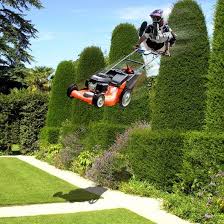 Well, there goes the neighborhood. Well, there goes the neighborhood.
That’s what I thought when I came home to find my next-door neighbor cutting his grass – for the first time since autumn. This was bad news. With the front yard of my other neighbor already short-cropped and neatly clipped, my own bedraggled lawn now stood out in sharp, unpretty relief. For some mysterious reason, the zoysia grass that dominates my front lawn is the last in the neighborhood to awaken each year from dormancy. Even worse, a variety of other grasses shoot up energetically with the outbreak of spring, speckling my lawn in malignant clumps that make the zoysia appear all the more anemic. In contrast to the golf course-like greens on either side of me, my patch of stringy yellow turf seemed to beckon for a rough-cut, whitewashed sign proclaiming CONDEMNED! My yard guys had yet to appear after the winter hiatus and hadn’t returned my phone calls. Were they out of town? Had they given up yard work for house painting or auto repair? It didn’t matter. Only one course of action remained: I would have to cut the grass myself. My sensibilities cried out against the wrongness of it all. The Creator did not plant grass upon His earth that it should be cut. He intended that it should grow, that it should go to seed, that it should produce new grass, and that the cycle should continue, uninterrupted by the meddling hands of Man. Cutting the lawn was a symbol of the same intrusive practices responsible for the destruction of the ozone layer and global warming, for deforestation and the extinction of new species every day, for Japanese kudzu smothering the southwest and Venezuelan hyacinths choking the Everglades. It all starts here, hacking down new growth sown by the Divine Hand to conform to some arbitrary aesthetic mean, branding every bayou a quagmire to justify turning it into a landfill or a parking lot. Was I now to become a part of this? “How about doing mine when you finish yours?” I called to my neighbor. Let him be the one to destroy the planet. “You’re welcome to borrow my mower when I finish,” he said. Terrific. Out of the frying pan, into the quagmire. Should I leave my lawn uncut to protest the destruction of the world’s ecosystem? No, my neighbors wouldn’t understand that I was making a political statement. Even worse, I would likely be cited by the city for crimes against civilization. And, worst of all, a small inner voice insisted that as an upstanding community member, as a father and a teacher, I had an obligation to uphold standards and preserve the status quo for the general welfare of the collective. Bah. Humbug. My neighbor finished. “You want to use it now?” he asked. Of course not, you infidel. But I didn’t say that: he would only have thought me rude. Instead I just smiled and nodded. He showed me how to operate the mower then went inside, mercifully, so not to behold me in my degradation. You know what? It wasn’t so bad. I even felt a kind of thrill as I assumed mastery over nature, subduing the power of the untamed wilderness, imposing order upon chaos. In fifteen minutes, the lawn looked great. I felt great. Maybe I should buy shares in John Deere. My only worry was that my wife might now expect me to mow the grass every two weeks. Well, maybe she wouldn’t notice. Half an hour later, as I was throwing the baseball with my son on our newly manicured front yard, my wife pulled into the driveway. “Honey,” she cried. “The lawn looks great. You cut it yourself?” Rats. She noticed. Previously published by the St. Louis Post-Dispatch and Jewish World Review |
 Yonason Goldson