Home » Posts tagged 'Virtue' (Page 14)
Tag Archives: Virtue
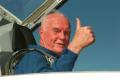
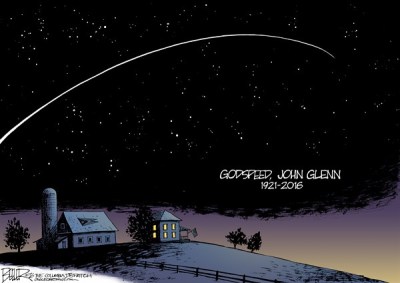
Beyond the Stars — A tribute to John Glenn
 If I have seen further than others, it is by standing upon the shoulders of giants.
~Sir Isaac Newton
There are two kinds of visionaries.
The first type sees farther, like Sir Isaac Newton. They possess a special gift of brilliance, genius, or perception. They see what others cannot, recognize mysteries that hide in plain sight, uncover beauty and order where the rest of us see only chaos. For the most part, they are born, not made.
Then there are those who are blessed not so much with the ability to see, but with the ability to bestow vision, to illuminate the world not with new insights but by giving the gift of insight to others. It is not their acumen, but rather their irrepressible pursuit of transcendence that inspires us to do as much with our lives as they have done with theirs.
Thirty-six years after becoming the first man in orbit, John Glenn became the oldest man in space, not as an ego trip or publicity stunt but to observe the effects of weightlessness on his 77-year-old body. As with his first trip, he showed that the limits upon human beings are mostly self-imposed.
Most of all, he showed us not only what a person can do, but what a person should be.
The real story about fake news
 Responding to headlines about “fake news,” silver-screen icon Denzel Washington offered up this classic quote from Mark Twain:
If you don’t read the newspaper, you’re uninformed, if you do read it, you’re misinformed.
He’s right, of course. The irony is that Mark Twain probably didn’t say it.
Which doesn’t make it fake news. To be fair, Mr. Washington himself didn’t cite Twain as author of the quote, which seems to derive from similar remarks by Thomas Fuller and Thomas Jefferson.
When I first saw the Fake News stories populating my newsfeed, I thought they must be referring to those absurd and provocative headlines that infest so many internet news pages. It seemed sad but not surprising that people give credence to this kind of salacious click-bait, but hardly worthy of national discussion.
I soon realized that the subject was more serious and, indeed, more substantive. Nevertheless, there may be a closer connection between the fraudulent and the whimsical than one might imagine.
Let’s start with the serious.
First of all, it’s not news that there is fake news or how harmful it can be.

Swearing makes you smarter. REALLY?
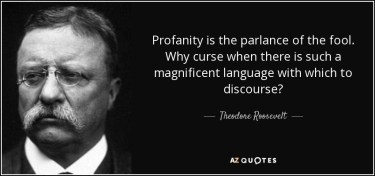 Experts have revealed [that] the use of profanity can in fact be a sign of a smart person.
This provocative assertion opened a recent article in the Daily Mail. The problem is, it’s not true.
Of course, that’s not the only problem. There’s also the problem of sloppy reporting, which comes from sloppy thinking, which comes from sloppy language. Which is what this story is really all about.
The alleged correlation between profanity and intelligence was inferred from a study concluding that people who know more curse words also know more words in general. Ipso facto, people who curse are smarter than people who don’t.
How much swearing do you suppose goes on at the Daily Mail?
Or you could ask a different question: Why should anyone take the Daily Mail seriously?
That’s a fair point. But the story also appeared in the Washington Post which, although avoiding the spurious equation between foul mouths and intelligence, still could not resist the lure of this equally misleading headline:
Why it’s a good sign if you curse. It isn’t. Which is clear from the Post article itself.

Of Doors and Windows
When the Lord closes a door, somewhere He opens a window.

No, I didn’t make that up. Julie Andrews says it in The Sound of Music. Half a century later, it may sound trite, but with the drama and trauma of this American election cycle finally behind us, it sure feels appropriate.
With uncharacteristic unity, liberals and conservatives alike long ago attained consensus that the ideological pendulum was never going to swing back again. The polling data had us all convinced that Hillary Clinton would continue the policies of our Visionary-In-Chief, opening up America’s borders, tearing down real and figurative walls, and redistributing wealth while running up debt toward the 15-figure mark.
Some welcomed this as advancement down the highway to Utopia. Some lamented it as racing headlong toward the abyss. But all that’s behind us now. The door to the past is closed. Where the window to the future will lead, only time will tell.
Be that as it may, a few thousand years before Julie Andrews, King Solomon offered his own observations about open doors. With respect to wisdom, he said:
Fortunate is the one who listens for me, attentively waiting by my doors day by day, keeping watch by my doorposts and entryways. For whoever finds me finds life…
From Solomon’s perspective, when a door closes, it likely means we have to work harder to find a way in.
After all, what is a door?
Click here to read the whole essay, from this month’s issue of The Wagon Magazine.

Liar, liar, house on fire
 In its never-ending quest for editorial balance and integrity, the venerable New York Times gave equal time to Israeli and Palestinian news channels in its reporting of the devastating fires sweeping through Israel.
Israeli news expressed the widely-held opinion that arson is behind the unprecedented rash of urban and forest conflagrations, the latest tactic of Palestinian terrorism.
Palestinian news reported that fires in Israel are started primarily by discarded cigarette butts and children playing with matches, with the remainder caused by electrical malfunction.
An Arab spokesman observed that Israel should take measures to ensure that these causes are addressed to prevent future fires. He failed to explain why fires anywhere near this scale have been unknown for the entire 68 year history of the State of Israel.
Thank you once again, New York Times, for honoring your famous motto:
All the news that fits, we print.
The Gift of Gratitude
 If I were to say, ‘God, why me?’ about the bad things, then I should have said, ‘God, why me?’ about the good things that happened in my life.
— Arthur Ashe
There’s no arguing that tennis legend Arthur Ashe had good reason to complain. His mother died when he was four years old. His brilliant tennis career was cut short at age 36 by a heart attack, followed by two open-heart bypass operations and one brain surgery, only to discover that he had contracted AIDS via blood transfusion. He died at age 49.
It’s extraordinary that a person could suffer so much and not cry out against his fate with anger and bitterness. But the explanation used to be obvious, before it became increasingly rare:
Gratitude.



It’s right before your eyes
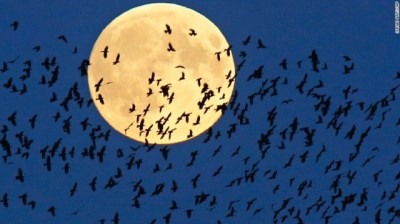 Yesterday’s supermoon, the closest and brightest in seven decades, is dramatic precisely because it fails to push back the darkness of night. King Solomon warns us of the pitfalls of living “under the sun,” reminding us that too much light can blind us to the dangers posed by our own misperception — a theme that figures prominently in my book Proverbial Beauty. I’m taking the opportunity to revisit this article from 2009.
Imagine if, in the late 1990s, a freshman congressman in the House of Representatives had submitted, as his first piece of legislation, a bill requiring airlines to install high-security doors on all passenger planes between the cockpit and the cabin. Imagine that the bill narrowly passed, was signed into law, and resulted — at great inconvenience and expense — with enhanced security for every commercial flight crew by the summer of 2001.
What would such an initiative have produced? Most notably (or really, just the opposite), September 11 would be a date of no greater significance than August 3. No terrorists would have seized those airliners and flown them into the Twin Towers that day. Perhaps American troops would never have gone into Afghanistan or Iraq. Perhaps the economy would not (yet) have collapsed. Quite possibly, Barack Obama would never have been elected president in an anti-George W. Bush backlash.
In his book The Black Swan: The Impact of the Highly Improbable , economist Nassim Nicholas Taleb proposes just such a scenario. But Mr. Taleb focuses less on the global consequences than on the fate of our fictional congressman — let’s call him Joe Smith. Congressman Smith will not be remembered as the hero who prevented the worst terrorist attack in history, precisely because he successfully prevented it. In all likelihood, he will be loudly denounced as the architect of an expensive and irrelevant measure and hounded out of office. He may live out his life regret his own lack of political saavy, which ended his career before it had even begun.
A complicated and often elusive treatise, The Black Swan proposes a correlation between history’s most significant events and the degree to which they were unanticipated. The stock crashes of 1929 and 1987; the outbreak of both world wars; the collapse of the Soviet bloc and the rise of Islamic fundamentalism. Each of these came as a profound shock to the world; only with the benefit of hindsight have historians explained all of them as political and economical inevitabilities.
Moreover, the lessons learned from history’s most earth-shattering events tend consistently to be exercises in locking the barn door after the horse has run away. Both individually and collectively, we implement strategies that would have changed the course of history had we applied them earlier, failing to realize that our measures to correct address the specific circumstances that shaped the past rather than the broader principles that will determine the future. The more closely we focus on what we expect to happen, the more we increase the probability that the future will arrive from an entirely unimagined direction.
DON’T LOOK NOW
The human eye is a truly remarkable organ. It is self-focusing, adjusts instantly from close-range to distance, discerns color and texture, judges distance, and adapts to bright sunlight, inky darkness, and everything in between. It allows us to focus on a single point of interest while, through our faculty of peripheral vision, we continue to process information coming in from all sides to provide context and enable us to respond to changing conditions.
 Instinctively and intuitively, we place the object of immediate interest at the center of our optic and cognitive attention. But this is not always the most effective means of perception. We have all experienced instances of looking directly at an object and failing to see it, either because it is so familiar or unremarkable that our minds filter it out as irrelevant, or because it is so incongruous that our subconscious refuses to accept its presence. In such cases, we may notice an object only when we are looking elsewhere and our peripheral vision, unencumbered by the censorship of our expectations, draws our attention back to that which had previously hidden in plain sight.
This phenomenon — called averted vision — was first alluded to by Aristotle and has become particularly important among astronomers, who have found that observing an object peripherally may increase its resolution by up to three or four magnitudes. Because the center of the eye contains only cones, which perceive brightness and color, fainter objects are more easily detected by the rods, which perceive dim, monochromatic light and occupy the outer regions of the eye.
LOOK AWAY AND ALL WILL BE REVEALED
We live in a world that, on its surface, seems well-ordered and readily understood. The cycle of seasons follows its natural course with relative predictability. The habits of animals remain virtually unchanged. The waters of the earth flow downward from the mountains to the seas, evaporate and rise up to the firmament, then return to the earth as rain.
On closer inspection, however, the world is a place of profound mystery. Solid objects are composed of increasingly tiny particles, many of which are spinning wildly in microscopic orbits at nearly the speed of light. Hundreds of other sub-atomic particles waft about our universe, many without any clear direction or purpose. The beginnings of physical existence and life itself cannot be substantiated through any empirical evidence or rational theory. The force of gravity, which is so fundamental that we scarcely give it any thought, has no satisfactory explanation.
Atoms, the building blocks of our universe, had never been directly observed until last year, when an electronic microscope powerful enough to view them was finally engineered. The protons, neutrons, and electrons, as well as those myriad other sub-atomic particles, are still yet to be seen. So how do we know they exist? Indirect evidence — the averted vision of science. By analyzing observable evidence, scientists have determined that these particles must exist to explain otherwise unexplainable phenomena.
But why should our universe be so impenetrably shrouded in mystery? The sages of the Talmud explain that ours is a world of hester ponim — a world in which the Almighty “hides His face.” The familiarity of the material world draws all our attention, distracts us from the true spiritual nature that reveals itself only at the periphery of our vision. The unanswered questions of science, the anomalies of nature, the enigmas of philosophy, the improbability of the cosmic and individual “coincidences” that surround us daily — all these testify to the order and the One who imposed order upon the universe. They whisper to us from the corners of our consciousness and beckon us from the edges of our awareness, vanishing to insignificance amidst the cacophony of physical existence the moment we try to focus on them, then reappearing as soon as we turn our attention elsewhere.
Search for G-d and all His might, says King David, seek His presence always.The harder we try to find order in our lives, the more chaotic our world seems to become. By allowing the subtle evidence that flutters at the fringes of Creation to hold out attention, however indirectly, the more we make our hearts and minds sensitive to the spiritual reality that is the foundation of the physical universe and the human condition.
 Yonason Goldson