Home » Moral Compass (Page 18)
Category Archives: Moral Compass

President Evil
 On 10 December, the St. Louis Post-Dispatch ran an editorial suggesting that Donald Trump was largely responsible for the gunman who attacked a Washington pizza parlor and the deranged woman who made death threats against the mother of a Sandy Hook massacre victim.
I submitted the following letter to the editor in response. Inexplicably, the paper chose not to print it.
Dear Editor,
Your editorial was absolutely correct. Donald Trump’s irresponsible rhetoric definitely has contributed to the corrosion of our culture and our safety. But please explain why you limit your indictment to Mr. Trump alone.
Why don’t you lay equal blame in the lap of Hillary Clinton for her amoral campaign of distortion, deception, and corruption? The former next-president-of-the-United-States racked up 24 pinocchios last year from the Washington Post, and has lied about everything from her emails to her foundation, from her fictitious ducking under Bosnian sniper fire to the origins of her own name.
Why don’t you assign equal guilt to Barack Obama, who denied calling ISIS “the JV team,” who misrepresented Republican filibustering by a factor of ten, and whose misinformation about Obamacare could fill a government website?
And why don’t you admit your own complicity as part of the injudicious media that perpetuated the big lie of “Hands up, don’t shoot,” continues to indulge the wicked moral equivalence that excuses and enables radical terrorism, and — oh, the irony — provided Donald Trump with millions of dollars in free column space and air time, helping catapult him to primary and ultimately national election victory.
By all means, blame Donald Trump for all of society’s ills. But first show the moral fortitude of placing the blame everywhere it belongs, including on your own shoulders.

The real story about fake news
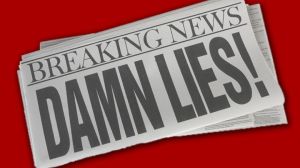 Responding to headlines about “fake news,” silver-screen icon Denzel Washington offered up this classic quote from Mark Twain:
If you don’t read the newspaper, you’re uninformed, if you do read it, you’re misinformed.
He’s right, of course. The irony is that Mark Twain probably didn’t say it.
Which doesn’t make it fake news. To be fair, Mr. Washington himself didn’t cite Twain as author of the quote, which seems to derive from similar remarks by Thomas Fuller and Thomas Jefferson.
When I first saw the Fake News stories populating my newsfeed, I thought they must be referring to those absurd and provocative headlines that infest so many internet news pages. It seemed sad but not surprising that people give credence to this kind of salacious click-bait, but hardly worthy of national discussion.
I soon realized that the subject was more serious and, indeed, more substantive. Nevertheless, there may be a closer connection between the fraudulent and the whimsical than one might imagine.
Let’s start with the serious.
First of all, it’s not news that there is fake news or how harmful it can be.

Scorched-earth redux
 If you’ve never heard of the Daily Banter, good for you. Here’s one of its latest headlines:
Trump Is Officially An Illegitimate President-Elect And The Democrats Have To Destroy Him
In a nutshell — or a nutcase — the hyper-hormonal screed asserts that Democrats need to take Republican scorched-earth policies to the next level to save our democratic republic.
Whatever one may think of Donald Trump, the manner of his election, or his adolescent tweeting, he has blunted the onslaught from many of his critics with the measured judgment of his cabinet picks and administrative appointments.
Aside from that, after eight years of partisan sniping, bullying, and obstructionism — from both sides of the aisle — what the country needs and wants is a spirit of cooperation from its lawmakers, not more posturing, bickering, and gridlock.
But here’s the question that really needs answering:
Why is a scandal sheet like the Daily Banter showing up at the top of my Google News feed?

Swearing makes you smarter. REALLY?
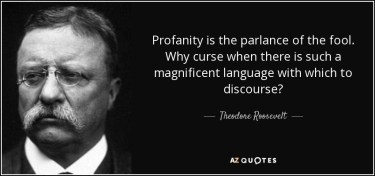 Experts have revealed [that] the use of profanity can in fact be a sign of a smart person.
This provocative assertion opened a recent article in the Daily Mail. The problem is, it’s not true.
Of course, that’s not the only problem. There’s also the problem of sloppy reporting, which comes from sloppy thinking, which comes from sloppy language. Which is what this story is really all about.
The alleged correlation between profanity and intelligence was inferred from a study concluding that people who know more curse words also know more words in general. Ipso facto, people who curse are smarter than people who don’t.
How much swearing do you suppose goes on at the Daily Mail?
Or you could ask a different question: Why should anyone take the Daily Mail seriously?
That’s a fair point. But the story also appeared in the Washington Post which, although avoiding the spurious equation between foul mouths and intelligence, still could not resist the lure of this equally misleading headline:
Why it’s a good sign if you curse. It isn’t. Which is clear from the Post article itself.

Liar, liar, house on fire
 In its never-ending quest for editorial balance and integrity, the venerable New York Times gave equal time to Israeli and Palestinian news channels in its reporting of the devastating fires sweeping through Israel.
Israeli news expressed the widely-held opinion that arson is behind the unprecedented rash of urban and forest conflagrations, the latest tactic of Palestinian terrorism.
Palestinian news reported that fires in Israel are started primarily by discarded cigarette butts and children playing with matches, with the remainder caused by electrical malfunction.
An Arab spokesman observed that Israel should take measures to ensure that these causes are addressed to prevent future fires. He failed to explain why fires anywhere near this scale have been unknown for the entire 68 year history of the State of Israel.
Thank you once again, New York Times, for honoring your famous motto:
All the news that fits, we print.

The Gift of Gratitude
 If I were to say, ‘God, why me?’ about the bad things, then I should have said, ‘God, why me?’ about the good things that happened in my life.
— Arthur Ashe
There’s no arguing that tennis legend Arthur Ashe had good reason to complain. His mother died when he was four years old. His brilliant tennis career was cut short at age 36 by a heart attack, followed by two open-heart bypass operations and one brain surgery, only to discover that he had contracted AIDS via blood transfusion. He died at age 49.
It’s extraordinary that a person could suffer so much and not cry out against his fate with anger and bitterness. But the explanation used to be obvious, before it became increasingly rare:
Gratitude.

Donald Trump has finally gone too far
 Perhaps we can forgive the president-elect for his crassness, his coarseness, his ultra-nationalist rhetoric, his mockingly superior tone, and for dragging the electoral process deeper into the mud than anytime in the last century.
But now he has officially gone too far.
Donald Trump has committed the unpardonable sin of not telling the press where he went for dinner last Tuesday evening.
By doing so, reports the Washington Post, Mr. Trump has “dispensed with generations-old traditions and formalities,” adopting a “combative approach to press relations” in a way that shows “he clearly doesn’t respect the media.”
Gee, is this the same media that rallied all its collective forces to discredit Donald Trump as a candidate and convince the country that a humiliating electoral defeat to Hillary Clinton awaited him come November 8? Might that have something to do with his perceived lack of respect?
But that’s not even the real issue.
More significant is the sense of entitlement the media feels to invade the private lives of every public figure, and the selective metric they apply when they do so. They grudgingly accord scant airtime and column space to stories that don’t fit their ideological agenda, then cry foul when they’re denied access to the not-yet-president’s family meal and frame the perceived offense as a threat to national security.
If the election results taught us anything, it’s that the media has become so skewed in its reporting that it can’t even trust itself. Maybe if reporters learn that lesson they’ll find themselves more welcome beside the presidential dinner table.

Six Recalibrations to get Success Back on Track
 In an earlier post, I outlined six misconceptions that stifle success. They are:
- Pleasure equals happiness
- Opinion equals fact
- Winning equals success
- Autonomy equals freedom
- Convenience equals peace of mind
- Legal equals ethical
When we use words without concern for their meaning, we deprive ourselves of the ability to think clearly. We confuse goals with side-effects, assets with obstructions, and benefits with pitfalls. We sabotage our own success because we aren’t clear about where we’re going or how we’re going to get there.
When we mistake happiness for pleasure, we end up chasing after instant gratification, which is emotional junk food. When we don’t consider ourselves winners unless someone else is losing, we drive away potential allies and advocates. When we refuse to reexamine our opinions, we are often denying reality.
The belief that freedom means no restrictions destroys discipline and makes us slaves to our bad habits. The notion that convenience leads to tranquility leaves us unable to cope with life’s difficulties and disappointments. And exploiting legal loopholes makes us untrustworthy and untrusted.
So let’s get down to definitions.
 Yonason Goldson