Home » Moral Compass (Page 30)
Category Archives: Moral Compass

The Boundaries of the World
 This week, the world observed the 100th anniversary of Albert Einstein publishing his General Theory of Relativity. The effects of his revelation extend far beyond what most of us imagine, as I outline in this excerpt from my book Proverbial Beauty: Secrets for Success and Happiness from the Wisdom of the Ages.
Do not remove the boundaries of eternity, which were set in place by your forefathers (Proverbs 22:28).
Writing for Environmental Health Perspectives, Ron Chepesiuk cites research that exposure to artificial light can prevent trees from adjusting to seasonal variation, affecting the behaviors, foraging areas, and breeding cycles of insects, bats, turtles, birds, fish, rodents, and reptiles even in rural settings. Urban light has caused disorientation in migrating birds, accounting for avian deaths estimated between 98 million and one billion each year.
The 24-hour day/night cycle, known as the circadian clock, affects physiologic processes in almost all organisms. These processes include brain wave patterns, hormone production, cell regulation, and other biologic activities. Disruption of the circadian clock is linked to several medical disorders in humans, including depression, insomnia, cardiovascular disease, and cancer, says Paolo Sassone-Corsi, chairman of the Pharmacology Department at the University of California, Irvine, who has done extensive research on the circadian clock. “Studies show that the circadian cycle controls from ten to fifteen percent of our genes,” he explains. “So the disruption of the circadian cycle can cause a lot of health problems.”
A meeting sponsored by the National Institute of Environmental Health Sciences (NIEHS) concluded that, although there is still no conclusive evidence, the correlation between altered patterns of light and dark in the modern world and dramatic increases in the risk of breast and prostate cancers, obesity, and early-onset diabetes appears more than coincidental.
And, of course, we can no longer see the stars.
Breaches in natural boundaries have taken many other forms as well:
- In 1884, a farmer visiting the Cotton States Exposition in Louisiana brought back a few Venezuelan water hyacinths to decorate the fountain outside his home in Florida. Today, the aggressive purple flowers choke 126,000 acres of waterways.
- Kudzu, a Japanese vine imported in 1876 to prevent erosion, is currently spreading through the southern United States and expanding at a rate of 150,000 acres a year.
- The European rabbit, introduced to Australia in 1859, has reached a population of over 200 million, necessitating the construction of a 2000 mile long rabbit-proof-fence to prevent the wholesale destruction of farmlands.
- In 1956, African bees brought over by Brazilian scientists to breed for honey production escaped their quarantine and gave rise to the noted “killer bee” scare.
The list goes on and on. In the United States alone, containment costs of invasive species are estimated at $138 billion annually.
But the violation of natural boundaries has even more broad-reaching consequences, affecting not only the stability of our physical world but the integrity of the moral universe as well. In his book Modern Times: the world from the twenties to the nineties, historian Paul Johnson analyzes the impact of Albert Einstein’s theory of relativity upon the way Western society began to look at the established values of the ages:
All at once, nothing seemed certain in the movements of the spheres… It was as though the spinning globe had been taken off its axis and cast adrift in a universe which no longer conformed to accustomed standards and measurement. At the beginning of the 1920s the belief began to circulate, for the first time at a popular level, that there were no longer any absolutes: of time and space, of good and evil, of knowledge, above all of value. Mistakenly but perhaps inevitably, relativity became confused with relativism.
No one was more distressed than Einstein by this public misapprehension. He was bewildered by the relentless publicity and error which his work seemed to promote…
Einstein was not a practicing Jew, but he acknowledged a God. He believed passionately in absolute standards of right and wrong… He wrote to [colleague Max] Born: “You believe in a God who plays dice, and I in complete law and order in a world which objectively exists and which I, in a wildly speculative way, am trying to capture. I firmly believe, but I hope that someone will discover a more realistic way or rather a more tangible basis than it has been my lot to find.”
But Einstein failed to produce a unified theory, either in the 1920s or thereafter. He lived to see moral relativism, to him a disease, become a social pandemic, just as he lived to see his fatal equation bring into existence nuclear warfare. There were times, he said at the end of his life, when he wished he had been a simple watchmaker…
[T]he public response to relativity was one of the principal formative influences on the course of twentieth-century history. It formed a knife, inadvertently wielded by its author, to help cut society adrift from its traditional moorings in the faith and morals of Judeo-Christian culture.
It’s hard not to be impressed by the prescience of King Solomon. When civilization depended upon candlelight to hold back the darkness, the inexorable cycle of day and night forced us to conform to the natural order. True, our lives have become more convenient and more comfortable, but once electric lighting pushes away the darkness of night, once central air conditioning and heating insulate us from the changing of the seasons, once cars and planes shrink the distance between faraway places, once electronic communication eliminates all delay in correspondence and information and, indeed, once science itself seems to provide justification that all boundaries are negotiable, is it not inevitable that society will begin to challenge moral boundaries as well?
There are no absolutes when every established norm is threatened by the inertia of change for the sake of change and an idealized vision of unrestricted freedom. Once change becomes the new normal, human society has little hope of curbing the headlong rush into chaos and social disintegration into moral anarchy.
In the same way that we have to defend the integrity of natural and moral boundaries as a society, we have to guard the boundaries between ourselves and those around us when the order of society begins to crumble. But no matter how much we try, we can never completely seal ourselves off from the influences of the culture in which we live.
I discovered this frightening truth on a trip to southern Asia, where a popular joke is repeated only half-jokingly:
In America people drive on the right side of the road.
In England, people drive on the left side of the road.
In India, it’s optional.
Only when society as a whole preserves its respect for the traditions that have been handed down through the ages will the structure of that society endure. But if each generation believes that it can reject the standards of its forbears from a position of moral superiority, the next age of darkness can be found lurking right around the corner.

Terrorism Close to Home
 This morning’s terrorist attack by a Palestinian who rammed his car into Israeli soldiers at a bus station struck a little closer to home. Both of the injured soldiers had just drafted into the army and were friends of my son from the same Lone Soldier group. They were released on leave a day before my son was, or he probably would have been standing right beside them.
At least one of them will be disabled for months: the Guardian reports this as “light to moderate” injury.
The story in the Guardian led by stating that the attack took place in the “occupied West Bank,” implying a John-Kerryesque legitimacy, then went on to report that the “incident raises the number of Palestinians killed since 1 October to 98, including an Israeli Arab.” In the interest of balance, the story did concede that, “More than half of them have been alleged perpetrators of stabbing, shooting and car ramming attacks aimed at Israeli civilians and security forces.”
However, the story neglected to mention that after ramming his car into the crowd, the Arab attacker was shot as he tried to stab one of his victims.
Allegedly.
Not the worst example of media bias by far, but shoddy journalism by any account. Our children who put themselves in harm’s way to protect others from violence deserve much better.

A Message to my Son

My oldest son enters the Israeli army this week, motivated by nothing other than a sense of commitment to the security of his people.
It seems fitting to revisit these thoughts, written on the occasion of his bar mitzvah ten years ago.
It’s not difficult to sympathize with the skeptics who questioned the ability of Avrohom Mordechai Altar, then still a teenager, to succeed his father as leader of the Gerrer Chassidim, possibly the most influential Torah community in Poland at the end of the 19th century. But the young scholar, who would grow up to become a great rabbi and author of the Imrei Emes, answered his critics with the following parable.
A small town in an isolated land rested at the foot of a great mountain, a peak so high and steep that all reasonable people considered it unconquerable. From time to time, however, some impetuous youth would set out to climb the mountain. Some of these returned admitting defeat. The rest were never heard from again.
Despite the warnings and prophesies of doom, a certain young man decided to challenge the mountain. Many times he nearly turned back, and many times he nearly met his end, but through sheer persistence he finally reached the mountain top. But he was utterly unprepared for what he found there.
A thriving city of people lived upon a great plateau at the mountain¹s summit. There were houses and farms — an entire community living where everyone believed that no one had ever set foot.
The inhabitants of the mountain top laughed at him when he expressed his astonishment. “Do you think you¹re the first one to climb the mountain?” they chided. “We also reached the top and, having done so, chose to build this town and make our lives here.”
Not yet recovered from his dismay, the young man noticed a small boy, only six or seven years old. This was more than he could believe. “Did you climb all the way up here, too?!” the young man exclaimed.
“No,” replied the boy. “I was born here.”
The youthful rabbi explained to his followers that indeed he was young. But he had been born into a dynasty of great Torah leaders, raised by and taught by the greatest sages of his generation who had in turn been taught and raised by the greatest sages of their generation. True, he was young; but he had been born on a mountain, and from his place atop the shoulders of the spiritual giants who preceded him he would build upon their greatness. In this way would he succeed as a leader of his people.
And so he did.
 Every year, on the sixth day of the Jewish month of Sivan, Jews around the world celebrate the revelation at Sinai, over 3300 years ago, when the Almighty gave us the Torah. It was the Torah that provided the moral and legal foundation that has enabled the Jewish people to build a nation devoted to spiritual ideals, a nation that endured for nearly 1,500 years in its land and nearly 2,000 years scattered across the globe. It was the Torah that introduced the concepts of peace, of charity, of justice, and of collective responsibility to a world that knew no value other than “might makes right.” It was the Torah that formed the basis of Christianity and Islam, spreading monotheism throughout the world and fashioning the attitudes of modern progressivism.
It all began on that mountain called Sinai, and from that point on the Jewish people have labored to climb the mountain of morality and virtue, sometimes succeeding, sometimes failing, sometimes wondering whether our efforts are worthwhile, but always persevering in our mission to attain the summit of spiritual and moral perfection.
Had our mission demanded completion within a single generation, we would never have held out hope of success. But every generation climbs a little higher, building on the accomplishments of their parents and grandparents, fighting for every handhold, struggling for every foothold, occasionally slipping back but never surrendering.
The mission that defines us as a people began 33 centuries ago; it continues today as we recommit ourselves to the study and observance of Torah, and celebrate it on the holiday of Shavuos.
And it was two weeks after Shavuos that I celebrated what happens only once in a lifetime — the bar mitzvah of my eldest son. In his first 13 years of life I did my utmost to teach him that he was born on the mountain, that he has the accomplishments of generations beneath his feet to support him, and that future generations will depend upon him for their support just as he depends on those who went before.
And so it is with every Jewish child. Each has his own contribution to make in the eternal mission of our eternal people. It is the Torah that defines us, the Torah that guides us, the Torah that sustains us, and the Torah that will ultimately bring us to the fulfillment of the spiritual goals for which the Almighty created us.
Climb, my son. Climb and keep climbing toward the top of the mountain.
Originally published by Aish.com.
Diversity, Einstein, and Identity Politics
Hear my interview with Ross Kaminsky from earlier this month:
The Legacy of Woodrow Wilson
 Once Iowa Democrats decided to rename the venerated event known as the Jefferson-Jackson dinner, it was only a matter of time before PC zealots would start demanding the purge of historical icons all across America. After all, how in good conscience can a country continue to commemorate its most influential leaders if they failed to anticipate that the legal and universally-accepted institutions of their times would eventually be regarded as immoral by their great-grandchildren?
Now it’s Woodrow Wilson’s turn, as students at Princeton demand that the memory of their university’s former president be expunged from under the heavens because he supported segregation, a policy viewed by many as progressive a century ago, no matter what we may think of it now.
There is a deeper irony in their campaign, however. In terms of political acumen, Woodrow Wilson has quite a bit in common with a much more contemporary figure, one who is revered by the very people who are protesting President Wilson’s racism and misogyny: Barack Obama.
Pollard and Nuremberg
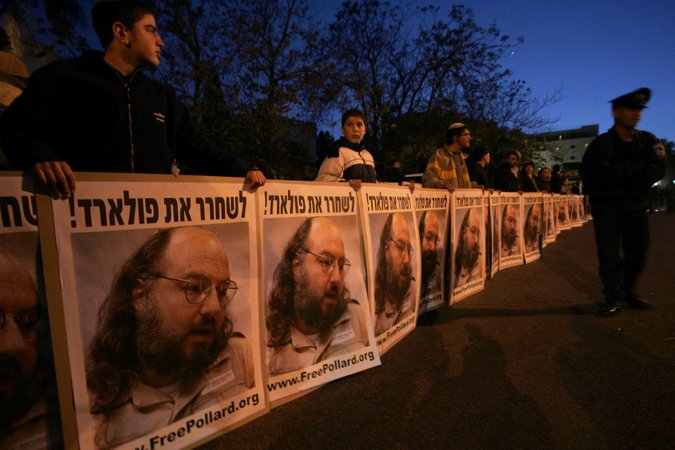 The case of Jonathan Pollard was more complicated than most people understood. His actions may have placed others in danger, and may have contributed to the death of agents he compromised. But almost everyone agrees that his punishment was disproportionate to his crime, and the sense of joy upon his release is more than justified.
The real take-away is this: whether one agrees with or disagrees with what Mr. Pollard did, he followed his conscience, and he was prepared to accept the consequences of his actions. If only more of our fellow citizens and more of our political leaders demonstrated the same courage and conviction.
Of course, not everyone’s moral compass is adequately calibrated. Edward Snowden also believed that he was following his conscience, and the morality of his actions is far more questionable for his having caused more damage by far than did Jonathan Pollard.
The Nuremberg trials after WW II changed forever the interrelationship between civil and moral law. No longer would it be legitimate to claim “I was only following orders” as a defense for crimes against man. A soldier has an obligation to refuse to carry out an immoral order, even if by doing so he puts himself in danger of court martial.
We should all consider ourselves foot-soldiers in the culture wars that threaten our society. But moral obligation implies more than just following our conscience. It means investing the effort, energy, and thought necessary to understand the decisions we will have to make and their consequences. Otherwise, our claim to the moral high ground can become a smokescreen to hide our moral irresponsibility.
That’s what makes Jonathan Pollard a hero in the eyes of so many, and Edward Snowden, perhaps, something very different indeed.

The Cost of Voyeurism
 Where were you on Tuesday, August 19th, 2014? That’s the day ISIS terrorists beheaded American journalist James Foley. Or, to be more accurate, that was when they posted the video of their atrocity on YouTube
Did you watch it? If you did, you had plenty of company. According to one poll, an estimated 1.2 million people in Great Britain watched the beheading in just the first few days after the video appeared online. In the United States, pollsters found that 9% of those surveyed had watched the brutal execution, suggesting that about 30 million Americans had witnessed the spectacle by mid-November.
And back in 2004, the video of Islamists beheading freelance repairman Nick Berg was the most popular search topic for a solid week; the al-Qaeda-linked website hosting the video received so much traffic it had to temporarily shut down.
According to Oxford anthropologist Frances Larson, this fascination with violent images is nothing new.
Read more at: http://www.learning-mind.com/voyeurism-violent-images/

Did That Really Happen?
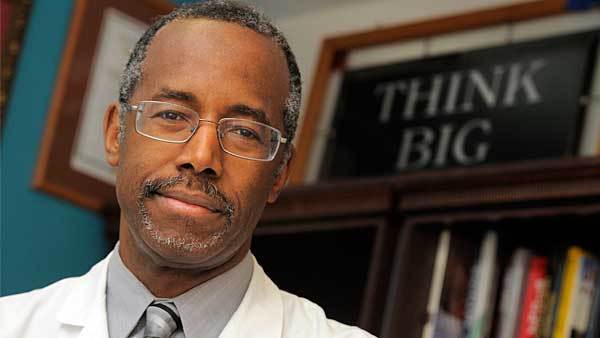 Well, it was probably inevitable. Dr. Ben Carson, quintessential political outsider and man of integrity, has been caught in a … well, let’s call it a modest inaccuracy for the time being. The inspirational narrative of his turning down a full scholarship to West Point proved somewhat less dramatic: at best, he was encouraged to attend West Point and chose otherwise.
This may have been an honest misstatement or trick of memory decades after the fact. It certainly can’t be compared to claims of having been shot down in a helicopter or having had to duck under sniper fire, and if it doesn’t emerge as part of a pattern of prevarication then the doctor can be forgiven.
It does demonstrate, however, how careful we should be with our words, especially in this day and age when everything is recorded and almost everything can be verified or disproven.
It’s a topic I address in this essay, published by Jewish World Review back in 2010.
Having circled the globe one and a half times before finding my way to Torah observance, having lived for nine years in Israel and one year in Hungary, having taught adolescents for nigh on two decades, it’s only natural that I have more than a few stories to tell. Consequently, it never fails to discomfit me when friends or neighbors respond to my essays by asking:
“Did that really happen?”
Are my anecdotes so truly unbelievable? After all, I never claimed to have flown to the moon on gossamer wings, to have crossed the Alps with Hannibal and his elephants, or to have led the attack against Custer’s army at Little Big Horn. No, I’ve merely looked to pluck useful insights from slightly quirky encounters and bring to light the Torah wisdom that resides within myriad aspects of the human condition.
 And so I’ve penned essays about my white fedora, which fellow travelers reported noticing as our paths crisscrossed throughout Europe; about the Israeli gentlemen who rebuked me in an elevator for wearing an earring while sporting tzitzis, the fringed tassels worn over the belt line according to Torah law; and about the ragged man who stopped in his tracks on the streets of Budapest, apparently overwhelmed and overjoyed to discover a religious Jew having survived the travails of the Holocaust and assimilation; these, together with assorted episodes from my high school class room.
“I loved your article,” an acquaintance will say. And then, with alarming frequency: “Did that really happen?”
I even get it from my mother.
To be honest, I can’t say that I’m surprised. After all, narrative accuracy has seen its market value tumble over the years. As candidate for president, John Kerry described how Christmas in Cambodia was “seared in his memory.” A stirring narrative, aside from the fact that he wasn’t actually there. In the Democratic primary four years later, Hillary Clinton reported that her parents had named her in honor of Sir Edmund Hillary — an impressive feat of prescience, since Sir Edmund had not conquered Mount Everest until five years after Ms. Clinton was born and named. Even Ronald Reagan, although never caught embellishing his own history, nevertheless brought tears to the eyes of his audiences with poignant war stories that turned out to be scenes from old movies.
Popular motion pictures that are “based on” or “inspired by” true stories often undergo such embellishment that they emerge bearing little resemblance to the events they claim to portray. Tonight Show host Jay Leno, in his autobiography, reportedly included anecdotes that actually happened to other people, but explained that he had permission to use one story, and that he had paid for the right to use the other.
As in so many cases, the Torah prohibition against speaking untruths extends far beyond the simple meaning of the words. MiDavar sheker tirchak translates, simultaneously, as “Distance yourself from a false word” and as “Distance yourself from a false thing.” From the perspective of Jewish philosophy, words are not mere symbols or labels; they possess a substance and a reality all their own. Consider how a cruel word can inflict more pain than a sharp blow between the eyes, or how a well-placed compliment can produce more pleasure than the sweetest dessert.
When does a word or a thing become false? In principle, the slightest embellishment or exaggeration constitutes a violation of Torah values, if not Torah law. If one is uncertain about the details of a story, it is easy enough to add “I think” or “something like” to one’s narrative. That small concession to veracity helps us preserve our respect for the lines between truth and falsehood — lines that grow increasingly blurred amidst the moral confusion of our generation.
 The Hebrew word emes, commonly translated as truth, is formed by the three letters that come, in sequence, at the very beginning, the precise middle, and the very end of the Hebrew alphabet. Before we can be certain that anything is true, we must have a sufficiently broad perspective; we must have all the information, accurately and in context; and we must have a clear understanding of the propriety of revealing that information and the consequences of doing so. Only then is it emes.
Consequently, sometimes even absolute truth may be considered false. In the case of malicious gossip, the accuracy of the information may result in harm even worse than slander by damaging relationships that would have been secure against rumor or innuendo. Similarly, details taken out of context, although factual, often imply conclusions that have no bearing on reality. They may be true, but they are not emes.
The distinction between words that are true and words that are emes easily leads us onto thin moral ice. What about “white lies” intended to spare the feelings of others, or “harmless” untruths meant to warm another person’s heart?
At first glance, Torah tradition seems to endorse such ideas. The sages teach that Aaron, the High Priest, upon discovering that two friends had come to quarrel, ran back and forth reporting to each how sorry the other was and how desperately he longed for reconciliation, until the two friends resolved their dispute and became friends once again. The same sages tell us to always call a bride beautiful, no matter what she actually looks like.
On deeper reflection, however, is it not true that true friends, divided by conflict, miss the relationship they once had and deeply long to restore their friendship? And is it not similarly true that every bride glows with an inner beauty projected at the moment of her greatest joy, and that she is truly beautiful in the eyes of her bridegroom? If so, is it not also true that the sages were offering us a profound lesson in how to interpret human nature?
Indeed, even if there may be cases that require us to speak some literal untruth to protect another person’s physical, mental, or spiritual welfare, such cases are few and far between. If we are honest with ourselves, we will concede that most of us will have rare occasion to bend or break the truth.
Perhaps, if we all exert more effort to ensure that all our words are words of emes, we will not find ourselves suspicious of those stories of little miracles and inspirational irony that can make our eyes sparkle and our hearts swell. And if a more profound commitment to honesty helps us become less cynical and more easily inspired, then what do we really have to lose?

Thank You
PROVERBIAL BEAUTY
Secrets for Success and Happiness from the Wisdom of the Ages
Available at Amazon.com
Thanks to all those who participated in my launch event this week at Subterranean Books. The crowd was standing room only and the responses were enthusiastic and encouraging.
Thanks also to Kelly, Alex, and Jenna at Subterranean Books for hosting the event.
If you weren’t able to make it, please take a look on my landing page or at Amazon.com and see what you’re missing.
If you’d like a signed copy, please send $20 and your inscription request to me at this address:
POB 11504
St. Louis, MO 63105

James Zogby is Right: Israel is Like Ferguson
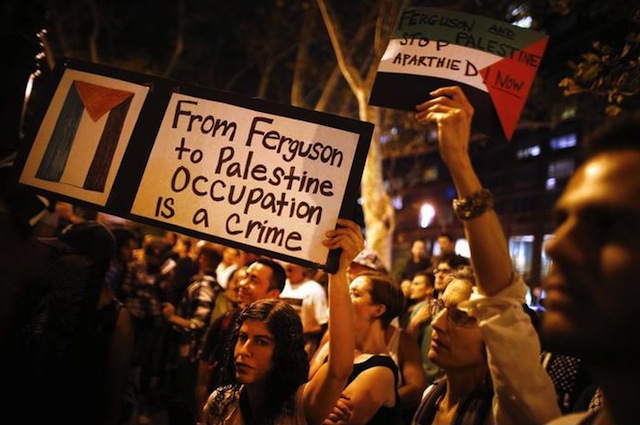 Random acts of violence. Daily stabbings. Bystanders run down on the sidewalks. A religious couple shot dead in front of their four children.
So says James Zogby, president of the Arab-American Institute. But Mr. Zogby offered an additional insight in a recent interview with Andrea Mitchell on MSNBC.
“Palestinian lives matter,” declared Mr. Zogby.
“Look, there’s a bit of Ferguson going on here. Maybe a little bit more than a bit of Ferguson… Unless we find a way for those who control the occupation — it’s not the Palestinians, it’s the Israelis — to give these kids a ray of hope, to say that there is a future for you that’s different than what you’re seeing right now, this isn’t going to end… The violence is the result of a situation of despair that is eating away at the lives and souls of both peoples.
“Palestinians are at the end of the day the ultimate victims.”
Mr. Zogby’s comparison is absolutely right. But he’s right for all the wrong reasons.
 Yonason Goldson