Home » Politics (Page 16)
Category Archives: Politics
Diversity, Einstein, and Identity Politics
Hear my interview with Ross Kaminsky from earlier this month:
The Legacy of Woodrow Wilson
 Once Iowa Democrats decided to rename the venerated event known as the Jefferson-Jackson dinner, it was only a matter of time before PC zealots would start demanding the purge of historical icons all across America. After all, how in good conscience can a country continue to commemorate its most influential leaders if they failed to anticipate that the legal and universally-accepted institutions of their times would eventually be regarded as immoral by their great-grandchildren?
Now it’s Woodrow Wilson’s turn, as students at Princeton demand that the memory of their university’s former president be expunged from under the heavens because he supported segregation, a policy viewed by many as progressive a century ago, no matter what we may think of it now.
There is a deeper irony in their campaign, however. In terms of political acumen, Woodrow Wilson has quite a bit in common with a much more contemporary figure, one who is revered by the very people who are protesting President Wilson’s racism and misogyny: Barack Obama.
The Ostrich Mentality
 More unprovoked murders today in Israel: this time the victims included men in the act of prayer.
The approach taken by the Obama administration and much of European leadership, differentiating between terrorism and Islam so not to further alienate the Muslim world, might sound plausible. But the incontrovertible evidence from Paris, Beirut, and Tel Aviv is that it’s not working. Ayaan Hirsi Ali makes a case no thinking person can refute.
But, of course, that’s the point: people aren’t thinking; they’re feeling. If only the rich and powerful Western nations would humble themselves before the oppressed peoples of the third world, then there would be peace. If only the intransigent Israelis would stop their illegal occupation, then there would be peace. If only the culture of white supremacy in America would confess and atone for its evil ways, then there would be peace.
From the United Nations to the European Union to the White House to many of the elite universities around the country, Utopian ideologues bury their heads in the sand and ignore reality so they can persist in their chants of kumbaya and we are the world, reaching out to embrace people who want nothing but to watch the world burn.
In every aspect of our lives we are becoming more confused: we alienate our friends while we appease enemies who want to kill us; we disdain the blessings we have while chasing shadows in pursuit of happiness; we preach tolerance while attempting to silence all who disagree with us; we dream of a perfect world while we stand idly by and let madmen tear down the world our fathers and grandfathers worked so hard to build.
The chaos of our times didn’t start this week in Paris. It won’t end there, either, unless we open our eyes and start confronting the moral anarchy that is eating away at the heart of civilization.

James Zogby is Right: Israel is Like Ferguson
 Random acts of violence. Daily stabbings. Bystanders run down on the sidewalks. A religious couple shot dead in front of their four children.
So says James Zogby, president of the Arab-American Institute. But Mr. Zogby offered an additional insight in a recent interview with Andrea Mitchell on MSNBC.
“Palestinian lives matter,” declared Mr. Zogby.
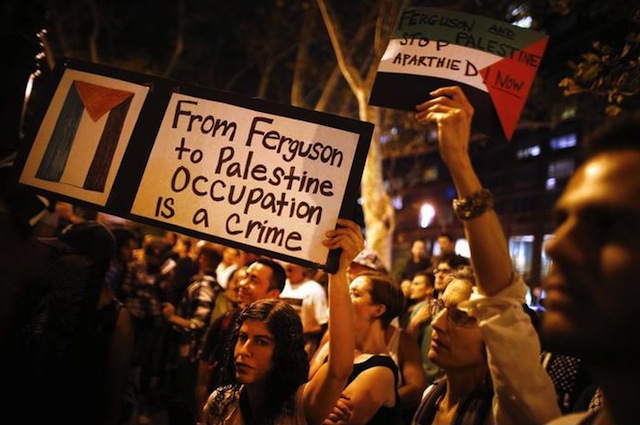
“Look, there’s a bit of Ferguson going on here. Maybe a little bit more than a bit of Ferguson… Unless we find a way for those who control the occupation — it’s not the Palestinians, it’s the Israelis — to give these kids a ray of hope, to say that there is a future for you that’s different than what you’re seeing right now, this isn’t going to end… The violence is the result of a situation of despair that is eating away at the lives and souls of both peoples.
“Palestinians are at the end of the day the ultimate victims.”
Mr. Zogby’s comparison is absolutely right. But he’s right for all the wrong reasons.

Maybe they really can’t handle the truth
 Earlier this week, James Zogby, president of the Arab-American Institute, told Andrea Mitchell on MSNBC that “Palestinian lives matter,” drawing a comparison between the violence in Israel and Ferguson, Missouri.
I was asked to comment on the Crane Durham radio program in a discussion about the historical and political origins of Mideast violence.
You can listen to the interview here.

How to Choose a Candidate
 We complain about our leaders. But are we doing all we can and should do to put responsible leaders in positions of authority, or do we deserve what we’ve been getting?
Here are some insights into political leadership and decision making in my radio interview with James Lowe.
The interview begins at 18:30 here.

Days of Outrage
Palestinian leaders appear to have little control over the actions of the mostly young attackers. – Washington Post, October 13
Anyone who pays attention to history and politics knows that exactly the opposite is true. Arab leaders have carried on a propaganda campaign to foment violent hatred against Israeli Jews since long before the state of Israel even existed.
In 1929, Arab riots culminated in the Hebron Massacre in which 67 Jews were murdered without provocation. In 1941, the Mufti of Jerusalem approached Adolf Hitler offering to help bring the Final Solution to the Mideast. In 1964, Yasser Arafat founded the PLO and began terrorist attacks against Israel — three years before Israel captured the so-called West Bank from Jordan in a war Jordan began.
And, after relinquishing Gaza to Arab control in 2005, Israelis watched from across the new border while Gaza Arabs, incited by the incendiary rhetoric of their leaders, demolished the hydroponic farms left by the Israelis that could have fed communities now increasingly dependent on international aid.
If that weren’t enough, Hamas leaders in Gaza then accused Israel of restraining trade as an excuse to launch rockets into Israel; at the same time, they diverted uncounted millions earmarked for humanitarian relief to build sophisticated tunnels from which to stage terrorist attacks against Israeli civilians.

So this new intifada has little to do with Israeli provocation or “occupation” and everything to do with Arab leaders eager to create young Arab martyrs so they can continue to hold the reins of power and profit from the suffering of their own people.
“If Palestine were to lay down their guns tomorrow, there would be no war. If Israel were to lay down theirs, there would be no Israel.” – Benjamin Netanyahu

Living Beneath Falling Skies
 Two stories from this morning’s headlines:
Man Suing Over Injury From Giant Pine Cone in San Francisco
Missile Brought Down Malaysia Airlines Plane in Ukraine, Investigators Conclude
Our hearts should truly go out to the U.S. Navy veteran who had the misfortune of relaxing in a national park when a 16-pound pine cone fell on his head. The story would be comical were it not so tragic. After serving their country, our servicemen deserve respect and appreciation, not traumatic brain injury from freak accidents.
But that’s just the point. This was an accident, and accidents happen.
I suppose lawyers will wrangle over whether the Park Service was negligent for not posting warning signs and fencing off the area, or for planting a non-native species that might threaten unsuspecting visitors. I suppose one could also make the case that the Park Service should assume a measure of responsibility by covering the victim’s medical expenses.
But what does it say about us when our natural impulse is to litigate every mishap, to turn to the courts, assign blame, and make others pay? Life is full of scrapes and bruises, and sometimes more painful twists of fate. How we deal with the apparent randomness of our world comes down to personal philosophy and theology, but it isn’t always someone else’s fault.
In truth, it reflects a kind of collective arrogance, resulting from the delusion that we are in total control of our lives and our world, and that anything bad that happens to us must have been inflicted in some kind of criminal act. Why fate smiles on some and torments others is a question we can’t expect to answer in this world. But there isn’t always a man behind the curtain whom we can haul into court to demand restitution.
Even worse, when we attribute wicked intent to every whim of fortune, we lose some of our contempt for true acts of evil. The recent finding that it was a Russian-built Buk missile that killed 298 people aboard Malaysia Airlines Flight 17 last year confirms what everyone expected. There is true evil in the world, and we dare not conflate incidental suffering with that perpetrated by authentic villains.
We live in a world full of contradictions. When bad things happen to good people, we owe them our comfort and sympathy. When bad people spread suffering among the innocent, we are duty bound to hunt them down and exact justice.
But we should never confuse the two.

Do we really want a leader?
 The second Republican debate provided three indisputable facts:
- The mainstream press can barely disguise its bias in favor of the democrat party. Virtually every question was designed to promote inter-party bickering rather than elicit either policy positions or evidence of executive experience and aptitude. Whether in the debate itself or beyond, the press devotes disproportional attention to Donald Trump, not because he is the front-runner, nor even because he’s good for ratings, but because he discredit the Republican party in the eyes of most Americans with his ill-mannered and self-serving bluster.
- Far too high a percentage of the electorate lacks any real understanding of the responsibility implicit in the right to vote. Donald Trump has insulted a war hero, insulted women, insulted his fellow candidates, and has skirted giving meaningful responses to specific questions while telling us all to trust how great a job he will do. That he maintains such a commanding lead over so many truly qualified candidates is perhaps the most depressing aspect of the primary race so far. True, represents a reaction against political corruption and political correctness. But incivility is not the opposite of either.
- Carly Fiorina stands head and shoulders above every other candidate. She is well-informed, specific and to the point, poised and articulate, strong yet civil. She’s exactly what the country needs, and she should be leading by a mile.
When the Children of Israel approached Samuel the Prophet to ask for a king, Samuel responded with anger and rebuke. It was not the people’s request that was wrong; it was their reason.
“Give us a king,” the people said, “like all the other nations.”
The surrounding nations submitted to the rule of kings to absolve themselves of the responsibility of making choices and of the consequences of their actions. A Jewish king was supposed to inspire the people to live up to their mission as children of the Almighty. But the people wanted to take the easy way rather than challenge themselves to strive for greatness.
Ultimately, this country will only find its way back to greatness when we, the people, stop looking at the window dressing, stop looking for an entertainer-in-chief, stop looking for who will promise us the most goodies or tell us what we want to hear. We can only restore our country to greatness when we rally behind a true leader who is qualified to understand complex issues, who is willing to make difficult choices that are best for the nation, and who has the character to earn trust and respect from friends and enemies alike, at home and across the world.
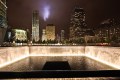
Balancing the Scales of Freedom
Originally published in the St. Louis Post-Dispatch the week after 9/11, between Rosh HaShonah and Yom Kippur.
 It was Judgment Day — exactly one week after the World Trade Center buildings collapsed and so many illusions along with them.
“Judgment Day” is the expression found in the traditional liturgy for Rosh HaShonah, the first day of the Jewish new year. And as I stood in the midst of the congregation intoning the High Holiday prayers, the vision of exploding passenger planes and twin towers crumbling to dust hovered before my eyes.
On Rosh HaShonah we will be inscribed … who will live and who will die … who by water and who by fire … who by storm and who by plague … Who will have peace and who will suffer … who will be cast down and who will be exalted.
The judgment upon Jews became kinder after the United States opened her doors to us a century ago. Where no one else would have us, America took us in, allowing us to live both as Americans and as Jews without persecution.
Yet for all that, American Jews often feel torn by opposing cultural forces, especially approaching our Day of Judgment in a society where there is no greater sin than “judgmentalism.”
Without judgment, however, society cannot endure. As good citizens we must judge others – not based on race or religion but upon actions and behavior. And we must judge ourselves as well, by constantly reexamining our motives and our prejudices and our values and our goals. To condemn even this kind of judgment as a threat to freedom is to retreat from our responsibility to discern right from wrong; it is to embrace the illusion of absolute theoretical freedom – moral anarchy – which is in reality no freedom at all.
September 11 brought us face to face with moral anarchy in the form of incomprehensible evil. Perhaps the first step toward confronting it is to remind ourselves that freedom is not a right – it is a privilege, and privileges carry with them obligations that are often inconvenient and occasionally painful. When Thomas Jefferson wrote that the tree of liberty must sometimes be refreshed with the blood of patriots, he warned that the threat against freedom can only be met by not taking freedom for granted.
Freedom is not democratic, as less than a score of suicidal zealots understood when they commandeered four transcontinental airliners. The duties of freedom are non-negotiable, as New York firefighters and policemen understood when they rushed into crumbling skyscrapers. And the rules of freedom cannot always be legislated: sometimes we have to choose between necessary evils, as the passengers aboard United Airlines flight 93 understood when they drove their plane into a Pennsylvania field.
These are the kinds of judgments we must make, every day and every year, to preserve our society, all the more so in a nation built out of so many cultures and beliefs as ours. Every freedom of the individual cannot be permitted if it threatens the collective, nor can every interest of the collective be observed if it oppresses the individual. But when we share the collective will to make our society stable and secure, then the individual will set aside his personal freedoms for the national good and the nation will bend over backward to protect individual freedom.
This is the mark of a great civilization, and it rests upon an informed and devoted citizenry prepared to debate, sometimes passionately but always civilly, the moral direction of our collective journey.
This Rosh HaShonah I stood shoulder to shoulder with friends and neighbors singing ancient liturgical poems in praise of our Creator, just as so many Americans stood together the week before singing “G-d Bless America.” There were no agendas, no politics, no grudges, no rivalries. All of a sudden we were one nation, indivisible, a people with one noble history and many noble ideals whose differences vanished in the shadow of our many common values and common goals.
As the Jews have had ample opportunity to learn, now America has learned that nothing brings us together like a common enemy. What we have yet to learn is how to continue to stand together even in times of peace.
 Yonason Goldson