Home » Politics (Page 8)
Category Archives: Politics

Hail to the new chief
 Congratulations to Missouri’s new governor, Eric Greitens.
After serving as a Navy Seal, devoting his career to help returning veterans, and defining himself according to the value of character over ideology, Governor Greitens will enter his new role as public servant with today’s inauguration ceremony.
He offers the kind of hope that we all so desperately look for: modesty, civility, and a commitment to service above political agendas. He faces the challenges of anyone who seeks to confront a culture of entrenched partisanship and cronyism.
King Solomon says that the heart of kings is in the hands of God. May the Almighty guide him and all our leaders to recognize what is right, to retain purity of vision and purpose, and to rally support to lead us on the path of peace and prosperity.
Write your Headline before you Run your Story
 “It seemed like a good idea at the time.”
How often have we heard someone say that? How many times have we said it ourselves? And it almost always comes as a response to the same question:
“What were you thinking?”
Our minds have a funny way of convincing us that our ideas will succeed on strength of creativity, sincerity, ingenuity, and necessity. We might have identified the true source of the problem; we might have formulated a real solution; we might be 100% committed to making things better.
But none of that is enough without two critical components:
Implementation and perception.


President Evil
 On 10 December, the St. Louis Post-Dispatch ran an editorial suggesting that Donald Trump was largely responsible for the gunman who attacked a Washington pizza parlor and the deranged woman who made death threats against the mother of a Sandy Hook massacre victim.
I submitted the following letter to the editor in response. Inexplicably, the paper chose not to print it.
Dear Editor,
Your editorial was absolutely correct. Donald Trump’s irresponsible rhetoric definitely has contributed to the corrosion of our culture and our safety. But please explain why you limit your indictment to Mr. Trump alone.
Why don’t you lay equal blame in the lap of Hillary Clinton for her amoral campaign of distortion, deception, and corruption? The former next-president-of-the-United-States racked up 24 pinocchios last year from the Washington Post, and has lied about everything from her emails to her foundation, from her fictitious ducking under Bosnian sniper fire to the origins of her own name.
Why don’t you assign equal guilt to Barack Obama, who denied calling ISIS “the JV team,” who misrepresented Republican filibustering by a factor of ten, and whose misinformation about Obamacare could fill a government website?
And why don’t you admit your own complicity as part of the injudicious media that perpetuated the big lie of “Hands up, don’t shoot,” continues to indulge the wicked moral equivalence that excuses and enables radical terrorism, and — oh, the irony — provided Donald Trump with millions of dollars in free column space and air time, helping catapult him to primary and ultimately national election victory.
By all means, blame Donald Trump for all of society’s ills. But first show the moral fortitude of placing the blame everywhere it belongs, including on your own shoulders.

The real story about fake news
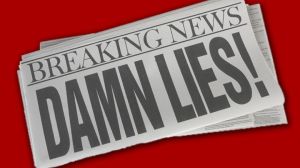 Responding to headlines about “fake news,” silver-screen icon Denzel Washington offered up this classic quote from Mark Twain:
If you don’t read the newspaper, you’re uninformed, if you do read it, you’re misinformed.
He’s right, of course. The irony is that Mark Twain probably didn’t say it.
Which doesn’t make it fake news. To be fair, Mr. Washington himself didn’t cite Twain as author of the quote, which seems to derive from similar remarks by Thomas Fuller and Thomas Jefferson.
When I first saw the Fake News stories populating my newsfeed, I thought they must be referring to those absurd and provocative headlines that infest so many internet news pages. It seemed sad but not surprising that people give credence to this kind of salacious click-bait, but hardly worthy of national discussion.
I soon realized that the subject was more serious and, indeed, more substantive. Nevertheless, there may be a closer connection between the fraudulent and the whimsical than one might imagine.
Let’s start with the serious.
First of all, it’s not news that there is fake news or how harmful it can be.

Scorched-earth redux
 If you’ve never heard of the Daily Banter, good for you. Here’s one of its latest headlines:
Trump Is Officially An Illegitimate President-Elect And The Democrats Have To Destroy Him
In a nutshell — or a nutcase — the hyper-hormonal screed asserts that Democrats need to take Republican scorched-earth policies to the next level to save our democratic republic.
Whatever one may think of Donald Trump, the manner of his election, or his adolescent tweeting, he has blunted the onslaught from many of his critics with the measured judgment of his cabinet picks and administrative appointments.
Aside from that, after eight years of partisan sniping, bullying, and obstructionism — from both sides of the aisle — what the country needs and wants is a spirit of cooperation from its lawmakers, not more posturing, bickering, and gridlock.
But here’s the question that really needs answering:
Why is a scandal sheet like the Daily Banter showing up at the top of my Google News feed?

Peace in our Mind
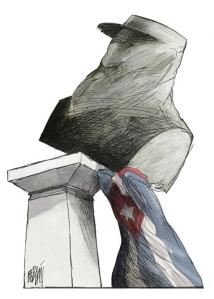 Two decades ago, Thomas Friedman suggested that someone should write a book called The Dictator Diet. Surely there must be some secret to the longevity of strongmen like Muammar Gaddafi, Yasser Arafat, and Fidel Castro. Like horror-movie mutations of the Eveready bunny, they just kept going and going and going.
Well, the last of them is gone at last. Adios, Mr. Castro. We wish we never knew ye.
But imagine if it had been different. What if Fidel had been a friend instead of a nuisance, if Cuba had been an ally instead of a thorn in America’s side?
It’s not such a wild notion.

Liar, liar, house on fire
 In its never-ending quest for editorial balance and integrity, the venerable New York Times gave equal time to Israeli and Palestinian news channels in its reporting of the devastating fires sweeping through Israel.
Israeli news expressed the widely-held opinion that arson is behind the unprecedented rash of urban and forest conflagrations, the latest tactic of Palestinian terrorism.
Palestinian news reported that fires in Israel are started primarily by discarded cigarette butts and children playing with matches, with the remainder caused by electrical malfunction.
An Arab spokesman observed that Israel should take measures to ensure that these causes are addressed to prevent future fires. He failed to explain why fires anywhere near this scale have been unknown for the entire 68 year history of the State of Israel.
Thank you once again, New York Times, for honoring your famous motto:
All the news that fits, we print.

The Pathology of Praise
 You’re so cute. You’re so sweet. You’re such a doll.
You slob. You moron. You’re such a loser.
Anyone who has studied education or taken parenting classes has heard the eight-to-one rule: offer eight positive comments for every negative one. The theory is sound. By responding to good behavior, we accomplish three things:
- reinforce that behavior so it will be repeated more often
- encourage a positive self-image inconsistent with bad behavior
- legitimize occasional criticism so it will be taken to heart
All well and good. Except when it doesn’t work.
In her acclaimed bestseller, Mindset, Dr. Carol Dweck reports that grade school teachers criticize boys eight times more often than girls. If that weren’t enough, school-age boys typically pepper their conversation with insults, put-downs, and name-calling. Consequently, we should expect to find that girls grow up into self-confidant over-achievers and boys grow up into meek underperformers.
In fact, just the opposite is true.
Professor Dweck observes that the constant negativity directed at boys makes them increasingly impervious to criticism, which may boost their confidence but leaves them unreceptive to constructive advice. In contrast, the praise lavished on girls can leave them hypersensitive to criticism, to the point where they are afraid to take risks and tend to indulge in constant self-doubt.
Applied to society at large, this may explain a lot about our collective cultural dysfunction.

Down with Democracy?
 AMERICANS AGAINST HATRED AND BIGOTRY.
DUMP TRUMP.
NOT MY PRESIDENT.
[EXPLETIVE] UR WALL.
WE WON’T GIVE UP. WE WON’T GIVE IN.
UNITED WE’RE STRONGER (you have to love the irony).
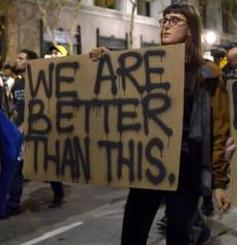
These are just a few of the slogans that bedecked the nation-wide protests against Donald Trump’s electoral victory, i.e., against the American democratic system. Accompanying images included swastikas and pictures of Adolf Hitler.
Of course, protest is a fundamental part of our democracy, guaranteed by the First Amendment (which, incidentally, many Yale students petitioned to repeal). But protest is only productive when it advocates a viable solution to a problem. When protest is nothing more than collective whining, it easily turns into mob violence — indeed, as it did in several instances.
So what do the protesters actually want? To repeal the democratic process? To overthrow a legally elected chief executive? Public lynching?
If they want to advocate dismantling the electoral college, they might find support on both sides of the aisle… but only for the next election cycle. And they could make their point without vandalism, arson, or public obstruction.
On the other extreme, you have college students so traumatized by the election results they have requested exemptions from classwork and midterm exams. Such fragility does not bode well for the future leadership of the country.
It’s a pity we can’t conjure up an alternative reality portal; it would be amusing to get a glimpse of how the anti-Trump contingent would be reacting — had the election gone the other way — to disgruntled Trump supporters protesting the “rigged” election that stole victory from their candidate.
But one does have to acknowledge that sometimes the left is right. One protest sign manages to say it all:
 Yonason Goldson