Home » Politics (Page 9)
Category Archives: Politics

How we move forward
 Too many voters held their noses yesterday as they entered the polling booth to vote for the candidate they considered least toxic. A smaller number could only make peace with their conscience by voting for some unexceptional third-party candidate. Then there were those who couldn’t bring themselves to vote at all.
Will the country survive this winter of our discontent? Only time will tell. But the question that lingers in the aftermath of electoral acrimony is this: are we going to start this all over again in two more years?
Sadly, we just might. Back in January, David Gelertner proposed in the Weekly Standard that the problem with the political left is that liberalism has become their new religion. For most people, religion is not a rational but an emotional commitment that emerges from some amorphous inner voice or feeling. And when people cannot defend their religious beliefs intellectually, they lash out with disproportionate ferocity at anyone who challenges those beliefs. Mr. Gelertner argues that the irrational dogmatism of many liberals bears less resemblance to political discourse and more to the religious fervor of blind faith.
He’s right, of course. But he’s wrong when he contends that this is overwhelmingly a phenomenon of the left.

Of frogs legs and scorpion tails

Indifferent to the specter of unleashed state-sponsored terrorism, France and China announced this week that they have joined forces to help Iran develop its natural gas fields. Apparently, an enriched and empowered radical theocracy is nothing to worry about — assuming the infamous Iran nuclear deal actually ensures any measure of global security.
It’s hard not to recall the parable of the frog and the scorpion:
A scorpion once asked to ride on the back of a frog to reach the other side of a river. At first, the frog refused, fearing for its life. But then the scorpion reasoned that the frog had nothing to worry about since, if it stung the frog, it would drown in the river as well. The frog could not argue with the scorpion’s logic and allowed it to climb aboard.
Midway across the river, the scorpion stung the frog. “Why did you do that?” cried the frog. “Now we will both die.”
“I couldn’t help it,” replied the scorpion. “It’s in my nature to sting, so I had to sting.”
The truth is that it’s easier to sympathize with the frog than with the French. The frog wanted to do a good deed and — albeit mistakenly — saw no cause for mistrusting the scorpion.
In contrast, the French and the Chinese want nothing but a larger slice of the world-economic pie, and they are willing to ignore the inevitable long-term dangers for short-term profit. The mild satisfaction of being able to tell them “we told you so” some years down the line will hardly supply adequate consolation for the precarious state the world will find itself in.
Of course, the allegory is imperfect for a different reason. France and China are scorpions, too. Dangerous, irresponsible, and unwilling to change their natures.
At the very least, however, their self-serving self-deception should make us ask ourselves: Are we frogs or scorpions? What about the candidates we vote into office?
And if we refuse to change our individual and collective natures, how far across the river can we expect to get?

My Interview with Bill Martinez
 Listen in on my conversation about political correctness and the culture wars with nationally syndicated radio host Bill Martinez on 10/19.

Political Correctness: the root of all evil

After last week’s wackiness at James Madison University, it’s time to revisit this post from last April. I fear there will be too many opportunities to do so.
A letter to the future president of the United States:
If you want to fix the country, you can start with the root cause of all that ails our country:
Political Correctness.
The truth is that political correctness is not a new idea at all; it is simply the new label for an old, established moral postulate once accepted by all.
The word civility shares its linguistic root with the word civilization. It means taking into consideration the comfort of others before expressing what I think or doing what I want. It means remembering that other people have rights before I assert my own. It means reflecting upon how my actions are going to affect my community and recognizing that I have a responsibility to a society that is more than the sum of autonomous individuals.
So what was wrong with the term civility that the concept needed rebranding as political correctness? Most likely, it was the connotation of political ideology that spawned this illegitimate offspring of cultural nobility.

A Zoo with a View
 In the 1920s, comedian Robert Benchley commented that there are two categories of people in the world: people who divide people into categories and people who don’t. He went on to remark that, “Both classes are extremely unpleasant to meet socially, leaving practically no one in the world whom one cares very much to know.”
Groucho Marx may have been thinking the same thing when he famously quipped that he wouldn’t want to belong to any club that would have him as a member.
In all seriousness, it may be high time that we took these humorists and their absurdist observations a bit more seriously.
My first serious exposure to absurdism was back in my sophomore year at the University of California, when my English professor introduced our class to playwright Edward Albee. I was immediately fascinated by The Zoo Story, although I wasn’t quite worldly enough to appreciate the subtext of class warfare and social malaise.
Time would solve that problem. But I was still able to recognize the hidden threads of realism sewn together in a garment of tragicomic incongruity.

When Kindness is Cruelty
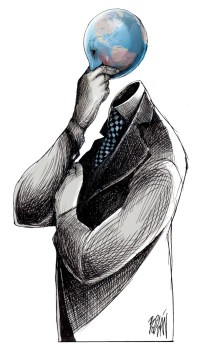 With a fury reminiscent of Hurricane Katrina, Typhoon Lionrock savaged northeast Asia two weeks ago, unleashing floods that left 100,000 North Koreans homeless and more than half a million without water. The devastation was so extraordinary that the North Korean government responded in a way equally unprecedented — by turning to the West for help.
I confess that my initial reaction was smug satisfaction. There’s something providential about a rogue nation responsible for instigating so much strife and apprehension around the world coming hat-in-hand to beg for international aid and succor.
However, after a moment’s reflection my feelings of moral superiority evaporated instantaneously. The victims here are not corrupt government nabobs; rather, they are the self-same people already victimized by the congenital corruption of their rulers. Even if the Orwellian tactics of the Kim dynasty have successfully hypnotized and lobotomized the people of North Korea into abject reverence, those hapless people hardly deserve the added suffering and indignation of a world denying them aid because of the sins of their overlords.
Divine justice will have to wait a bit longer.
To complicate matters further, just last week North Korea conducted yet another nuclear test in violation of its already-violated non-proliferation treaty. And so, with the UN blustering about increased sanctions and South Korea preparing for “the worst-case scenario,” humanitarian organizations are grappling with the logical and logistical problems of aiding the unfortunate citizens of a terrorist nation without helping the nation itself.
Of course, this is hardly a new dilemma.

9/11 — Visionaries and Ideology: A study in contrasts
 Originally published in 2015 by Jewish World Review.
Who knew a trip to New York could be so emotional?
I didn’t want to go in the first place. As my 92-year-old student likes to quote: Travelling is for peasants.
But my wife convinced me with simple arithmetic. Four tickets to bring three kids and son-in-law home or two tickets to visit them. No-brainer.
So I went grudgingly, confirming in the end the truism that some of life’s most profound moments come not only unexpected but against our will.
Our first stop was the 9/11 museum. I marveled at the artistic vision that had conceived the memorial pools, the water channeling down in rivulets that mirrored the face of the fallen towers, the continuous downward rush balanced by the redemptive feeling of water — the source of life — returning to the heart of the world. Here there was solace, closure, and consolation.
But a very different feeling accosted me inside. Almost upon entering the doors a single word brandished itself across my mind’s eye: Holocaust.
Let me explain.
To begin… obviously there is no comparison between the monstrosity of wantonly dehumanizing genocide and any single act of terror; obviously there is no equivalence between the systematic psychological, spiritual, and physical destruction of millions and a few thousand relatively instantaneous murders.
But then again, yes there is.
First, there is the shock value. 3000 murders compressed into 102 minutes is mathematically equivalent to six million in 139 days. Add to that the psychological trauma upon a nation that thought itself secure within its borders, the ensuing economic crisis, the emotional aftermath, the agonizing reappraisal, the moral uncertainties, and the recriminations that followed and remain woven into the social fabric of America to this day. Then add in the ideology of death that rejoices in the destruction of perceived enemies even (or all the more so) through self-destruction. Finally, add in the certainty that it could happen again.
These two abominations have much in common.
 The images in the 9/11 museum are haunting from the first. The twisted support beams, the bits of recovered debris, the walls of smiling faces of victims all conspire to pierce our hearts with the helpless torment of senseless violence. And around every turn, or so it seemed to me, the words “Remember” and “Don’t forget.”
Whether the architects of the memorial intended this biblical resonance I cannot say. But those three words are so much a part of Jewish tradition that for me they sealed the connection between the fate of the twin towers and the fate of European Jewry.
Remember what Amalek did to you on the way as you came out from Egypt; how he came upon you and struck down from behind all who were faint and weary; and he feared not G-d. Therefore it shall be… that you shall blot out the remembrance of Amalek from under heaven; do not forget.
Who is Amalek? He is the first terrorist nation in recorded history, the prototype of ideological nihilism and a culture of moral anarchy, the spiritual progenitor of every philosophy of hate and violence and, according to the traditions handed down by the sages across the generations, the ultimate ancestor of the German nation.
Remember what Amolek did to you, and remember why: to erase all awareness that a culture of moral integrity can flourish on this earth. Don’t forget, lest you leave yourself vulnerable to his never-ending mission to destroy you. There is only one way to deal with terrorist: blot them out from under heaven, or else they will do the same to you. It is a simple matter of self-preservation.
In 3,300 years, little has changed.
My handkerchief was damp before I left the museum. The magnitude of the destruction perpetrated by unadulterated hatred and evil was overwhelming. If we don’t fight against it, we become party to it. If we don’t acknowledge it for what it is, we allow it to consume us. And yet every visitor will leave this hallowed place and promptly lose himself in the vanities and trivialities of everyday life… myself included.
But this was only the first part of my New York epiphany. The second would come a few days later, when my wife led me into Federal Hall.
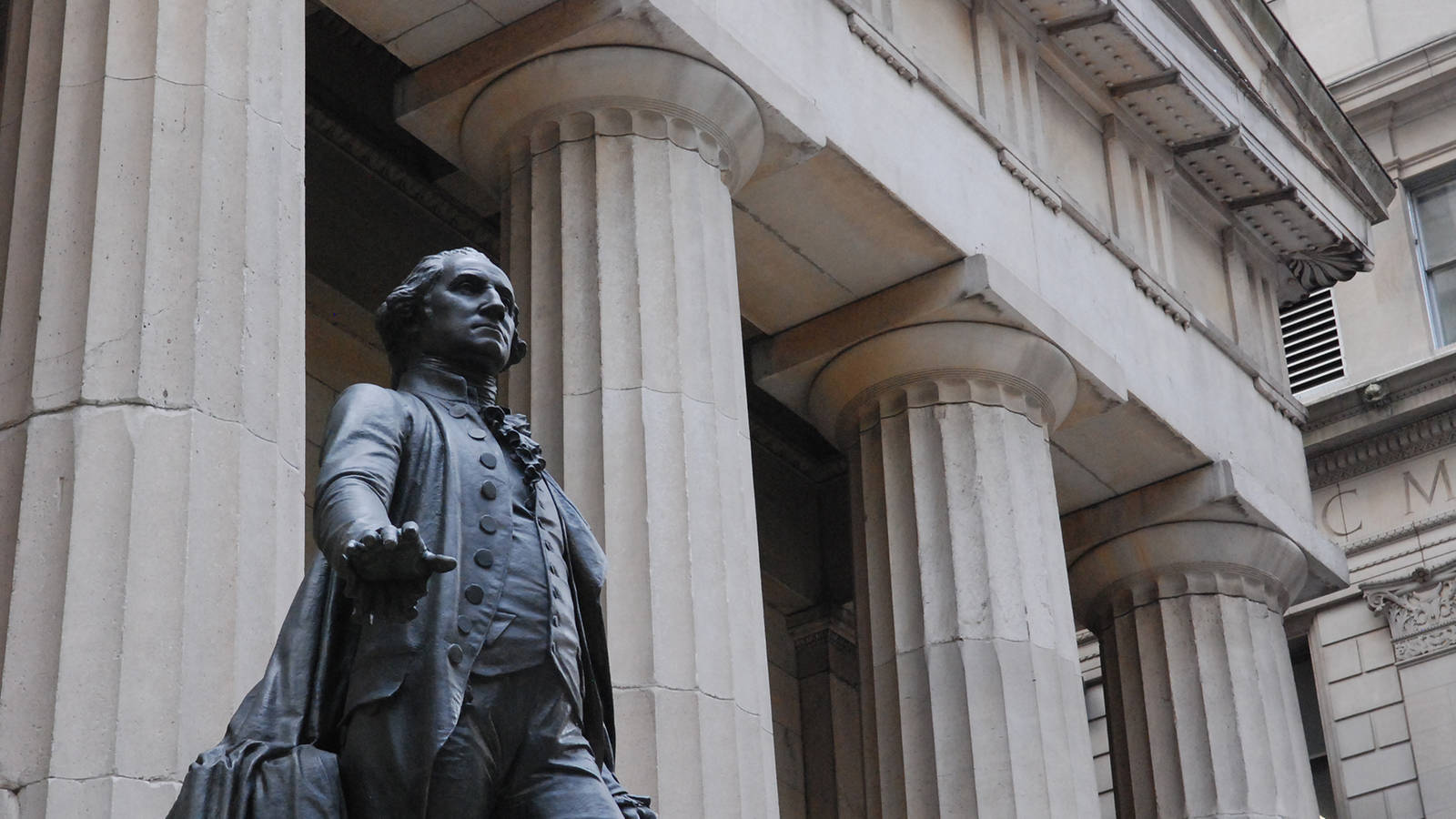 The site of George Washington’s inauguration provided as emotional an experience as the 9/11 museum. Here was a shrine to visionary ideology, not distorted into evil but elevated to the highest imaginable strata of human aspiration. Here, a fledgling nation conceived in the minds of practical dreamers took its incipient steps toward the lofty goals of justice, virtue, and equality before the law in a true meritocracy. Here, the noblest impulses of man forged a society out of shared values that had never been applied, never been attempted, never been imagined beyond the musings of political fantasy.
The obstacles had been myriad and megalithic. The chances of success had been spare. The need for compromise and cooperation had required superhuman resources of selflessness, humility, and a sense of common purpose. The collective will to succeed in their grand vision was the bond that overcame their differences, and the resourcefulness born of desperate times guided them to find solutions to their most intractable problems. And if our democracy today is slipping into a sad shadow of what it was conceived to be… well, it still stands alone in the world as a symbol of the ideals and the responsibilities of freedom.
Vision and ideology — the sources of unimaginable heroism and of monstrous evil. This is what we must remember. This is what we must never forget.
May we find the wisdom to follow the way of heroes.

Karma Always Strikes Twice

Arriving in Hangzhou on Saturday, President Obama received an unexpected welcome. Absent were both rolling staircase and television coverage. Instead, the president was compelled to disembark ignominiously through a high-security door in the belly of the plane.
New York Times reporter Mark Landler mused that in his six years covering the White House he had never witnessed the president shut off from the media.
And that was only the beginning. Both reporters and staffers — including National Security Advisor Susan Rice and her deputy — found their way blocked by bright-blue police tape. When Ms. Rice tried to duck under the tape, Chinese officials swiftly intercepted her. When White House staff members protested the radical departure from protocol, their objections were met by angry shouts from the Chinese.
Some saw in this a reprise of Mr. Obama’s first visit to China in 2009, when the Chinese censored coverage of the president’s town hall meeting and an interview with the non-government press. Maybe the administration’s much-heralded pivot-to-Asia swung too far and came around full-circle.
Or it may be yet another case of karma, which chooses its targets without political bias.

Love Work
 Shemayah says: Love work, despise high position, and do not seek to become intimate with power.
~ Ethics of Fathers 1:10
How far we have come from the wisdom of the sages, who remind us that there is no deeper feeling of satisfaction and fulfillment than that of a purposeful job well-done, no more corrupting influence than the desire for mastery over others, and no more corrosive influence in the erosion of our values than currying favor with those we think can change our fortunes.
When we look at the twisted lives of so many politicians and celebrities, do we need any further reminder that we ought to revel in the blessings of humble productivity and quiet dignity?

Open Season on Everyone
 Let me be clear. I am no fan of Ann Coulter.
The right-wing firebrand disdains all forms of moderation in both tone and worldview, whether she is tweeting expletives about Jews or hailing Donald Trump’s immigration plan as a new Magna Carta. When it comes to discrediting the intellectual and moral integrity of conservatism, nobody does it better.
Even Ms. Coulter’s political mentor, arch-conservative David Horowitz, disavowed her for attempting to resurrect as a martyred crusader Senator Joseph McCarthy, whose self-serving campaign against communists real and imagined represents one of American history’s ugliest eras.
For my part, I’ve never gotten out of my head Ms. Coulter’s inexcusably cruel and utterly gratuitous swipe at Margot Kidder in a 2004 column about the controversy that eventually ended the career of CBS anchor Dan Rather. With neither context nor pretext, Ms. Coulter’s savaging of an admired actress struggling with bipolar disorder was even more contemptible that Donald Trump’s mocking of disabled reporter Serge Kovaleski.
So it may be simple karma that Ms. Coulter received as good as she dishes out at last weekend’s Comedy Central roast of actor Rob Lowe. Her mere presence on the dais apparently marked her as fair game, making her the target of more vicious barbs than the man-of-honor himself.
But karma does not excuse the cast of notables who turned what should have been good-natured (if adolescent) banter into a lynching party.
 Yonason Goldson