Home » Posts tagged 'Conflict Resolution' (Page 8)
Tag Archives: Conflict Resolution

Liar, liar, house on fire
 In its never-ending quest for editorial balance and integrity, the venerable New York Times gave equal time to Israeli and Palestinian news channels in its reporting of the devastating fires sweeping through Israel.
Israeli news expressed the widely-held opinion that arson is behind the unprecedented rash of urban and forest conflagrations, the latest tactic of Palestinian terrorism.
Palestinian news reported that fires in Israel are started primarily by discarded cigarette butts and children playing with matches, with the remainder caused by electrical malfunction.
An Arab spokesman observed that Israel should take measures to ensure that these causes are addressed to prevent future fires. He failed to explain why fires anywhere near this scale have been unknown for the entire 68 year history of the State of Israel.
Thank you once again, New York Times, for honoring your famous motto:
All the news that fits, we print.

When Satan Calls
 Few people set out wanting to do evil. So how does evil happen?
Most evil begins with the desire to do good. But when we don’t recognize where good ends and evil begins, then we’re bound to cross the line between them.
Something about a certain road paved with good intentions.
But the most insidious kind of evil is the kind that continues to masquerade as good long after we’ve crossed the line. This is the favorite device of Satan, one that we usually recognize too late, after we have everything we wanted… and we’re stuck with it.
We’ve embraced the information revolution, which has so efficiently opened the floodgates of knowledge that we’re now drowning in a sea of pseudo-facts and misinformation. We’ve embraced the communication revolution, which has so thoroughly created lines of connection that we are more deeply disconnected than ever from one another and from reality.
Now that correspondence is effortless, we often leave emails unopened and, even more often, unanswered. Now that recorded messages are a click away, we’re too distracted to check our voice mail. We think it’s rude to call without texting first, and we consider it rude to end a text with a period.
We click to the next page only halfway through the current page, and we escape exposure to ideas that make us uncomfortable because mysterious algorithms are filtering the information that reaches us. And when unpleasant news does make it through the gauntlet of ideological censorship, we sink into a morass of emotional angst and cry out against a world that defies our comprehension.
Satan is laughing all the way to the motherboard.
But not everyone is deceived. There’s a growing, grassroots movement to observe a technology Sabbath, to unplug in order to turn on and disconnect in order to reconnect. No phones, no computers, no videos, no texting.
Does that sound horrifying? Impossible? Cruel and unusual?
Convince your friends and family to try it. Pull a dusty book of the shelf and remember what it’s like to feel what you’re reading. Go to the park, play softball, plan a progressive meal with friends and neighbors, enjoy a family game night.
Feel the technology toxins flow out of your body. Once the shock wears off, you’ll wonder why you didn’t start it years ago. And when you start the new week, you’ll be more rested, more relaxed, more focused, and the envy of your coworkers.
And then you’ll wonder how you will make it all the way to your next Sabbath.

Down with Democracy?
 AMERICANS AGAINST HATRED AND BIGOTRY.
DUMP TRUMP.
NOT MY PRESIDENT.
[EXPLETIVE] UR WALL.
WE WON’T GIVE UP. WE WON’T GIVE IN.
UNITED WE’RE STRONGER (you have to love the irony).
These are just a few of the slogans that bedecked the nation-wide protests against Donald Trump’s electoral victory, i.e., against the American democratic system. Accompanying images included swastikas and pictures of Adolf Hitler.
Of course, protest is a fundamental part of our democracy, guaranteed by the First Amendment (which, incidentally, many Yale students petitioned to repeal). But protest is only productive when it advocates a viable solution to a problem. When protest is nothing more than collective whining, it easily turns into mob violence — indeed, as it did in several instances.
So what do the protesters actually want? To repeal the democratic process? To overthrow a legally elected chief executive? Public lynching?
If they want to advocate dismantling the electoral college, they might find support on both sides of the aisle… but only for the next election cycle. And they could make their point without vandalism, arson, or public obstruction.
On the other extreme, you have college students so traumatized by the election results they have requested exemptions from classwork and midterm exams. Such fragility does not bode well for the future leadership of the country.
It’s a pity we can’t conjure up an alternative reality portal; it would be amusing to get a glimpse of how the anti-Trump contingent would be reacting — had the election gone the other way — to disgruntled Trump supporters protesting the “rigged” election that stole victory from their candidate.
But one does have to acknowledge that sometimes the left is right. One protest sign manages to say it all:
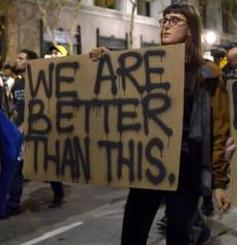

How we move forward
 Too many voters held their noses yesterday as they entered the polling booth to vote for the candidate they considered least toxic. A smaller number could only make peace with their conscience by voting for some unexceptional third-party candidate. Then there were those who couldn’t bring themselves to vote at all.
Will the country survive this winter of our discontent? Only time will tell. But the question that lingers in the aftermath of electoral acrimony is this: are we going to start this all over again in two more years?
Sadly, we just might. Back in January, David Gelertner proposed in the Weekly Standard that the problem with the political left is that liberalism has become their new religion. For most people, religion is not a rational but an emotional commitment that emerges from some amorphous inner voice or feeling. And when people cannot defend their religious beliefs intellectually, they lash out with disproportionate ferocity at anyone who challenges those beliefs. Mr. Gelertner argues that the irrational dogmatism of many liberals bears less resemblance to political discourse and more to the religious fervor of blind faith.
He’s right, of course. But he’s wrong when he contends that this is overwhelmingly a phenomenon of the left.

Why people give up
 Anna Vital’s infographic reminds us of what we easily forget.
Hat tip: Joseph Lizio.

4 Lessons for Successful Leadership
(Expanded from a previous article.)

Tom Hanks’s recent movie “Sully” allows us to re-experience the dramatic events of January, 2009. Looking back, there are three great stories in the averted disaster of US Airways Flight 1549 that can change our outlook on life’s unexpected twists and turns.
First is the story of providence, which placed a pilot with precisely the right training, experience, and temperament at the helm of the crippled jetliner while placing the aircraft within reach of the only feasible landing strip — the Hudson River — for a safe, if chilly, touchdown.
Lesson 1: Even when things go wrong, look for an unexpected solution at hand to make them go right.
Second is the story of heroism. The pilot, Chesley Sullenberger, drew upon his experience with both military fighters and gliders to bring the passenger plane safely down from the sky. The flight crew quickly and efficiently instructed the people to prepare for impact and then hastened them off the sinking plane. The rescuers, both professional and private citizens, steered their craft to the crash site within minutes. Not one life was lost.
Lesson 2: With the right people ready and waiting, almost anything is possible.
But the third story is that of the passengers. For the most part untrained and unprepared, without exception the passengers on Flight 1549 did precisely what they needed to do in order to survive.
They followed instructions.

Rejecting the new Age of Inevitability
 Isn’t it great to live in an age when machines can do anything? Cars drive themselves, jetliners land themselves, and smartphones do just about everything but tuck us into bed.
Recognition software can read our moods and even catch us telling lies. (That’s a good thing, right?) Programs can analyze our handwriting and predict our likes, dislikes, and likely actions by tracking our digital footprints. Soon, Amazon may be filling orders for us that we haven’t even placed yet.
In the workplace, software programs may start deciding who gets hired or promoted based on models constructed from data gathered about the highest performing employees. This may include variables based on medical history, psychological markers, and virtual clues to everything about us including age, gender, political leanings, and sexual preference.
In a recent Ted Talk, Zeynep Tufekci acknowledges that these programs may make decisions more objectively than humans do. But she cautions that machines trained to infer and predict are only as good as their programming, and will of necessity reflect the biases of their programmers — which could mean compounding, not eliminating, bias.
What’s more, the algorithms that produce this kind of “machine learning” don’t allow for human insight and intuition. It’s all statistical analysis, which turns probabilities into absolutes with no assessment by human reasoning and without allowing room for appeal to a higher authority.
The more troubling issue is our willingness to abdicate the responsibility implicit in free choice. In a culture that has long conflated judgment with judgmentalism, it’s hardly surprising to find how eager people are to reduce every decision to a binary option and thereby eliminate all shades of gray from the mix. And if that’s not enough, we can simply block any information that doesn’t conform to our way of thinking.

Political Correctness: the root of all evil

After last week’s wackiness at James Madison University, it’s time to revisit this post from last April. I fear there will be too many opportunities to do so.
A letter to the future president of the United States:
If you want to fix the country, you can start with the root cause of all that ails our country:
Political Correctness.
The truth is that political correctness is not a new idea at all; it is simply the new label for an old, established moral postulate once accepted by all.
The word civility shares its linguistic root with the word civilization. It means taking into consideration the comfort of others before expressing what I think or doing what I want. It means remembering that other people have rights before I assert my own. It means reflecting upon how my actions are going to affect my community and recognizing that I have a responsibility to a society that is more than the sum of autonomous individuals.
So what was wrong with the term civility that the concept needed rebranding as political correctness? Most likely, it was the connotation of political ideology that spawned this illegitimate offspring of cultural nobility.

When the plane falls from the sky
With Tom Hanks’s new movie “Sully” allowing us to re-experience the dramatic events of January, 2009, I’m taking the opportunity to revisit my thoughts from the aftermath of the heroic rescue, originally published on Aish.com.

There are three great stories in the averted disaster of US Airways Flight 1549.
First is the story of Divine Providence, which placed a pilot with precisely the right training, experience, and temperament at the helm of the crippled jetliner and the only feasible landing strip — the Hudson River — close enough at hand for a safe, if chilly, touchdown.
Second is the story of heroism. The pilot, Chesley Sullenberger, drew upon his experience with both military fighters and gliders to bring the passenger plane safely down from the sky. The flight crew quickly and efficiently instructed the people to prepare for impact and then hastened them off the sinking plane. The rescuers, both professional and private citizens, steered their craft to the crash site within minutes. Not one life was lost.
But the third story is that of the passengers. For the most part untrained and unprepared, without exception the passengers on Flight 1549 did precisely what they needed to do in order to survive.
They followed instructions.
In moments of crisis, bold leaders act decisively, heroes rise to the occasion and show their true colors, and acts of selflessness inspire those of us thousands of miles away who find our faith — in both Divine mercy and in our fellow man — renewed.
But heroes cannot succeed in a vacuum. Had the passengers on the stricken plane responded with panic, had they stormed the cockpit in a frenzied attempt to seize the controls, had they ignored the directions of the captain and the flight attendants, had they fought one another to reach the emergency exits first, then this story would have a much less happy ending.
The sages of the Talmud teach: “In a place where there are no leaders, strive to become a leader.” On the surface, this means precisely what it appears to mean. It is leaders who impose the unity and direction that constitutes the difference between a community and a mob, between order and chaos, between a chance for survival and self-destructive pandemonium. Where there is no one to take charge, every individual must see himself as a potential leader and do all he can to shoulder the responsibilities of leadership.
 At the same time, the sages tell us that this principle applies only in a place where there are no leaders. Wherever there is someone qualified and willing to lead, then it becomes the responsibility of others to follow, to become good soldiers and carry out orders. It was the passengers of Flight 1549 who enabled the heroes of the story to perform heroically.
Perhaps the exultation we feel over the survival of Flight 1549 stems from a deeper, often subconscious conviction in the unity of mankind. We can transform ourselves from a divided rabble into a society of leaders and followers, of captains and foot soldiers. We can achieve great things when we come together in a common cause for the common welfare.
Nothing catalyzes us like crisis. When the ship is sinking, when the plane is going down, when the enemy is at the gates, we find ourselves motivated to set aside our egos and our petty differences and stand together for the sake of our own survival.
Perhaps this is the most relevant lesson of Flight 1549. At a moment in history when the world has become less predictable than ever, when unstable nations like Iran and North Korea are on the brink of acquiring nuclear weapons, when terrorists strike against our most beloved kinsmen without reason or pretext, when enemies at our borders would rather suffer self-destruction than make peace, when the world economy teeters on the brink of collapse and our leaders spin like weather vanes grasping for solutions — what better time to reflect upon our potential to come together in the most hopeless moments, as when a hundred thousand tons of steel is falling out of sky, as when all human society seems ready to fall back into the dark ages, and change the outcome, against all odds, from tragedy to triumph.
With common purpose, we can accomplish virtually anything, as the Framers did when they envisioned a great nation with the motto e pluribus unum — out of many, one — hearkening back to a day over 3000 years earlier, when a people newly freed from bondage stood in the wilderness at the foot of a mountain and accepted their divine mission, as one man, with one heart.

Acquire a Friend
 Yehoshua ben Perachya says: Make for yourself a mentor; acquire for yourself a friend; and grant every person the benefit of the doubt.
~Ethics of Fathers 1:6
A successful life is depends upon the guidance of responsible teachers, the company of sound friends, and a willingness to fully understand who people are before judging them.
Submitting to authority keeps us respectful, humble, and confident in the path we follow. The company of worthy companions prevents us from straying after our own egos and illusions. Deliberation in forming our opinions of others saves us from the evils of stereotyping and groupthink.
But not every authority is responsible, not every would-be friend is deserving of friendship, and some people are truly wicked. Wisdom comes with experience, and experience can be painful.
If we are sincere and disciplined in our efforts, then our missteps will always be instructive rather than catastrophic, and we will ultimately find our way.
 Yonason Goldson