Home » Posts tagged 'Culture Wars' (Page 10)
Tag Archives: Culture Wars

How to End a Conversation
 A classic riddle asks: Using three periods (.), two commas (,), and one question mark (?), punctuate the following line to produce a logical and grammatically correct sentence:
That that is is that that is not is not is that it it is
If you know the answer, don’t text it to your friends. You might hurt their feelings.
However, just between us, here’s the solution:
That that is, is. That that is not, is not. Is that it? It is.
The beauty of a brainteaser like this one is not just that it gets us to think. More important, it gets us to think about thinking, to appreciate how communication is critical to critical thinking, and to think about how the same string of words can be fashioned into a cogent message or left as a meaningless hodgepodge of phonetic symbols.
But don’t say so out loud. You might offend someone.
That’s what Professor Celia Klin and researchers at Binghamton University found when they asked undergraduates to interpret text messages responding to an invitation. Their study revealed that students perceived responses properly punctuated with a period at the end as less sincere and, in some cases, psychologically combative.
In other words, it’s antisocial to be articulate, crass to follow convention, and reprobate to observe the rules.
Click here to read the whole essay.

My Interview with Bill Martinez
 Listen in on my conversation about political correctness and the culture wars with nationally syndicated radio host Bill Martinez on 10/19.
The War to End all Wars
This Sunday evening, Jews around the world will begin their observance of the week-long festival of Sukkos. There’s much to learn from this celebration that concludes the annual cycle of Jewish holidays. So I’m returning to these thoughts from September, 2001, which remain more relevant than ever.
 Once upon a time there were three little pigs. One built a house of straw, until the big, bad wolf blew it down and gobbled him up. One built a house of sticks, until the big, bad wolf blew it down and gobbled him up. But one built a house of bricks and was safe from all the huffing and puffing of the big, bad wolf.
Society teaches values to successive generations through its children’s stories. The story of the Three Little Pigs is one of our most enduring fables, teaching the importance of good planning and disciplined effort. But it also carries with it a more subtle message, that safety rests in our own hands and our own labors, that security can be bought for the price of a pile of bricks and a bucket of mortar. This ideal, if it was ever true, went up in flames together with New York City ‘s skyline and Washington’s military nerve center on September 11.
More appropriate now than the Three Little Pigs is Robert Burns’s adage about “the best laid schemes of mice and men.” Indeed, the World Trade Center towers were each designed to absorb the impact of a Boeing 727; what the architects failed to factor in was how the fuel carried aboard a transcontinental airliner would create an inferno capable of compromising the structural strength of steel support beams. Of course, we don’t blame the architects; none of us imagined the acts of incomprehensible evil that brought down those towers.
Which is precisely the point. We cannot imagine the design and the reach of evil. We can make our best effort, erect walls of brick around ourselves and roofs of steel over our heads, but we will never be completely safe. The world is too unpredictable an arena, the mind of the wicked too dark a cavern.
As if to drive home the instability of temporal existence, observant Jews around the world will disrupt their normal lives this week by moving out of their homes into little stick houses to live as our ancestors lived in the desert after their exodus from Egypt. But more than an attempt to recreate the experience of a fledgling nation traveling toward its homeland, the holiday of Sukkos offers us an opportunity to attune our minds to a most fundamental principle of Judaism — that however great our strength and the might of our own hands, however elaborate and well conceived our plans, life strews unexpected obstacles in our path that can scuttle our most certain victories and demolish our most solid edifices.
 A sukkah may be built of virtually any material: wood, brick, steel, canvas, or even string may be used to construct its walls. But no matter how stable or how precarious its walls, the roof of a sukkah must be composed of s’chach, thin strips of wood or leaves, through which the light of the stars can shine at night. And when one sits in the sukkah and looks up at the s’chach — the barest representation of a roof, which will not protect him from even the lightest rainfall — he is inspired by the recollection of his ancestors who trusted in the protection of the Almighty, the One who took them out from under the rod of their oppressors and guided them through the inimical desert before bringing them safely home.
In his visionary writings, the prophet Ezekiel describes a great battle on the eve of the messianic era, when the all forces of evil in the world combine themselves into a great army called by the name Gog and Magog. The brilliant eighteenth century thinker Rabbi Samson Rafael Hirsch interprets the prophet’s vision not as a military battle but as an ideological war between the philosophy of gog — “roof”– and the philosophy of sukkah, where those convinced that their fate lies in the power of their own hands and their own resources will attack the values of those who recognize the limits of human endeavor to influence the world.
In the immediate wake of the World Trade Center destruction, cries rang out for vengeance and military retribution. Since then, more measured voices have asserted that this war will be like no other, without defined enemies or defined borders, without clear strategies or decisive victories. This is an unfamiliar kind of crisis, where we find our capacity to respond in our own defense or to secure our own future profoundly diminished in a new world order.
So now the citizens and leaders of the world’s last remaining superpower must grapple with the uncertainties of a violent present and a murky future. Some will respond by declaring that we must work harder to take control of our own fate. Others will concede that we will never be secure again. And they will be right: no building, no bunker, no shelter made of brick or concrete or iron will guarantee our safety from the perverse imagination of extremists who can rationalize indiscriminate mass murder.
 Yet for all that, the Jew sitting in his sukkah will look up at the heavens and be at peace. He will recognize that the best laid schemes often come to naught and that, after doing all that can be done, we are best off leaving our fate in the hands of the One who placed the stars in their courses, the One from whom protection ultimately comes for those who trust not in their own strength, but in the source of all strength.
As the winds of autumn blow with the first hint of winter, we may shiver with cold but never with fear. The illusion of the roof we can see reminds of the invisible reality of the wings of the Divine presence. We neither abandon ourselves to fate nor try to seize hold of it, but turn with confidence to face the future, secure in the knowledge that we have prepared ourselves as best we can to meet whatever life holds in store for us.

Political Correctness: the root of all evil

After last week’s wackiness at James Madison University, it’s time to revisit this post from last April. I fear there will be too many opportunities to do so.
A letter to the future president of the United States:
If you want to fix the country, you can start with the root cause of all that ails our country:
Political Correctness.
The truth is that political correctness is not a new idea at all; it is simply the new label for an old, established moral postulate once accepted by all.
The word civility shares its linguistic root with the word civilization. It means taking into consideration the comfort of others before expressing what I think or doing what I want. It means remembering that other people have rights before I assert my own. It means reflecting upon how my actions are going to affect my community and recognizing that I have a responsibility to a society that is more than the sum of autonomous individuals.
So what was wrong with the term civility that the concept needed rebranding as political correctness? Most likely, it was the connotation of political ideology that spawned this illegitimate offspring of cultural nobility.

An Ode to Almustafa
 If memory serves — after all, it has been 32 years — I was somewhere between New Orleans, Louisiana, and Waycross, Georgia. It was late winter, but the southern air was mild and the sun brightened the sky.
Hitchhiker’s weather, to be sure.
I was waiting at a rest stop with my thumb stuck out when a pickup towing a large camper lumbered to a halt in front of me. I climbed in and uttered my heartfelt thanks.
The driver, wearing a red flannel coat in hunter’s plaid, surprised me by identifying himself as a pastor on vacation. He asked the usual questions — where was I headed, where was I from, why was I traveling this way — then launched into his story.
There are two ways hitchhikers pay for their rides. One is by talking, by entertaining a driver lonely from the road and weary of recorded music or talk radio. The other is by listening, by letting drivers unburden themselves without the cost of therapy, secure in the knowledge that their disclosures will vanish into the air the moment the passenger exits the vehicle … comfort of strangers and all that.
Clergy have gotten a bad rap in recent years — much of it their own doing. Corruption is bad enough from politicians and business executives, but we have every right to expect more from our religious leaders. The entire edifice of theology suffers from every single act of spiritual infidelity.
But there are still many sincere men of the cloth, and my benefactor appeared faithful to the integrity of his office. He saw his mission not only to minister but to shepherd his flock toward pastures sown thick with the morality and ethics of scripture, to challenge them to challenge themselves and prod them to pay closer attention to the calling of their conscience.
And sadly, like spiritual leaders from Moses until today, he had found ample cause for disappointment.

Rosh Hashanah and the Mysteries of the Universe
 Originally published by Jewish World Review in 2003.
96% of the matter in the universe is invisible. Mysterious “dark energy” is pushing all of space apart. Empty space is not really empty, but filled with subatomic “foam.” At least seven parallel universes exist, each a trillionth the size of a proton.
Science fiction? Fantasy? The product of opium hallucinations?
Guess again. According to an article in U.S. News and World Report, these hypothesized phenomena represent the mainstream of current scientific thought.
In the wake of observations reported last March by NASA’s Wilkinson Microwave Anisotropy Probe, astronomers and physicists are resorting to these and other fantastic models to explain anomalous temperature variations in the background radiation permeating the heavens.
And who knows? They may be right. After all, once upon a time a round earth, a heliocentric solar system, and manned flight were all scorned as flights of the wildest fancy. Perhaps entire universes really do exist, wrapped up in a particle of dust beneath your finger nail.
On the other hand, increasingly complex and convoluted theories begin to look like the frantic flailings of scientists drowning in the mysteries of human existence. Indeed, one noted physicist confessed that, if he’d been presented with these theories not long ago, “I’d either ask what you’ve been smoking or tell you to stop telling fairy tales.”
Of course, one almost has to feel sorry for these scientists. Every discovery, every revelation, every insight, opens up a new Pandora’s Box of inexplicable phenomena. A few short decades ago, we knew of about half a dozen known sub-atomic particles. Today there are hundreds, with the number growing all the time, and often only the haziest guesses as to why they exist. Relativity theory and quantum theory both seem to describe the workings of the universe, but only the most strained and unproven theory suggests how to unite these two approaches.
 It’s almost enough to make one contemplate — dare we say it? — Divine Creation. Indeed, man’s desire to plumb the secrets of the universe is nothing new. Newton, Descartes, Galileo, Aristotle, all of these and many others grappled with physics and metaphysics in their labors to comprehend the vast expanse of time and space that stretches toward the boundaries of existence.
But long before the first scientist or philosopher raised his eyes to gaze into outer space and contemplate the stars, another man searched inner space seeking understanding. His name was Job.
A righteous man who lost his fortune, his family, and his health, Job questioned whether there was any rhyme or reason to explain the suffering of the righteous and the prosperity of the wicked. And as he sank into the mire of self-pity and nihilism, a Voice from above answered him:
“Where were you when I laid the foundations of the earth?” asked the Almighty. “What is the path where light dwells? And darkness, where is its place, that you may take it to its boundary, that you may understand the paths of its home?”
The Creator never explains Job’s suffering, but He does provide Job with the answer that restores his faith: The complexity of creation is not only more that you know, but more than you can begin to imagine. Every star above you in the sky, every drop of water in the sea, and every grain of sand upon the shore resides in its place and follows the course chosen for it; so too is every seeming whim of fate rather an unfathomable pulse from the primordial machine that steers the unfolding of eternity.
And so we say in the Rosh HaShanah liturgy, “This day is the anniversary of the beginning of Your handiwork, a remembrance of the First Day.” As we stand in the murky spiritual twilight between the end of one year and the start of another, we contemplate that amidst the mystery and uncertainty that surrounds us, one constant offers us security and safety if we take hold of it: the indivisible relationship between the Creator of all and His ultimate creation — Mankind, for whom He brought all else into being.
This day. This day of Rosh HaShanah begins a new year, a new season, a new opportunity to draw near to the Master of Creation. This day offers us a poignant reminder of how to cling to the godliness the resides within us, to strive to become more devoted in our relationships and less demanding in our expectations, more focused on others and less fixated on ourselves, less passionate about material gain and more ardent in our pursuit of spiritual fulfillment.
 This day reminds us that we hold in our hands an awesome privilege, as well as an awesome responsibility. How willingly are we seduced into looking for simplistic solutions to the moral and ethical dilemmas that life throws at us day after day? How longingly do we embrace superficial cliches and bromides that urge us to pull the warm covers of apathy over our heads?
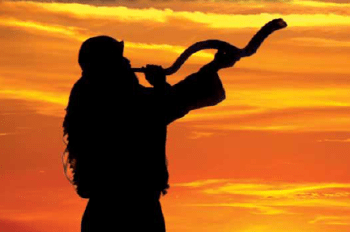
This day. Rosh HaShanah is our wake up call, and the sound of the shofar signals our reveille to open our eyes and behold the breathtaking magnificence that is Creation. And if our minds reel as we try to grasp the limitless expanse of the universe, we can yet grasp onto this certainty: that the One who placed us in its midst has revealed Himself through His Word and has given each of us a priceless gift, no less than the sand and the sea and the stars — an indispensable role to play in the completion of His masterpiece and the means through which we can become one with the infinite and with the divine.

A Zoo with a View
 In the 1920s, comedian Robert Benchley commented that there are two categories of people in the world: people who divide people into categories and people who don’t. He went on to remark that, “Both classes are extremely unpleasant to meet socially, leaving practically no one in the world whom one cares very much to know.”
Groucho Marx may have been thinking the same thing when he famously quipped that he wouldn’t want to belong to any club that would have him as a member.
In all seriousness, it may be high time that we took these humorists and their absurdist observations a bit more seriously.
My first serious exposure to absurdism was back in my sophomore year at the University of California, when my English professor introduced our class to playwright Edward Albee. I was immediately fascinated by The Zoo Story, although I wasn’t quite worldly enough to appreciate the subtext of class warfare and social malaise.
Time would solve that problem. But I was still able to recognize the hidden threads of realism sewn together in a garment of tragicomic incongruity.

Block Yeshiva closing marks end of an era
 Ask any teacher. Ask any informed parent. Educational standards are in free-fall across America — perhaps around the world. And in St. Louis, Missouri, an extraordinary institution has closed its doors.
Block Yeshiva High School did not come into existence as something new or revolutionary. Its roots reach all the way to the ancient traditions articulated by the sages of the Second Temple period, and its style expressed the more recent articulations of one of the most influential thinkers of the last two centuries.
In 1851, Rabbi Samson Raphael Hirsch relinquished both his pulpit and his seat in the Moravian parliament to accept the position as leader of the Torah community in Frankfurt-am-Main. In response to the rapid assimilation of Western European Jews, Rabbi Hirsch developed a movement that embraced both secular knowledge and passionate commitment to Torah study and observance.
The approach that became known as Neo-Orthodoxy was built upon a rigorous 12-year primary and secondary education system providing Jewish children with the fundamental skills and philosophic outlook to remain strong in their traditions while simultaneously preparing them to flourish in the professional world of gentile society. By doing so, Rabbi Hirsch created a bulwark against the sweeping tide of secularization while establishing a model to produce fluent and committed Torah Jews for generations.
For 38 years, St. Louis has boasted a school that has earned an extraordinary reputation among both American universities and Israeli yeshivos and seminaries. Following the trail blazed by Rabbi Hirsch a century and a half ago, Block Yeshiva High School graduates have distinguished themselves in medicine, law, and business, as well as in the world of Torah scholarship. Perhaps more significantly, as a group, Block Yeshiva graduates have retained an extraordinary commitment to Jewish tradition and values, to the Jewish people and the Land of Israel, and to the refinement of moral and spiritual character that is our true legacy as a nation.
Here are a few examples of what Block Yeshiva has produced:
Click here to read the whole article. Please comment and share.

Pledging Allegiance
 After a certain Miami Dophins wide receiver garnered his 15 minutes of fame (by aping a certain San Francisco 49ers quarterback), he explained that — even though he loves his country and meant no disrespect — nevertheless “it’s time for us to come together in solidarity.”
Even if we assume that his stunt was not merely a crass grab for attention, he succeeded in accomplishing exactly the opposite of what he claims he wanted. His refusal to stand for the National Anthem is profoundly offensive and only serves to drive a deeper wedge into a an already fractured society.
The American flag is a symbol of freedom, of human dignity, of personal responsibility, and of collective purpose. It makes no more sense to show contempt for what the flag represents than it does to protest arson by burning down a firehouse.
The insult reminded me of an incident with my own father that I recorded in this essay, originally published by the St. Louis Post-Dispatch on Father’s Day, 2001.
I was ten or twelve years old. My father and I had arrived at the stadium early, and I felt a thrill of excitement as we stood up for the Star Spangled Banner. Down on the field, our home team, the Los Angeles Rams, stood in a line holding their helmets under their arms. And in the row in front of us, a middle aged man stood with his hat perched casually upon his head.
The man didn’t respond. “Hey you,” my father said, louder, “take off your hat.”
The man grunted an unintelligible, though clearly dismissive remark.
“You unpatriotic SOB,” growled my father; he didn’t abbreviate, either.
“Dad!” I whispered, mortified and afraid, but also faintly confused. My father had never before demonstrated any dramatic displays of patriotism.
The national anthem ended, the game began, and I guess I forgot about the incident because I never discussed it with my father, never asked him to explain an indignation that seemed entirely out of character.
But now I’m a father myself, and I don’t find my father’s action thirty years ago perplexing at all.
Why should we take off our hats for the national anthem? Why should we stand up for the flag? Why should we address strangers as “Sir” or “Madam,” wear coats and ties to church or synagogue, and give up our seats to the elderly?
It’s a matter of respect. Respect for people. Respect for institutions. Respect for wisdom and values and human dignity.
 Unfortunately, respect has been going out of fashion for a long time. Sex scandals and no-fault divorce have eroded respect for marriage and commitment. Partisan politics has eroded respect for leadership. Inflated grades and deflated standards have eroded respect for teaching. Abortion-on-demand and doctor-assisted suicide have eroded respect for life. “Reality television” has eroded respect for ourselves.
Which was our first step onto this slippery slope? Maybe it was the noble ideal of social equality, set spinning so wildly out of control that we began to equate respect with elitism. Maybe the information glut convinced us that we know as much about medicine as our doctors, as much about cars as our mechanics, and as much about education as our children’s teachers. Maybe our relentless pursuit of leisure time has made us too selfish to value age and experience, too lazy to act civilly toward our neighbors.
When respect is not earned, it disintegrates; when respect is exploited, it implodes. Indeed, after his desperate quest for legacy, Bill Clinton was best remembered at the time of his departure as the American president who made his underwear preferences a matter of public policy, who pilfered the White House china, and for whom a large percentage of once-self-respecting Americans so casually excused perjury in federal court. Barack Obama will leave behind the first video of an American president making faces in the mirror in preparation for an historic selfie.
But we should never rely on respect to percolate down from the top; it is our responsibility to grow it up from the grass roots. It is the job of parents to teach their children to say “please” and “thank you,” to not interrupt and not talk with their mouths full, to speak civilly and give up their seats to the elderly, to pick up their own litter and maybe even someone else’s. By doing so, parents instill in their children an intuitive sense of respect for others, even if their children may not understand why all these social minutiae are indispensable.
But too many parents have abdicated that job, either because they’re not around enough or because they never learned to be respectful themselves.
The Talmud says that where there are no leaders, strive to be a leader yourself. In today’s increasingly fatherless society, teachers, scout leaders, and little league coaches have a greater obligation than ever to teach respect by showing respect for others — and so do we all every time we walk down the street or through the supermarket aisle.
A journey of a thousand miles begins with a single step. And a journey through life begins with a step in the right direction. Help a child take that step and, many steps later, his success will speak his thanks louder than words.
Every Father’s Day offers a reminder to say every day: Thanks, Dad.

9/11 — Visionaries and Ideology: A study in contrasts
 Originally published in 2015 by Jewish World Review.
Who knew a trip to New York could be so emotional?
I didn’t want to go in the first place. As my 92-year-old student likes to quote: Travelling is for peasants.
But my wife convinced me with simple arithmetic. Four tickets to bring three kids and son-in-law home or two tickets to visit them. No-brainer.
So I went grudgingly, confirming in the end the truism that some of life’s most profound moments come not only unexpected but against our will.
Our first stop was the 9/11 museum. I marveled at the artistic vision that had conceived the memorial pools, the water channeling down in rivulets that mirrored the face of the fallen towers, the continuous downward rush balanced by the redemptive feeling of water — the source of life — returning to the heart of the world. Here there was solace, closure, and consolation.
But a very different feeling accosted me inside. Almost upon entering the doors a single word brandished itself across my mind’s eye: Holocaust.
Let me explain.
To begin… obviously there is no comparison between the monstrosity of wantonly dehumanizing genocide and any single act of terror; obviously there is no equivalence between the systematic psychological, spiritual, and physical destruction of millions and a few thousand relatively instantaneous murders.
But then again, yes there is.
First, there is the shock value. 3000 murders compressed into 102 minutes is mathematically equivalent to six million in 139 days. Add to that the psychological trauma upon a nation that thought itself secure within its borders, the ensuing economic crisis, the emotional aftermath, the agonizing reappraisal, the moral uncertainties, and the recriminations that followed and remain woven into the social fabric of America to this day. Then add in the ideology of death that rejoices in the destruction of perceived enemies even (or all the more so) through self-destruction. Finally, add in the certainty that it could happen again.
These two abominations have much in common.
 The images in the 9/11 museum are haunting from the first. The twisted support beams, the bits of recovered debris, the walls of smiling faces of victims all conspire to pierce our hearts with the helpless torment of senseless violence. And around every turn, or so it seemed to me, the words “Remember” and “Don’t forget.”
Whether the architects of the memorial intended this biblical resonance I cannot say. But those three words are so much a part of Jewish tradition that for me they sealed the connection between the fate of the twin towers and the fate of European Jewry.
Remember what Amalek did to you on the way as you came out from Egypt; how he came upon you and struck down from behind all who were faint and weary; and he feared not G-d. Therefore it shall be… that you shall blot out the remembrance of Amalek from under heaven; do not forget.
Who is Amalek? He is the first terrorist nation in recorded history, the prototype of ideological nihilism and a culture of moral anarchy, the spiritual progenitor of every philosophy of hate and violence and, according to the traditions handed down by the sages across the generations, the ultimate ancestor of the German nation.
Remember what Amolek did to you, and remember why: to erase all awareness that a culture of moral integrity can flourish on this earth. Don’t forget, lest you leave yourself vulnerable to his never-ending mission to destroy you. There is only one way to deal with terrorist: blot them out from under heaven, or else they will do the same to you. It is a simple matter of self-preservation.
In 3,300 years, little has changed.
My handkerchief was damp before I left the museum. The magnitude of the destruction perpetrated by unadulterated hatred and evil was overwhelming. If we don’t fight against it, we become party to it. If we don’t acknowledge it for what it is, we allow it to consume us. And yet every visitor will leave this hallowed place and promptly lose himself in the vanities and trivialities of everyday life… myself included.
But this was only the first part of my New York epiphany. The second would come a few days later, when my wife led me into Federal Hall.
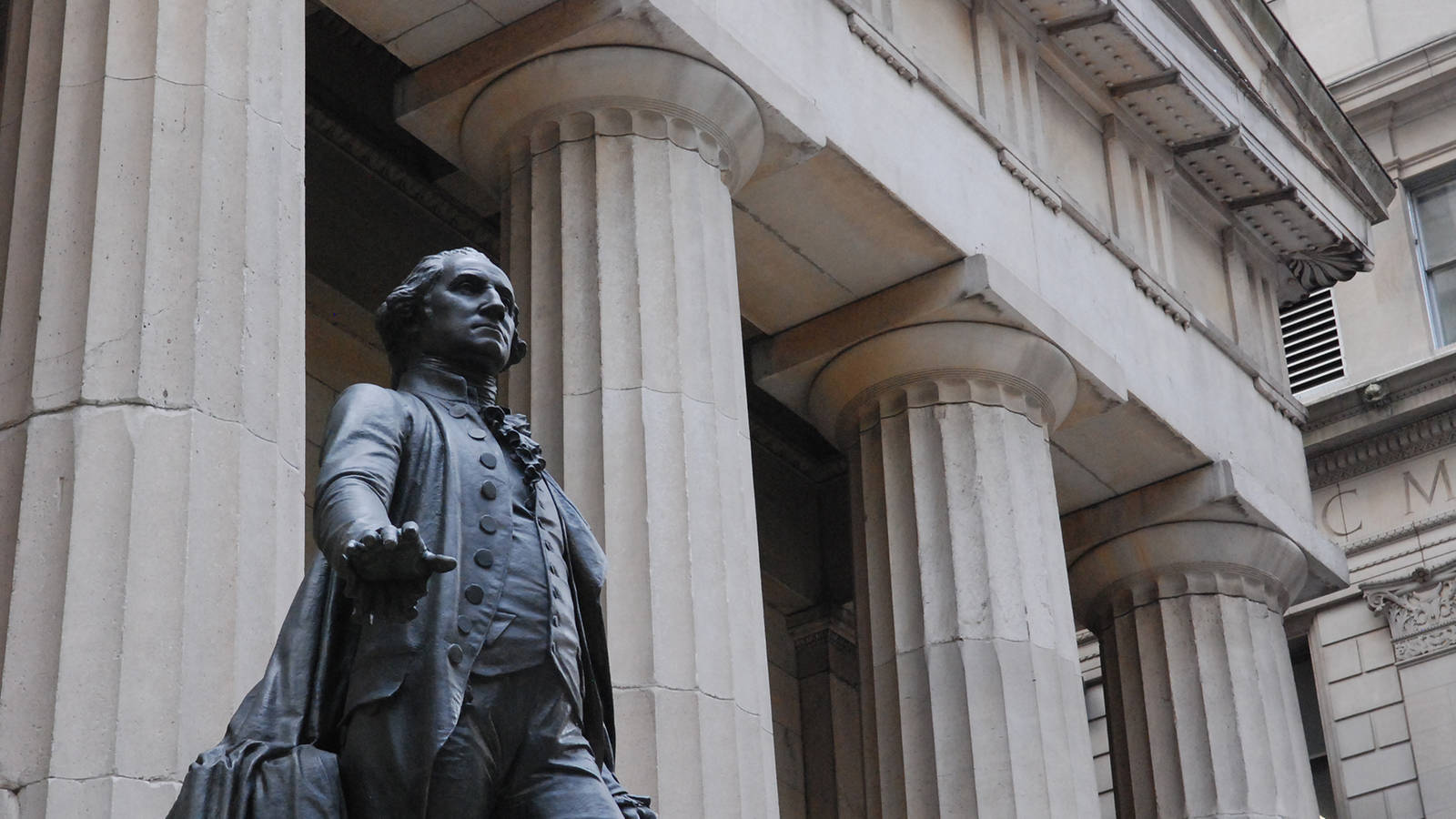 The site of George Washington’s inauguration provided as emotional an experience as the 9/11 museum. Here was a shrine to visionary ideology, not distorted into evil but elevated to the highest imaginable strata of human aspiration. Here, a fledgling nation conceived in the minds of practical dreamers took its incipient steps toward the lofty goals of justice, virtue, and equality before the law in a true meritocracy. Here, the noblest impulses of man forged a society out of shared values that had never been applied, never been attempted, never been imagined beyond the musings of political fantasy.
The obstacles had been myriad and megalithic. The chances of success had been spare. The need for compromise and cooperation had required superhuman resources of selflessness, humility, and a sense of common purpose. The collective will to succeed in their grand vision was the bond that overcame their differences, and the resourcefulness born of desperate times guided them to find solutions to their most intractable problems. And if our democracy today is slipping into a sad shadow of what it was conceived to be… well, it still stands alone in the world as a symbol of the ideals and the responsibilities of freedom.
Vision and ideology — the sources of unimaginable heroism and of monstrous evil. This is what we must remember. This is what we must never forget.
May we find the wisdom to follow the way of heroes.
 Yonason Goldson