Home » Posts tagged 'Culture Wars' (Page 9)
Tag Archives: Culture Wars

Swearing makes you smarter. REALLY?
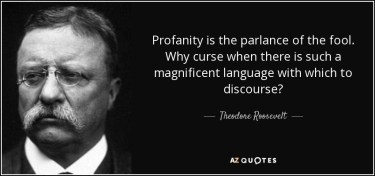 Experts have revealed [that] the use of profanity can in fact be a sign of a smart person.
This provocative assertion opened a recent article in the Daily Mail. The problem is, it’s not true.
Of course, that’s not the only problem. There’s also the problem of sloppy reporting, which comes from sloppy thinking, which comes from sloppy language. Which is what this story is really all about.
The alleged correlation between profanity and intelligence was inferred from a study concluding that people who know more curse words also know more words in general. Ipso facto, people who curse are smarter than people who don’t.
How much swearing do you suppose goes on at the Daily Mail?
Or you could ask a different question: Why should anyone take the Daily Mail seriously?
That’s a fair point. But the story also appeared in the Washington Post which, although avoiding the spurious equation between foul mouths and intelligence, still could not resist the lure of this equally misleading headline:
Why it’s a good sign if you curse. It isn’t. Which is clear from the Post article itself.

Peace in our Mind
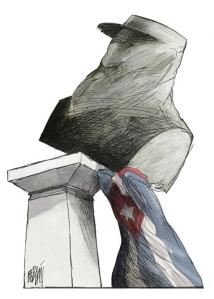 Two decades ago, Thomas Friedman suggested that someone should write a book called The Dictator Diet. Surely there must be some secret to the longevity of strongmen like Muammar Gaddafi, Yasser Arafat, and Fidel Castro. Like horror-movie mutations of the Eveready bunny, they just kept going and going and going.
Well, the last of them is gone at last. Adios, Mr. Castro. We wish we never knew ye.
But imagine if it had been different. What if Fidel had been a friend instead of a nuisance, if Cuba had been an ally instead of a thorn in America’s side?
It’s not such a wild notion.

Liar, liar, house on fire
 In its never-ending quest for editorial balance and integrity, the venerable New York Times gave equal time to Israeli and Palestinian news channels in its reporting of the devastating fires sweeping through Israel.
Israeli news expressed the widely-held opinion that arson is behind the unprecedented rash of urban and forest conflagrations, the latest tactic of Palestinian terrorism.
Palestinian news reported that fires in Israel are started primarily by discarded cigarette butts and children playing with matches, with the remainder caused by electrical malfunction.
An Arab spokesman observed that Israel should take measures to ensure that these causes are addressed to prevent future fires. He failed to explain why fires anywhere near this scale have been unknown for the entire 68 year history of the State of Israel.
Thank you once again, New York Times, for honoring your famous motto:
All the news that fits, we print.

When Satan Calls
 Few people set out wanting to do evil. So how does evil happen?
Most evil begins with the desire to do good. But when we don’t recognize where good ends and evil begins, then we’re bound to cross the line between them.
Something about a certain road paved with good intentions.
But the most insidious kind of evil is the kind that continues to masquerade as good long after we’ve crossed the line. This is the favorite device of Satan, one that we usually recognize too late, after we have everything we wanted… and we’re stuck with it.
We’ve embraced the information revolution, which has so efficiently opened the floodgates of knowledge that we’re now drowning in a sea of pseudo-facts and misinformation. We’ve embraced the communication revolution, which has so thoroughly created lines of connection that we are more deeply disconnected than ever from one another and from reality.
Now that correspondence is effortless, we often leave emails unopened and, even more often, unanswered. Now that recorded messages are a click away, we’re too distracted to check our voice mail. We think it’s rude to call without texting first, and we consider it rude to end a text with a period.
We click to the next page only halfway through the current page, and we escape exposure to ideas that make us uncomfortable because mysterious algorithms are filtering the information that reaches us. And when unpleasant news does make it through the gauntlet of ideological censorship, we sink into a morass of emotional angst and cry out against a world that defies our comprehension.
Satan is laughing all the way to the motherboard.
But not everyone is deceived. There’s a growing, grassroots movement to observe a technology Sabbath, to unplug in order to turn on and disconnect in order to reconnect. No phones, no computers, no videos, no texting.
Does that sound horrifying? Impossible? Cruel and unusual?
Convince your friends and family to try it. Pull a dusty book of the shelf and remember what it’s like to feel what you’re reading. Go to the park, play softball, plan a progressive meal with friends and neighbors, enjoy a family game night.
Feel the technology toxins flow out of your body. Once the shock wears off, you’ll wonder why you didn’t start it years ago. And when you start the new week, you’ll be more rested, more relaxed, more focused, and the envy of your coworkers.
And then you’ll wonder how you will make it all the way to your next Sabbath.

The Gift of Gratitude
 If I were to say, ‘God, why me?’ about the bad things, then I should have said, ‘God, why me?’ about the good things that happened in my life.
— Arthur Ashe
There’s no arguing that tennis legend Arthur Ashe had good reason to complain. His mother died when he was four years old. His brilliant tennis career was cut short at age 36 by a heart attack, followed by two open-heart bypass operations and one brain surgery, only to discover that he had contracted AIDS via blood transfusion. He died at age 49.
It’s extraordinary that a person could suffer so much and not cry out against his fate with anger and bitterness. But the explanation used to be obvious, before it became increasingly rare:
Gratitude.

Donald Trump has finally gone too far
 Perhaps we can forgive the president-elect for his crassness, his coarseness, his ultra-nationalist rhetoric, his mockingly superior tone, and for dragging the electoral process deeper into the mud than anytime in the last century.
But now he has officially gone too far.
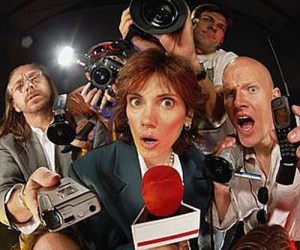
Donald Trump has committed the unpardonable sin of not telling the press where he went for dinner last Tuesday evening.
By doing so, reports the Washington Post, Mr. Trump has “dispensed with generations-old traditions and formalities,” adopting a “combative approach to press relations” in a way that shows “he clearly doesn’t respect the media.”
Gee, is this the same media that rallied all its collective forces to discredit Donald Trump as a candidate and convince the country that a humiliating electoral defeat to Hillary Clinton awaited him come November 8? Might that have something to do with his perceived lack of respect?
But that’s not even the real issue.
More significant is the sense of entitlement the media feels to invade the private lives of every public figure, and the selective metric they apply when they do so. They grudgingly accord scant airtime and column space to stories that don’t fit their ideological agenda, then cry foul when they’re denied access to the not-yet-president’s family meal and frame the perceived offense as a threat to national security.
If the election results taught us anything, it’s that the media has become so skewed in its reporting that it can’t even trust itself. Maybe if reporters learn that lesson they’ll find themselves more welcome beside the presidential dinner table.

Down with Democracy?
 AMERICANS AGAINST HATRED AND BIGOTRY.
DUMP TRUMP.
NOT MY PRESIDENT.
[EXPLETIVE] UR WALL.
WE WON’T GIVE UP. WE WON’T GIVE IN.
UNITED WE’RE STRONGER (you have to love the irony).
These are just a few of the slogans that bedecked the nation-wide protests against Donald Trump’s electoral victory, i.e., against the American democratic system. Accompanying images included swastikas and pictures of Adolf Hitler.
Of course, protest is a fundamental part of our democracy, guaranteed by the First Amendment (which, incidentally, many Yale students petitioned to repeal). But protest is only productive when it advocates a viable solution to a problem. When protest is nothing more than collective whining, it easily turns into mob violence — indeed, as it did in several instances.
So what do the protesters actually want? To repeal the democratic process? To overthrow a legally elected chief executive? Public lynching?
If they want to advocate dismantling the electoral college, they might find support on both sides of the aisle… but only for the next election cycle. And they could make their point without vandalism, arson, or public obstruction.
On the other extreme, you have college students so traumatized by the election results they have requested exemptions from classwork and midterm exams. Such fragility does not bode well for the future leadership of the country.
It’s a pity we can’t conjure up an alternative reality portal; it would be amusing to get a glimpse of how the anti-Trump contingent would be reacting — had the election gone the other way — to disgruntled Trump supporters protesting the “rigged” election that stole victory from their candidate.
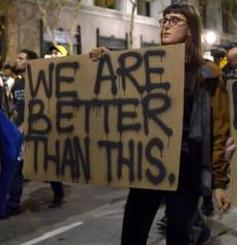
But one does have to acknowledge that sometimes the left is right. One protest sign manages to say it all:

How we move forward
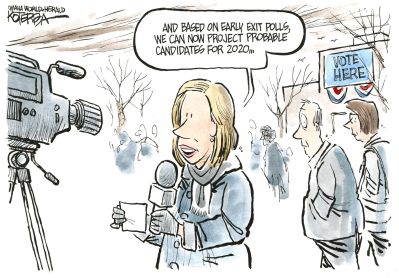 Too many voters held their noses yesterday as they entered the polling booth to vote for the candidate they considered least toxic. A smaller number could only make peace with their conscience by voting for some unexceptional third-party candidate. Then there were those who couldn’t bring themselves to vote at all.
Will the country survive this winter of our discontent? Only time will tell. But the question that lingers in the aftermath of electoral acrimony is this: are we going to start this all over again in two more years?
Sadly, we just might. Back in January, David Gelertner proposed in the Weekly Standard that the problem with the political left is that liberalism has become their new religion. For most people, religion is not a rational but an emotional commitment that emerges from some amorphous inner voice or feeling. And when people cannot defend their religious beliefs intellectually, they lash out with disproportionate ferocity at anyone who challenges those beliefs. Mr. Gelertner argues that the irrational dogmatism of many liberals bears less resemblance to political discourse and more to the religious fervor of blind faith.
He’s right, of course. But he’s wrong when he contends that this is overwhelmingly a phenomenon of the left.

Of frogs legs and scorpion tails

Indifferent to the specter of unleashed state-sponsored terrorism, France and China announced this week that they have joined forces to help Iran develop its natural gas fields. Apparently, an enriched and empowered radical theocracy is nothing to worry about — assuming the infamous Iran nuclear deal actually ensures any measure of global security.
It’s hard not to recall the parable of the frog and the scorpion:
A scorpion once asked to ride on the back of a frog to reach the other side of a river. At first, the frog refused, fearing for its life. But then the scorpion reasoned that the frog had nothing to worry about since, if it stung the frog, it would drown in the river as well. The frog could not argue with the scorpion’s logic and allowed it to climb aboard.
Midway across the river, the scorpion stung the frog. “Why did you do that?” cried the frog. “Now we will both die.”
“I couldn’t help it,” replied the scorpion. “It’s in my nature to sting, so I had to sting.”
The truth is that it’s easier to sympathize with the frog than with the French. The frog wanted to do a good deed and — albeit mistakenly — saw no cause for mistrusting the scorpion.
In contrast, the French and the Chinese want nothing but a larger slice of the world-economic pie, and they are willing to ignore the inevitable long-term dangers for short-term profit. The mild satisfaction of being able to tell them “we told you so” some years down the line will hardly supply adequate consolation for the precarious state the world will find itself in.
Of course, the allegory is imperfect for a different reason. France and China are scorpions, too. Dangerous, irresponsible, and unwilling to change their natures.
At the very least, however, their self-serving self-deception should make us ask ourselves: Are we frogs or scorpions? What about the candidates we vote into office?
And if we refuse to change our individual and collective natures, how far across the river can we expect to get?

Rejecting the new Age of Inevitability
 Isn’t it great to live in an age when machines can do anything? Cars drive themselves, jetliners land themselves, and smartphones do just about everything but tuck us into bed.
Recognition software can read our moods and even catch us telling lies. (That’s a good thing, right?) Programs can analyze our handwriting and predict our likes, dislikes, and likely actions by tracking our digital footprints. Soon, Amazon may be filling orders for us that we haven’t even placed yet.
In the workplace, software programs may start deciding who gets hired or promoted based on models constructed from data gathered about the highest performing employees. This may include variables based on medical history, psychological markers, and virtual clues to everything about us including age, gender, political leanings, and sexual preference.
In a recent Ted Talk, Zeynep Tufekci acknowledges that these programs may make decisions more objectively than humans do. But she cautions that machines trained to infer and predict are only as good as their programming, and will of necessity reflect the biases of their programmers — which could mean compounding, not eliminating, bias.
What’s more, the algorithms that produce this kind of “machine learning” don’t allow for human insight and intuition. It’s all statistical analysis, which turns probabilities into absolutes with no assessment by human reasoning and without allowing room for appeal to a higher authority.
The more troubling issue is our willingness to abdicate the responsibility implicit in free choice. In a culture that has long conflated judgment with judgmentalism, it’s hardly surprising to find how eager people are to reduce every decision to a binary option and thereby eliminate all shades of gray from the mix. And if that’s not enough, we can simply block any information that doesn’t conform to our way of thinking.
 Yonason Goldson