Home » Posts tagged 'Ideology' (Page 5)

Tag Archives: Ideology

A View from the Frontlines

fairness-wordleReporter Hunter Stuart describes how a strong dose of reality forced him to reconsider his biases and preconceptions.

In the summer of 2015, just three days after I moved to Israel for a one-and-a-half year stint freelance reporting in the region, I wrote down my feelings about the Israeli-Palestinian conflict. A friend of mine in New York had mentioned that it would be interesting to see if living in Israel would change the way I felt about it. My friend probably suspected that things would look differently from the front-row seat, so to speak.

Boy was he right.

Read the whole article here.

Walking the Talk

diogIf Diogenes couldn’t find an honest man 24 centuries ago in ancient Greece, it’s hard to imagine his search would prove more fruitful in modern-day Washington, D.C. or, lamentably, in modern-day America.
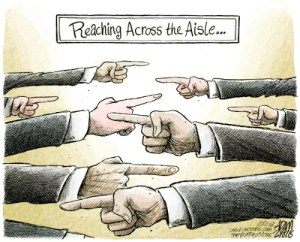
It’s not hard to understand why.  In our age of personal gratification, truth has become more than merely inconvenient.  It has become an utter nuisance.

Conservatives have been eager – and correctly so – to shine the light of hypocrisy on Sally Yates, the acting Attorney General fired by Donald Trump last week for refusing to enforce his recent executive order on refugees.  Ms. Yates might have argued against the order’s constitutionality; instead, she based her decision primarily on personal bias.

Celebrated by the left for her stand on principle, what Ms. Yates really did was to violate her oath of office by failing to fulfill her duties.  It’s her job to uphold the law, not her individual values. If conscience prevented her from performing her duties, she would have resigned in protest.  But that would have required true principle.  So much easier to merely participate in another round of partisan gamesmanship.

This brings us back to Kim Davis, the Kentucky clerk who refused to grant marriage licenses to same-sex couples back in 2015.  She too claimed to stand on principle by refusing to honor her oath of office.

partisanshipSo why are the same voices that castigated Ms. Davis hailing Sally Yates as a hero?  And where were the critics of Ms. Yates when Kim Davis was making herself a martyr in name only?


Jedediah Bila posed that very question on The View, prompting Whoopi Goldberg to go ballistic and invoke the popular refrain, it’s not the same thing.

Nowadays, principle is just a synonym for equivocation.

Click here to read the rest in Jewish World Review.

Behind the hero on the screen

In the wake of Meryl Streep’s finely crafted but sanctimonious speech at the Golden Globe awards, I’m revisiting these thoughts from 2009. 

195257_imageWhich of the following quotes does not belong with the others:

It is not what I am underneath, but what I do that defines me.

With great power comes great responsibility.

It is a far, far better thing that I do than I have ever done before.

Literary mavens will quickly identify the third quote as different from the first two for several reasons. First, it was written in the 19th century, where the others were written in the 21st. Second, it is a line from novel, where the others are lines from motion pictures. And third, it is the only one of the three not spoken by a Marvel Comic superhero.

On a more substantive level, however, all three have very much in common.

The first of the three is spoken by Bruce Wayne in his guise as Batman, explaining away his public playboy persona as a device to conceal his secret identity. The second is spoken by Peter Parker, aka Spiderman, explaining why he is walking away from the woman he loves in order to protect her from the enemies that would try to strike at him through the people closest to him.

The third quote is the closing line of Charles Dickens’s classic A Tale of Two Cities, in which the heretofore-undistinguished Sydney Carton expresses his love for Lucie Darnay by taking the place of her husband, Charles, and suffering death by guillotine so that Charles might live.

All three quotes issue from heroes who not only do great things at personal risk, but who sacrifice life, love, and reputation for a higher ideal. From a brooding moralizer like Dickens, we expect nothing less. From Hollywood scriptwriters and producers, however, we expect anything else.

FOLLOW THE MONEY

As the Oscar season descends upon us, its worth reflecting that Hollywood is known as Tinsel Town for good reason. Glitz, superficiality, and immediate gratification have become synonymous with the land responsible for most of today’s entertainment industry. Revolving door marriages and divorces, infidelity, and recreational drugs are only the most obvious symptoms of a culture that glorifies the pursuit of pleasure and the deification of personal autonomy.

Predictably, the film industry can be counted on to turn out major motion pictures that are thinly veiled propaganda pieces. Such unmemorable productions as Brokeback Mountain, Lions for Lambs, and The Good Shepherd may have curried favor with Hollywood politicos eager to promote alternative lifestyles or government conspiracy theories, but the movie-going public has shown considerably more enthusiasm for traditional good versus-evil-stories in which good triumphs in the end. (For the record, haven’t seen either Brokeback Mountain or Lions for Lambs.)

Top-10-heroesIf box office receipts are any indication, there can be no doubt that audiences will choose classic heroism every time. The musings of a couple of culturally conflicted cowboys on the open plain can hardly compete with such memorable moments as the President of the United States (played by Harrison Ford) throwing an international terrorist out the cargo hold of his plane in Air Force One or Kevin Kline’s presidential impersonator cutting government pork at a cabinet meeting to save funding for an orphanage in Dave.

That Hollywood did in fact release such movies as Batman Begins, Spiderman, and Air Force One, however, reveals an insight into Left Coast Culture that is at once obvious and surprising.

What is obvious is that money trumps ideology. When all is said and done, filmmakers would rather see increased revenues than the spread of counter-culture ideology. Fair enough. But what is truly remarkable is how well they understand the nobility, the selflessness, and the heroism of personal sacrifice that are so often at the heart of successful moviemaking.

MANKIND’S INNER HERO

Once upon a time, heroism in Hollywood was the norm. But we don’t have to go all the way back to Humphrey Bogart’s “the problems of three little people don’t add up to hill of beans” speech in Casablanca when he gives up Ingrid Bergman. When Helen Hunt refused to abandon her family for Tom Hanks in Cast Away, when Kelly McGillis refused to abandon her Amish community for Harrison Ford in Witness, when Robert Redford emptied out of his life’s savings to rescue Brad Pitt in Spy Games, the positive resolution of their inner conflicts provided some of the most powerful emotional climaxes in modern cinema. And let’s not forget this year’s biggest hit, The Dark Knight, in which Batman takes the blame for murder to allow Gotham City to keep its illusion of hope.

Perhaps the culture of make-believe that turns out movies of heroism is incapable of believing in either real heroism or the values that turn ordinary people into heroes. Why else would they persist in churning out so many ideological flops in between traditionalist blockbusters? One almost feels sorry for the creative geniuses that can portray such compelling drama on the screen but seem incapable of applying it to the reality of their lives.

The classical philosopher Rabbi Moshe Chaim Luzzato describes the human condition thus:

And so [man] finds himself truly in the midst of a raging battle, in which all the matters of the material world, whether good or evil, serve as trials for man. Poverty confronts him on the one side and wealth on the other… comfort on the one side, and suffering on the other, until he faces a battlefront before him and behind. But if he will be valiant and prevail against his adversaries on every side, then he will become a Complete Man.

Movies can remind us of the moral battles we face constantly in our own lives between what we know and what we feel, between what is right and what is pleasing, between rising to each new challenge or abdicating struggle for the line of least resistance. We rejoice when silver screen heroes emerge triumphant from their inner struggles, for they remind us that we too can emerge triumphant. But we despair when they fail, for they remind us how easily we too can fall prey to our inner demons.

It’s ironic that Hollywood filmmakers can describe the human condition so vividly with so little understanding of it. Perhaps they should watch their own movies – the ones that audiences go to see.

Originally published on Jewish World Review

Lighting our way to the Palace of the King

ballroom-at-the-grand-palace-in-peterhofThere is a story of a prince, a true prodigal son, whose antics and excesses taxed his father’s patience until the king, with no other recourse, sent his son penniless into exile to learn responsibility and humility.
The prince wandered from place to place, half-starving, unqualified for any craft or labor, until he finally found work as a shepherd in a distant land. The job of shepherding was not overly difficult, but the sun burned the prince’s back by day, the wind froze him at night, and the rain soaked through his clothes in winter.

Other shepherds built little huts to protect them from the elements, but whenever the poor prince tried to build himself a hut it toppled over in the first strong breeze.

Years went by, until at last the prince heard that the king was coming to the province where he lived. There was a custom in the kingdom that people would write their wishes upon scraps of paper and throw them at the king’s carriage. Any requests that the king picked up a read would be granted immediately. So the prince positioned himself along the parade route and, as the king’s carriage passed, he took careful aim and tossed his note.

The paper fell at the king’s feet. He unrolled it and, recognizing his son’s handwriting, he began to weep. For the note asked if the king would give the prince a little hut to protect him from the sun and the wind and the rain.

“My son could have asked to return to the palace,” cried the king, “but he no longer knows he is a prince.”

So it was in the days of the Maccabees, when the Jewish people were so steeped in the physical aestheticism and indulgences of Greek culture that many of them forgot that they were in exile, forgot that they were inheritors of a priceless spiritual legacy, forgot that they were children of the King.

But a few didn’t forget. A few risked their lives to honor the Sabbath, to circumcise their sons, to study the Torah of their fathers and grandfathers, to preserve the divine spark that had guided their ancestors for a thousand years. And, when their moment came, those few took up arms against their oppressors and fought for the privilege of living as Jews. They recaptured the Holy Temple and, as they rekindled the menorah, divine light flooded the streets and courtyards of Jerusalem, pushing off the darkness of exile, waking the people from cultural forgetfulness, inspiring a generation to remember its ancient roots cast its aspirations once more toward the heavens.

Today, 2,180 years later, we too live in an age of spiritual darkness, when the loudest and most persistent voices in our surrounding culture cry out to expunge every mention of the divine, to condemn every moral judgment, to sanctify every perversion in the name of “tolerance.” We live in an era of unprecedented material comfort and convenience, tranquilizing our bodies and our minds so that we can easily stifle the yearning of our souls.

slvm5919016But when the days are shortest and the nights are coldest, just then can a little light shine forth and dispel much darkness. Like a lighthouse guiding a ship home, the lights of the Chanukah menorah can draw us back from the abyss of spiritual oblivion. And as we add candle upon candle and light upon light, the growing radiance of the menorah reminds us of the divine flame that has guided us through the darkness of exile and saved us from the darkness of assimilation for generation after generation.

If we, like the Hellenist Jews, allow the material values of contemporary culture to shape our thinking and guide our actions, then we have truly forgotten who we are. Like the prince whose soul longed for nothing but a little hut to protect him from the sun and the rain, we will be destined to live out our days in futility.

But if we cling to all that which is noble within us, if the values of our tradition drive us to perform acts of kindness and charity, to devote a few moments each day to heartfelt and meditative prayer, to treat neighbors and strangers alike with respect, to set an example of morality and character for our children — then we will have rekindled the spark of divinity inside us, and we will have earned the privilege to have our Father, the King, bring us home.

Originally published in 2003 by Jewish World Review

Illuminating the Days of Darkness

3184543T.S. Eliot may have denounced April as the cruelest month, but most of us are far more likely to feel pangs of depression beginning to stir sometime around December.

As the days grow short and gray, and the nights turn cold and dark, that is the time we find our spirits truly starting to wither. We mourn the passing of those slow, sticky summer afternoons, long buried beneath the frost. As the threat of snow looms, we reflect sadly that winter will only grow crueler before we can begin to hope for the thaw.

It may be natural to attribute our mood to the inexorable cycle of nature and the change of seasons. But in this, as with all things, Jewish tradition offers a deeper insight into the spiritual torpor that descends upon us each year with the onset of winter.

The Talmud describes how, after eating from the forbidden fruit, Adam noticed that the days began growing shorter and the nights longer. Adam despaired. “On account of my sin,” he conjectured, “the Creator is gradually returning the world to the state of Primordial Darkness.”

With the passing of the winter solstice, however, the days began to lengthen once again, and Adam realized that the changing of the seasons was just part of the natural pattern of creation. He rejoiced, inaugurating a festival of eight days to celebrate the renewal of the world.

In this same season, 2,180 years ago, the Jewish people inaugurated the eighth-day festival of Chanukah, celebrating the victory of light over darkness.

CULTURE OF THE GREEKS

The number seven symbolizes perfection in nature, the complete, ordered system brought into existence through the seven days of creation. As such, it also symbolizes the culture of the Greeks, which then weighed heavily on the backs of the Jewish nation.

Greek culture worshipped physical perfection, artistic expression, and unblemished aestheticism. It exalted the physical form and physical prowess in their art and their architecture, in their Olympics and in their philosophy. It honored and revered all that the physical world represented.

In their aspiration for aesthetic idealism, however, the Greeks denied the transcendence of the human spirit and rejected the notion of any metaphysical reality. It should, therefore, come as no surprise that we find the gods of Greek mythology to be mere caricatures of men, with exaggerated human desires arid contemptible human shortcomings.

Neither should it surprise us that the Greeks fought so desperately to uproot the Torah, the spiritual compass that has kept the Jewish people pointed toward the light through the darkness of exile.

Judaism teaches that the potential for human greatness is achieved not through the ascendancy of the physical, but by subjugation of the physical to the spiritual. The symbol for this spiritual transcendence is the number eight, representing that which breaks through the bounds of physical limitation (symbolized by seven) and aspires for a higher reality, one that lies beyond materialism, beyond superficiality.

EIGHT DAYS

For this reason do we circumcise a Jewish boy on the eighth day after birth, to signify the covenant charges him with conquering his physical desires and redirecting them in the pursuit of spiritual goals.

bigstock-hanukkah-candles-copyFor this reason did Adam celebrate for eight days, in recognition that the spiritual design behind the workings of nature is even more complex and wondrous than nature itself.

And for this reason do we light the Chanukah lights for eight days: to push off the dark and cold of winter and to remember that we must all see ourselves as lights amidst the spiritual darkness of the physical world, no less than the stars scattered across the heavens.

Only by igniting our own cultural enthusiasm with the flame of our tradition and our heritage will we inspire ourselves and our children to strive toward achieving the spiritual greatness that lies within every one of us.

Originally published in 2002 by Aish.com

President Evil

5790fbf54aa21822d5000009On 10 December, the St. Louis Post-Dispatch ran an editorial suggesting that Donald Trump was largely responsible for the gunman who attacked a Washington pizza parlor and the deranged woman who made death threats against the mother of a Sandy Hook massacre victim.  

I submitted the following letter to the editor in response.  Inexplicably, the paper chose not to print it.

Dear Editor,

Your editorial was absolutely correct.  Donald Trump’s irresponsible rhetoric definitely has contributed to the corrosion of our culture and our safety.  But please explain why you limit your indictment to Mr. Trump alone.

Why don’t you lay equal blame in the lap of Hillary Clinton for her amoral campaign of distortion, deception, and corruption?  The former next-president-of-the-United-States racked up 24 pinocchios last year from the Washington Post, and has lied about everything from her emails to her foundation, from her fictitious ducking under Bosnian sniper fire to the origins of her own name.

Why don’t you assign equal guilt to Barack Obama, who denied calling ISIS “the JV team,” who misrepresented Republican filibustering by a factor of ten, and whose misinformation about Obamacare could fill a government website?

And why don’t you admit your own complicity as part of the injudicious media that perpetuated the big lie of “Hands up, don’t shoot,” continues to indulge the wicked moral equivalence that excuses and enables radical terrorism, and — oh, the irony — provided Donald Trump with millions of dollars in free column space and air time, helping catapult him to primary and ultimately national election victory.

By all means, blame Donald Trump for all of society’s ills.  But first show the moral fortitude of placing the blame everywhere it belongs, including on your own shoulders.

Down with Democracy?

anti-trump-protests-1114AMERICANS AGAINST HATRED AND BIGOTRY.

DUMP TRUMP.

NOT MY PRESIDENT.

[EXPLETIVE] UR WALL.

WE WON’T GIVE UP.  WE WON’T GIVE IN.

UNITED WE’RE STRONGER (you have to love the irony).

These are just a few of the slogans that bedecked the nation-wide protests against Donald Trump’s electoral victory, i.e., against the American democratic system.  Accompanying images included swastikas and pictures of Adolf Hitler.

Of course, protest is a fundamental part of our democracy, guaranteed by the First Amendment (which, incidentally, many Yale students petitioned to repeal).  But protest is only productive when it advocates a viable solution to a problem.  When protest is nothing more than collective whining, it easily turns into mob violence —  indeed, as it did in several instances.

So what do the protesters actually want?  To repeal the democratic process?  To overthrow a legally elected chief executive?  Public lynching?

If they want to advocate dismantling the electoral college, they might find support on both sides of the aisle… but only for the next election cycle.  And they could make their point without vandalism, arson, or public obstruction.

On the other extreme, you have college students so traumatized by the election results they have requested exemptions from classwork and midterm exams.  Such fragility does not bode well for the future leadership of the country.

It’s a pity we can’t conjure up an alternative reality portal; it would be amusing to get a glimpse of how the anti-Trump contingent would be reacting — had the election gone the other way — to disgruntled Trump supporters protesting the “rigged” election that stole victory from their candidate.

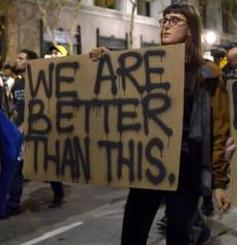
But one does have to acknowledge that sometimes the left is right.  One protest sign manages to say it all:

aptopix-election-protests-california

My Interview with Bill Martinez

Bill_Martinez_210x174Listen in on my conversation about political correctness and the culture wars with nationally syndicated radio host Bill Martinez on 10/19.

Interview begins around the 07:00 mark here.

Political Correctness: the root of all evil

Attachment-1

After last week’s wackiness at James Madison University, it’s time to revisit this post from last April.  I fear there will be too many opportunities to do so.

A letter to the future president of the United States:

If you want to fix the country, you can start with the root cause of all that ails our country:

Political Correctness.

The truth is that political correctness is not a new idea at all; it is simply the new label for an old, established moral postulate once accepted by all.

The word civility shares its linguistic root with the word civilization.  It means taking into consideration the comfort of others before expressing what I think or doing what I want.  It means remembering that other people have rights before assert my own.  It means reflecting upon how my actions are going to affect my community and recognizing that I have a responsibility to a society that is more than the sum of autonomous individuals.

So what was wrong with the term civility that the concept needed rebranding as political correctness?  Most likely, it was the connotation of political ideology that spawned this illegitimate offspring of cultural nobility.

Read the whole article here.

An Ode to Almustafa

lonely-walkerIf memory serves — after all, it has been 32 years — I was somewhere between New Orleans, Louisiana, and Waycross, Georgia.  It was late winter, but the southern air was mild and the sun brightened the sky.

Hitchhiker’s weather, to be sure.

I was waiting at a rest stop with my thumb stuck out when a pickup towing a large camper lumbered to a halt in front of me.  I climbed in and uttered my heartfelt thanks.

The driver, wearing a red flannel coat in hunter’s plaid, surprised me by identifying himself as a pastor on vacation.  He asked the usual questions — where was I headed, where was I from, why was I traveling this way — then launched into his story.

There are two ways hitchhikers pay for their rides.  One is by talking, by entertaining a driver lonely from the road and weary of recorded music or talk radio.  The other is by listening, by letting drivers unburden themselves without the cost of therapy, secure in the knowledge that their disclosures will vanish into the air the moment the passenger exits the vehicle … comfort of strangers and all that.

Clergy have gotten a bad rap in recent years — much of it their own doing.  Corruption is bad enough from politicians and business executives, but we have every right to expect more from our religious leaders.  The entire edifice of theology suffers from every single act of spiritual infidelity.

But there are still many sincere men of the cloth, and my benefactor appeared faithful to the integrity of his office.  He saw his mission not only to minister but to shepherd his flock toward pastures sown thick with the morality and ethics of scripture, to challenge them to challenge themselves and prod them to pay closer attention to the calling of their conscience.

And sadly, like spiritual leaders from Moses until today, he had found ample cause for disappointment.

Click here to read the whole essay.