Home » Posts tagged 'Leadership' (Page 13)
Tag Archives: Leadership

Scorched-earth redux
 If you’ve never heard of the Daily Banter, good for you. Here’s one of its latest headlines:
Trump Is Officially An Illegitimate President-Elect And The Democrats Have To Destroy Him
In a nutshell — or a nutcase — the hyper-hormonal screed asserts that Democrats need to take Republican scorched-earth policies to the next level to save our democratic republic.
Whatever one may think of Donald Trump, the manner of his election, or his adolescent tweeting, he has blunted the onslaught from many of his critics with the measured judgment of his cabinet picks and administrative appointments.
Aside from that, after eight years of partisan sniping, bullying, and obstructionism — from both sides of the aisle — what the country needs and wants is a spirit of cooperation from its lawmakers, not more posturing, bickering, and gridlock.
But here’s the question that really needs answering:
Why is a scandal sheet like the Daily Banter showing up at the top of my Google News feed?

Peace in our Mind
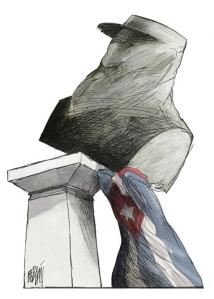 Two decades ago, Thomas Friedman suggested that someone should write a book called The Dictator Diet. Surely there must be some secret to the longevity of strongmen like Muammar Gaddafi, Yasser Arafat, and Fidel Castro. Like horror-movie mutations of the Eveready bunny, they just kept going and going and going.
Well, the last of them is gone at last. Adios, Mr. Castro. We wish we never knew ye.
But imagine if it had been different. What if Fidel had been a friend instead of a nuisance, if Cuba had been an ally instead of a thorn in America’s side?
It’s not such a wild notion.

Six Recalibrations to get Success Back on Track
 In an earlier post, I outlined six misconceptions that stifle success. They are:
- Pleasure equals happiness
- Opinion equals fact
- Winning equals success
- Autonomy equals freedom
- Convenience equals peace of mind
- Legal equals ethical
When we use words without concern for their meaning, we deprive ourselves of the ability to think clearly. We confuse goals with side-effects, assets with obstructions, and benefits with pitfalls. We sabotage our own success because we aren’t clear about where we’re going or how we’re going to get there.
When we mistake happiness for pleasure, we end up chasing after instant gratification, which is emotional junk food. When we don’t consider ourselves winners unless someone else is losing, we drive away potential allies and advocates. When we refuse to reexamine our opinions, we are often denying reality.
The belief that freedom means no restrictions destroys discipline and makes us slaves to our bad habits. The notion that convenience leads to tranquility leaves us unable to cope with life’s difficulties and disappointments. And exploiting legal loopholes makes us untrustworthy and untrusted.
So let’s get down to definitions.

Down with Democracy?
 AMERICANS AGAINST HATRED AND BIGOTRY.
DUMP TRUMP.
NOT MY PRESIDENT.
[EXPLETIVE] UR WALL.
WE WON’T GIVE UP. WE WON’T GIVE IN.
UNITED WE’RE STRONGER (you have to love the irony).
These are just a few of the slogans that bedecked the nation-wide protests against Donald Trump’s electoral victory, i.e., against the American democratic system. Accompanying images included swastikas and pictures of Adolf Hitler.
Of course, protest is a fundamental part of our democracy, guaranteed by the First Amendment (which, incidentally, many Yale students petitioned to repeal). But protest is only productive when it advocates a viable solution to a problem. When protest is nothing more than collective whining, it easily turns into mob violence — indeed, as it did in several instances.
So what do the protesters actually want? To repeal the democratic process? To overthrow a legally elected chief executive? Public lynching?
If they want to advocate dismantling the electoral college, they might find support on both sides of the aisle… but only for the next election cycle. And they could make their point without vandalism, arson, or public obstruction.
On the other extreme, you have college students so traumatized by the election results they have requested exemptions from classwork and midterm exams. Such fragility does not bode well for the future leadership of the country.
It’s a pity we can’t conjure up an alternative reality portal; it would be amusing to get a glimpse of how the anti-Trump contingent would be reacting — had the election gone the other way — to disgruntled Trump supporters protesting the “rigged” election that stole victory from their candidate.
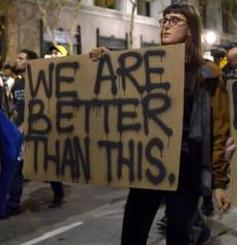
But one does have to acknowledge that sometimes the left is right. One protest sign manages to say it all:

Six Misconceptions that Stifle Success
 Why aren’t we more successful? Why aren’t we happier? Why do we have so many problems? Why can’t we get along?
We might blame it all on any number of things:
- Texting
- The internet
- Political correctness
- Self-esteem philosophy
The truth is, all of these are symptoms of the real problem:
The devaluation of self-discipline and personal responsibility.
More and more, we live in a culture that teaches us to expect what we want without effort and without concern for consequences. We know this doesn’t apply at work or in the gym; we should know that it doesn’t apply in school, in relationships, or in government.
But the social messages of immediate gratification and entitlement have seeped in everywhere, most of all into the one area on which all others depend.

How we move forward
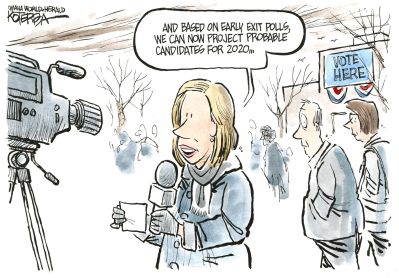 Too many voters held their noses yesterday as they entered the polling booth to vote for the candidate they considered least toxic. A smaller number could only make peace with their conscience by voting for some unexceptional third-party candidate. Then there were those who couldn’t bring themselves to vote at all.
Will the country survive this winter of our discontent? Only time will tell. But the question that lingers in the aftermath of electoral acrimony is this: are we going to start this all over again in two more years?
Sadly, we just might. Back in January, David Gelertner proposed in the Weekly Standard that the problem with the political left is that liberalism has become their new religion. For most people, religion is not a rational but an emotional commitment that emerges from some amorphous inner voice or feeling. And when people cannot defend their religious beliefs intellectually, they lash out with disproportionate ferocity at anyone who challenges those beliefs. Mr. Gelertner argues that the irrational dogmatism of many liberals bears less resemblance to political discourse and more to the religious fervor of blind faith.
He’s right, of course. But he’s wrong when he contends that this is overwhelmingly a phenomenon of the left.

Of frogs legs and scorpion tails

Indifferent to the specter of unleashed state-sponsored terrorism, France and China announced this week that they have joined forces to help Iran develop its natural gas fields. Apparently, an enriched and empowered radical theocracy is nothing to worry about — assuming the infamous Iran nuclear deal actually ensures any measure of global security.
It’s hard not to recall the parable of the frog and the scorpion:
A scorpion once asked to ride on the back of a frog to reach the other side of a river. At first, the frog refused, fearing for its life. But then the scorpion reasoned that the frog had nothing to worry about since, if it stung the frog, it would drown in the river as well. The frog could not argue with the scorpion’s logic and allowed it to climb aboard.
Midway across the river, the scorpion stung the frog. “Why did you do that?” cried the frog. “Now we will both die.”
“I couldn’t help it,” replied the scorpion. “It’s in my nature to sting, so I had to sting.”
The truth is that it’s easier to sympathize with the frog than with the French. The frog wanted to do a good deed and — albeit mistakenly — saw no cause for mistrusting the scorpion.
In contrast, the French and the Chinese want nothing but a larger slice of the world-economic pie, and they are willing to ignore the inevitable long-term dangers for short-term profit. The mild satisfaction of being able to tell them “we told you so” some years down the line will hardly supply adequate consolation for the precarious state the world will find itself in.
Of course, the allegory is imperfect for a different reason. France and China are scorpions, too. Dangerous, irresponsible, and unwilling to change their natures.
At the very least, however, their self-serving self-deception should make us ask ourselves: Are we frogs or scorpions? What about the candidates we vote into office?
And if we refuse to change our individual and collective natures, how far across the river can we expect to get?

My Interview with Bill Martinez
 Listen in on my conversation about political correctness and the culture wars with nationally syndicated radio host Bill Martinez on 10/19.
 Yonason Goldson