Home » Posts tagged 'Virtue' (Page 24)
Tag Archives: Virtue

The War to End all Wars
Originally published by Jewish World Review in September, 2001, two weeks after the attacks on the Twin Towers.
 Once upon a time there were three little pigs. One built a house of straw, until the big, bad wolf blew it down and gobbled him up. One built a house of sticks, until the big, bad wolf blew it down and gobbled him up. But one built a house of bricks and was safe from all the huffing and puffing of the big, bad wolf.
Society teaches values to successive generations through its children’s stories. The story of the Three Little Pigs is one of our most enduring fables, teaching the importance of good planning and disciplined effort. But it also carries with it a more subtle message, that safety rests in our own hands and our own labors, that security can be bought for the price of a pile of bricks and a bucket of mortar. This ideal, if it was ever true, went up in flames together with New York City ‘s skyline and Washington’s military nerve center on September 11.
More appropriate now than the Three Little Pigs is Robert Burns’s adage about “the best laid schemes of mice and men.” Indeed, the World Trade Center towers were each designed to absorb the impact of a 727; what the architects failed to factor in was how the fuel carried aboard a transcontinental airliner would create an inferno capable of compromising the structural strength of steel support beams. Of course, we don’t blame the architects; none of us imagined the acts of incomprehensible evil that brought down those towers.
 Which is precisely the point. We cannot imagine the design and the reach of evil. We can make our best effort, erect walls of brick around ourselves and roofs of steel over our heads, but we will never be completely safe. The world is too unpredictable an arena, the mind of the wicked too dark a cavern.
As if to drive home the instability of temporal existence, observant Jews around the world will disrupt their normal lives this week by moving out of their homes into little stick houses to live as our ancestors lived in the desert after their exodus from Egypt. But more than an attempt to recreate the experience of a fledgling nation traveling toward its homeland, the holiday of Sukkos offers us an opportunity to attune our minds to a most fundamental principle of Judaism — that however great our strength and the might of our own hands, however elaborate and well conceived our plans, life strews unexpected obstacles in our path that can scuttle our most certain victories and demolish our most solid edifices.
A sukkah may be built of virtually any material: wood, brick, steel, canvas, or even string may be used to construct its walls. But no matter how stable or how precarious its walls, the roof of a sukkah must be composed of s’chach, thin strips of wood or leaves, through which the light of the stars can shine at night. And when one sits in the sukkah and looks up at the s’chach — the barest representation of a roof that won’t protect him from even the lightest rainfall — he is inspired by the recollection of his ancestors who trusted in the protection of the Almighty, the One who took them out from under the rod of their oppressors and guided them through the inimical desert before bringing them safely home.
In his visionary writings, the prophet Ezekiel describes a great battle on the eve of the messianic era, when the all forces of evil in the world combine themselves into a great army called by the name Gog and Magog. The brilliant eighteenth century thinker Rabbi Samshon Raphael Hirsch interprets the prophet’s vision not as a military battle but as an ideological war between the philosophy of gog — “roof”– and the philosophy of sukkah, where those convinced that their fate lies in the power of their own hands and their own resources will attack the values of those who recognize the limits of human endeavor to influence the world.
In the immediate wake of the World Trade Center destruction, cries rang out for vengeance and military retribution. Since then, more measured voices have asserted that this war will be like no other, without defined enemies or defined borders, without clear strategies or decisive victories. This is an unfamiliar kind of crisis, where we find our capacity to respond in our own defense or to secure our own future profoundly diminished in a new world order.
So now the citizens and leaders of the world’s last remaining superpower must grapple with the uncertainties of a violent present and a murky future. Some will respond by declaring that we must work harder to take control of our own fate. Others will concede that we will never be secure again. And they will be right: no building, no bunker, no shelter made of brick or concrete or iron will guarantee our safety from the perverse imagination of extremists who can rationalize indiscriminate mass murder.

Yet for all that, the Jew sitting in his sukkah will look up at the heavens and be at peace. He will recognize that the best laid schemes often come to naught and that, after doing all that can be done, we are best off leaving our fate in the hands of the One who placed the stars in their courses, the One from whom protection ultimately comes for those who trust not in their own strength, but in the source of all strength.
As the winds of autumn blow with the first hint of winter, we may shiver with cold but never with fear. The illusion of the roof we can see reminds of the invisible reality of the wings of the Divine presence. We neither abandon ourselves to fate nor try to seize hold of it, but turn with confidence to face the future, secure in the knowledge that we have prepared ourselves as best we can to meet whatever life holds in store for us.

Do we really want a leader?
 The second Republican debate provided three indisputable facts:
- The mainstream press can barely disguise its bias in favor of the democrat party. Virtually every question was designed to promote inter-party bickering rather than elicit either policy positions or evidence of executive experience and aptitude. Whether in the debate itself or beyond, the press devotes disproportional attention to Donald Trump, not because he is the front-runner, nor even because he’s good for ratings, but because he discredit the Republican party in the eyes of most Americans with his ill-mannered and self-serving bluster.
- Far too high a percentage of the electorate lacks any real understanding of the responsibility implicit in the right to vote. Donald Trump has insulted a war hero, insulted women, insulted his fellow candidates, and has skirted giving meaningful responses to specific questions while telling us all to trust how great a job he will do. That he maintains such a commanding lead over so many truly qualified candidates is perhaps the most depressing aspect of the primary race so far. True, represents a reaction against political corruption and political correctness. But incivility is not the opposite of either.
- Carly Fiorina stands head and shoulders above every other candidate. She is well-informed, specific and to the point, poised and articulate, strong yet civil. She’s exactly what the country needs, and she should be leading by a mile.
When the Children of Israel approached Samuel the Prophet to ask for a king, Samuel responded with anger and rebuke. It was not the people’s request that was wrong; it was their reason.
“Give us a king,” the people said, “like all the other nations.”
The surrounding nations submitted to the rule of kings to absolve themselves of the responsibility of making choices and of the consequences of their actions. A Jewish king was supposed to inspire the people to live up to their mission as children of the Almighty. But the people wanted to take the easy way rather than challenge themselves to strive for greatness.
Ultimately, this country will only find its way back to greatness when we, the people, stop looking at the window dressing, stop looking for an entertainer-in-chief, stop looking for who will promise us the most goodies or tell us what we want to hear. We can only restore our country to greatness when we rally behind a true leader who is qualified to understand complex issues, who is willing to make difficult choices that are best for the nation, and who has the character to earn trust and respect from friends and enemies alike, at home and across the world.

Yom Kippur: Playoff Season for the Soul
Guest post by Mendel Horowitz

Like a field of dreams Yom Kippur counts on ghosts to inspire. In Kevin Costner’s sentimental role, his character Ray Kinsella carves a baseball diamond from a cornfield after hearing a mysterious whisper “if you build it he will come.” Encouraged by the prophecy and by the spirits of departed ballplayers, Ray in the end discovers his estranged father behind the plate and engages him in a seraphic game of catch. The High Holidays too can be stirred by fantastic voices – inexplicable motivators of contrition, correction, change. On Yom Kippur, standing solemn before my Maker with ghosts of past defeats and not-yet triumphs at hand, I too will aspire to engage Him. I too will hew a future from the past.
This year, the portentous Day of Atonement falls on the eve of September 23, while Sir David Wright hosts the Braves and the Mets delight in their amazing dream. For believers in Flushing, on that weekend baseball might seem delightfully temporal, repentance as distant a notion as spring. For me, our pastime is irresistibly spiritual, her diamond silhouette an invocation, her metaphors as vibrant as her checkered outfield grass. In my synagogue, that holy day will be celebrated as an occasion of longing, an extra-inning playoff of abstinence and prayer. I may not be rooting for the home team that afternoon but I will be encouraged by baseball’s oddities.
Our national pastime is peculiar indeed. When Yogi Berra quipped “it ain’t over till it’s over” during the summer of 1973, the Mets were in last place, finishing July a dismal 44-57. By August 30 the team was 61-71, 6.5 games back with 29 to play. Before the season closed the Mets would claim the NL East, victorious in 21 of their last 29 contests. The Mets infiltrated the postseason with a record of 82-79, to date the worst percentage by a division champion. After raising the NL pennant and battling to a World Series Game Seven, it was finally over when the Mets fell to the Mustache Gang and their swaggering MVP.
Yogi was only half right. In all professional team sports – baseball included – a playoff berth is routinely clinched before the season officially ends. It can be over before it’s over. Baseball is, however, unique in disallowing any single game to be over before its final out. Only on a diamond can a team come back from any deficit with no buzzer, whistle, or horn interrupting its rally. No game is over till it’s over. Just ask Mookie Wilson, who in 1986 delegitimized Billy Buckner on the tenth pitch of his heroic at-bat after the Red Sox were at three times one strike from deliverance. Baseball is a game of second chances.
For diehards, Yom Kippur is a final opportunity in a season of do-overs. When the Israelites forged a golden calf at Sinai Moses was compelled to smash the original tablets, tossing the first pitch in an epic struggle for God’s favor. Throughout a heated summer Moses labored valiantly atop the hill, earning the right to carve new tablets by offering himself for his team. On Yom Kippur, his efforts rewarded, the prophet descended triumphant, with God’s unassuming pardon and trophy slabs in hand. From the assurance of spring through the worry of summer, Moses carried his team to a fall salvation. Not bad for a rookie.
Relived annually, the Jewish season of second chances gets underway with the advent of Elul, the final month before the New Year. From then, each morning after services a shofar sounds and a special psalm is recited, calling to mind the far-reaching potential of the ensuing homestand. For a meritorious few and their less fortunate opposites, Rosh Hashanah, thirty days later, is the conclusive day of judgement, when the righteous and the wicked are inscribed in their respective tomes. Yom Kippur occurs ten days after that, allowing unremarkable journeymen extra innings to settle their score. Before the season’s final strike everyone will have their say at the plate.
A forty day homestand of penitence offers adequate occasions for transcendance. The process of repentance can invigorate, awakening dormant courage from slumber. But introspection is notoriously difficult to maintain, the stretch from Elul to Yom Kippur wearisome, draining. Like an ordinary baseball season (which spans three of four climatic seasons) the Days of Awe rely more on storylines than thrills, more on drama than excitement. Baseball is neither raucous nor bold. When “90% of the game is half mental” its energy is bound to be subtle.
 By some estimates 90% of the game is also spent standing around. According to the WSJ baseball’s fleeting moments of action account for but 17 minutes and 58 seconds of a typical three hour game. From on-deck circle to bullpen, from pathological glove adjustments to obsessive shaking off signs, baseball is an exhibition of exaggerated preparedness. Everything important in baseball happens in the heartbeats between anticipation. Apprehension is baseball’s charm; waiting, her mystique.
What made the pennant race endearing in ‘73 and the rally against Boston amazing in ‘86, were the unhurried ways they unfolded. Few things happen suddenly in baseball, it’s magic evolves leisurely in plain sight. No need for rapid eye movement or instant replay; baseball’s feats are taken in with a pencil and a stomach for suspense. In baseball, time is not something to play against but to toy with, the moments between activity more moving than the action itself.
The Day of Atonement is itself drawn out, prone to rushes of emotion and spans of boredom too. Between its haunting first inning and expectant last are 25 self-denying hours, an ascetic journey of supplication, ceremony, and song. Like baseball, Yom Kippur is a slow game, one that rewards patience with equal measures of elation. The enchantment of the day lingers in its tensions, its allure apparent in its yearning. A classic Yom Kippur unfolds without hurry, its promise swelling cautiously, its hesitancy bursting my heart.
As a religious orientation, baseball imbues the virtue of readiness, the modesty of reacting to something thrown at you really fast. At the plate and on Yom Kippur I can never be sure what may be tossed my way. All I can do is to prepare. Before the ghosts arrived, Ray Kinsella sculpted sacred space from profane, building it so “he will come.” Before knowing who he was, Ray was prepared for his arrival.
Absolution is never assured. To encounter Him on September 23 I will rely on ritual and superstition to get myself ready. My personal playoff will be lengthy, and if all goes well, improbable. I envision a nail-biter until late innings when, like Kirk Gibson, I will limp to the plate and achieve the impossible. Preferably with a longball. Preferably on a full count.

Rethink Everything
 The ten days from Rosh Hashanah to Yom Kippur commemorate the Creation of the universe and the creation of mankind. Rosh Hashanah is called the Day of Judgment, reminding us that all our actions matter, whether great or small, whether public or private.
By contemplating that we will have to make an accounting before the One Judge, we become more aware of our own choices, more cautious in how we judge others, and more willing to rethink the many ideas and attitudes we take for granted.
Ultimately, we want to be the best people we can be, which means looking back on the past year to evaluate how we’ve succeeded and how we have fallen short. It also means looking forward to envision where we would like to see ourselves this time next year, and then setting the bar a little higher, knowing that we will always fall short of our goals.
Change isn’t easy. But it is inevitable, for better or for worse.
And it’s in our hands to see that we change for the better.

Remembering 9/11: Visionaries and Ideology
 Who knew a trip to New York could be so emotional?
Our first stop was the 9/11 museum. I marveled at the artistic vision that had conceived the memorial pools, the water channeling down in rivulets that mirrored the face of the fallen towers, the continuous downward rush balanced by the redemptive feeling of water — the source of life — returning to the heart of the world. Here there was solace, closure, and consolation.
But a very different feeling accosted me inside. Almost upon entering the doors a single word brandished itself across my mind’s eye: Holocaust.
Obviously there is no comparison between the monstrosity of wantonly dehumanizing genocide and any single act of terror; obviously there is no equivalence between the systematic psychological, spiritual, and physical destruction of millions and a few thousand relatively instantaneous murders.
But then again, yes there is.
Read the whole article here:
Balancing the Scales of Freedom
Originally published in the St. Louis Post-Dispatch the week after 9/11, between Rosh HaShonah and Yom Kippur.
 It was Judgment Day — exactly one week after the World Trade Center buildings collapsed and so many illusions along with them.
“Judgment Day” is the expression found in the traditional liturgy for Rosh HaShonah, the first day of the Jewish new year. And as I stood in the midst of the congregation intoning the High Holiday prayers, the vision of exploding passenger planes and twin towers crumbling to dust hovered before my eyes.
On Rosh HaShonah we will be inscribed … who will live and who will die … who by water and who by fire … who by storm and who by plague … Who will have peace and who will suffer … who will be cast down and who will be exalted.
The judgment upon Jews became kinder after the United States opened her doors to us a century ago. Where no one else would have us, America took us in, allowing us to live both as Americans and as Jews without persecution.
Yet for all that, American Jews often feel torn by opposing cultural forces, especially approaching our Day of Judgment in a society where there is no greater sin than “judgmentalism.”
Without judgment, however, society cannot endure. As good citizens we must judge others – not based on race or religion but upon actions and behavior. And we must judge ourselves as well, by constantly reexamining our motives and our prejudices and our values and our goals. To condemn even this kind of judgment as a threat to freedom is to retreat from our responsibility to discern right from wrong; it is to embrace the illusion of absolute theoretical freedom – moral anarchy – which is in reality no freedom at all.
September 11 brought us face to face with moral anarchy in the form of incomprehensible evil. Perhaps the first step toward confronting it is to remind ourselves that freedom is not a right – it is a privilege, and privileges carry with them obligations that are often inconvenient and occasionally painful. When Thomas Jefferson wrote that the tree of liberty must sometimes be refreshed with the blood of patriots, he warned that the threat against freedom can only be met by not taking freedom for granted.
Freedom is not democratic, as less than a score of suicidal zealots understood when they commandeered four transcontinental airliners. The duties of freedom are non-negotiable, as New York firefighters and policemen understood when they rushed into crumbling skyscrapers. And the rules of freedom cannot always be legislated: sometimes we have to choose between necessary evils, as the passengers aboard United Airlines flight 93 understood when they drove their plane into a Pennsylvania field.
These are the kinds of judgments we must make, every day and every year, to preserve our society, all the more so in a nation built out of so many cultures and beliefs as ours. Every freedom of the individual cannot be permitted if it threatens the collective, nor can every interest of the collective be observed if it oppresses the individual. But when we share the collective will to make our society stable and secure, then the individual will set aside his personal freedoms for the national good and the nation will bend over backward to protect individual freedom.
This is the mark of a great civilization, and it rests upon an informed and devoted citizenry prepared to debate, sometimes passionately but always civilly, the moral direction of our collective journey.
This Rosh HaShonah I stood shoulder to shoulder with friends and neighbors singing ancient liturgical poems in praise of our Creator, just as so many Americans stood together the week before singing “G-d Bless America.” There were no agendas, no politics, no grudges, no rivalries. All of a sudden we were one nation, indivisible, a people with one noble history and many noble ideals whose differences vanished in the shadow of our many common values and common goals.
As the Jews have had ample opportunity to learn, now America has learned that nothing brings us together like a common enemy. What we have yet to learn is how to continue to stand together even in times of peace.
When we aren’t who we think we are
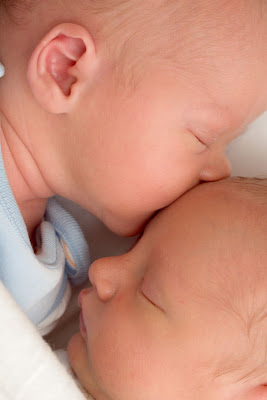 After several months, two babies switched in an El Slavador hospital were both reunited yesterday with their biological parents, respectively, in Dallas, Texas, and the United Kingdom.
But it didn’t have to turn out that way. Like this story from the news in 2009.
It sounds like a movie. Nurses bring a newborn daughter back to her mother after bathing. The mother insists that she’s been given the wrong baby. The nurses, who clearly know better, dismiss her concerns.
But 56 years later, DNA testing proves that Marjorie Angell, the real mother in this real story, was right.
Kay Rene Reed and DeeAnn Angell were both born on the third of May, 1953 in eastern Oregon’s Pioneer Memorial Hospital. As babies they were switched, presumably while being given baths, and grew up to become wives, mothers, and grandmothers. Less than a year ago Kay Rene’s brother discovered an old photograph of Kay Rene in middle school. Except that it wasn’t a picture of Kay Rene; rather, the schoolgirl who could have been her twin was in fact the sister of DeeAnn.
Subsequent DNA testing proved what had already become obvious. Kay Rene wasn’t a Reed, and DeeAnn wasn’t an Angell.
“I cried,” said Kay Rene. “My life wasn’t my life.”
MISTAKEN IDENTITY
Imagine waking up one morning and discovering that you were someone else. Nothing has changed, yet everything has changed. You have the same friends, the same family, the same job. But you also have another family and another past — a whole different identity about which you know nothing. A careless moment over which you had no control and an innocent mistake outside your knowledge conspired to leave you wondering how your whole life might have unfolded if not for that momentary twist of fate.
What would you do? What would you think? How would you feel?
If you have lived a happy and well-adjusted life, you’d probably wrestle with some inner confusion and then return to your friends and family. But if your life had been difficult, if you had endured an existence of hardships and traumas that had left you broken and bitter, how might you cry out against the cruelty of chance that had snatched away the happy life you might have had.
And what if, somehow, it had actually been your own fault?
THE ULTIMATE ANGUISH
The Sages teach that when a soul departs from this world, it lets out a scream that can be heard from one end of the universe to the other. Contemporary scholars have explained their meaning as follows:
Once freed from the bonds of physical existence, every soul ascends to the next world and comes before the Heavenly tribunal for judgment. Upon our arrival, each of us will witness a reenactment of his entire life on earth, as if projected upon a giant screen, with all of our good deeds and accomplishments, but also with all our carelessness and self-absorption. Recognizing the futility of excuses or apologies, we will feel the shame and remorse of a life poorly lived, with no further chance of redemption.
Simultaneously, as if on a split-screen, a different story plays out. Here we will behold the life of a tzaddik, a truly righteous and pious individual whose every thought and deed is for others and whose efforts are directed entirely toward moral and spiritual self-perfection. The contrast between the two images will be astonishing.
As the painful exercise concludes, each of us will pose a question to the court: “I recognize my own life, but who is this tzaddik that lived so perfect a life, and why was his story projected next to mine?”
“That tzaddik,” the court replies, “is the person you could have been.”
With sudden clarity, the ascendant soul will understand the consequences of a life lived in pursuit of physical pleasure and material goals. Perceiving that there had resided within him the potential to become someone else altogether and, realizing that it is too late to go back and relive his life, the unfortunate soul will emit a scream that can be heard from one end of the universe to the other.
BEFORE IT’S TOO LATE
As long as we remain alive in this world, however, there is time to go back. What’s past is not necessarily past, for the Creator has programmed into his universe the extraordinary capability to go back in time and reshape what has already been done. This is teshuva — repentance or, literally, return.
The Jewish concept of repentance is not mere chest-clopping and confession.Teshuva is a process of self-transformation, of changing ourselves into the kinds of individuals incapable of ever again committing our earlier transgressions and indiscretions. Through sincere self-reflection, our genuine remorse will catapult us to new levels of spiritual and moral sensitivity. By returning to the straight path the Creator laid out before us from the moment we were born, we literally re-create ourselves and severe all connection to the errors of the past.
What’s done is now undone, and we have nothing to fear from the ultimate Day of Judgment. It is no longer our past that defines us. It is what we have made of ourselves, and what we do from this point forward, that will define our future.
 The two women switched at birth have gotten on with their lives, and they have even become friends. Kay Rene introduces DeeAnn as her “swister.”
“I’m trying to move forward and look at the positive,” DeeAnn said. “You can’t look back. It just drives you crazy.”
As we approach Rosh Hashanah, the day on which all the world is judged for the coming year, it would serve us well to contemplate both who we are and who we ought to be.

Rosh Hashanah: Letting our spirits soar
 When my youngest daughter was three years old, she discovered the helium balloons in the flower section of our local supermarket, handed out free to every child who asks. I tied the string around her wrist so the precious balloon wouldn’t escape up to the rafters. She bounced it on its string as I pulled it this way and that to avoid bumping other shoppers. She hugged it as we climbed into the car for the ride home.
As I pulled into the driveway, my daughter flew out of the car, her balloon bobbing along behind her, raced in through the front door and out again to our back yard, slipped the string off her wrist and gazed upward as the balloon rose into the sky and slowly drifted away.
“Why did you let go of your balloon?” I asked, slightly miffed that she had so casually cast away the new toy she had been fussing over for the last half hour.
My daughter just shrugged, giggled, and watched the balloon disappear from sight.
After our next trip to the market she did it again. Then again, over and over for months. Every time I asked the same question. “Why did you let go of your balloon?”
Finally I got an answer. My daughter looked me in the eye and replied, “It’s a present for God.”
* * *
She doesn’t do it anymore. And part of me mourns for the pure, innocent faith that prompted a little girl to give up her toy as an offering to the Almighty.
For all our experience and the sophistication, for all our indulgent smiles at the simplicity of our children’s beliefs, is it not likely that our children know something we don’t, something they themselves soon won’t know or even remember they once knew? And perhaps it is precisely their power of belief that sets them apart from the adults they will become.
Children believe in God, believe in their parents, believe in their country and their school and their friends and that good will always win out over evil. Their trust and faith haven’t yet been sullied by the lies of politicians, the corruption of law and justice, the avarice of sports heroes, the superficiality of Hollywood or, most importantly, the cynicism of their parents, who may try for a time to put on an act to spare their children from their own disillusionment.
But what if it worked the other way, that we could learn an old lesson from our children instead of imposing yet another new lesson upon them? What if we could turn the clock back and recapture even a whiff of the innocence of youth? Would we reach out to grasp it, or have we grown too jaded even to try?
 This Rosh Hashana, Jews around the world will fill synagogues to inaugurate the first day of the Jewish new year. But Rosh Hashana celebrates much more than the beginning of another calendrical cycle. It celebrates birth and rebirth; it celebrates beginning and renewal, for it commemorates nothing less than the Creation of the world and Mankind.
As we approach the New Year, let us ask ourselves how we can turn back the clock, exchanging bad habits for new challenges, routine for renewal, and cynicism for enthusiasm. Instead of smiling with adult condescension at the innocence of children, let us consider instead that the difference between childhood and maturity is not whether we give presents to our Creator, but what kind of presents we choose to give. A child serves God by sending a balloon up into the sky. An adult serves God by releasing his spirit to soar to the heights of Godliness.
Have we given charity in proportion with our means? Have we visited the sick and comforted the distressed? Have we consistently spoken with kindness to our neighbors, with respect to our superiors, and with patience to our children? Have we honored the Sabbath and studied the ancient wisdom of our people?
It’s not enough to make resolutions; we need to inspire ourselves to see them through. We need to awaken in ourselves an awe of the Almighty by reflecting upon the vastness of creation, the unfathomability of the stars in their courses, the mysteries of life, and the limitless potential of the soul — to behold for a lingering moment the immeasurable beauty and majesty of our universe.
And if we can follow through, if we can make the moment last without slipping back into our well-traveled rut of discounting every noble and beautiful thought and deed, then perhaps we can retain our faith in those things truly worthy of faith throughout the coming year.
Originally published by the St. Louis Post-Dispatch and Aish.com

Why Souls Come Back: A Study of Reincarnation
 What is déjà vu? Some believe it’s an echo of recognition resonating through the curtain that separates one incarnation from another. For one brief moment, two separate but interconnected lives make contact through a flicker of metaphysical commonality. Maybe that’s true; maybe it isn’t. But a recent study of reincarnation by Dr. Ian Stevenson supports the belief that our souls do in fact return to this world after we die.
One of the most persistent dilemmas in spiritual philosophy is why bad things happen to good people, followed closely by its sister conundrum, why good things happen to bad people. If we believe in Divine justice, why does our world operate according to a system in which justice seems to be the exception rather than the rule?
Read more at: http://www.learning-mind.com/why-souls-come-back-a-study-of-reincarnation/

Days of Fear, Days of Love
 You must know that there is fear, and there is fear: there is warranted fear and senseless fear. Then there is trust and there is naiveté.
Rabbi Moshe Chaim Luzzato, 18th Century kabbalist
We have nothing to fear but fear itself.
Franklin Delano Roosevelt
As we approach Rosh Hashanah and Yom Kippur, the days of fear and the days of love, we should remind ourselves that the real dangers we face are not from the Ayatollah, not from Vladimir Putin, not from Donald Trump, and not from Hillary Clinton.
The greatest dangers that we face are from our own bitterness, our own complacency, our own pettiness, and our own resistance to challenging ourselves to learn, to grow, and to bring the spirit of God into our world.
 Yonason Goldson