Home » Posts tagged 'Culture' (Page 31)

Tag Archives: Culture

The Candles and the Tree

640x-1It was the December after my ninth birthday. A menorah rested on the bookshelf over the television console. Across the room, beside the fireplace, the lights of a tree twinkled red and green and blue. I was standing next to my mother as she held a candle in her hand. My father wasn’t there. He wasn’t into these things.

My mother lit the lone candle, ushering in the first night of Chanukah. She didn’t recite the blessing. She didn’t know it. I remember watching the wick catch, watching the flame grow bright, and asking myself, “Now what happens?”

“We light the candles for eight nights because the oil burned for eight days,” my mother had told me. What oil? I wondered. But something about her brief explanation stopped me before I asked. Maybe she didn’t know, either.

A year or two later, at my suggestion, the menorah had disappeared and only the tree remained. Waiting for the morning of December 25th when all the presents could be opened at once seemed far more dramatic than diluting the experience over a week, especially when those wrapped boxes mysteriously appeared under the tree day after day over the course of almost a whole month. Chanukah just couldn’t compete.

Only two decades later did I come to appreciate how much my own experience had truly been a Chanukah story.

SEEKING SPIRITUALITY FROM A TO ZEN

When I went away to college, I left behind the tree with the menorah. December 25th had become as irrelevant as Santa Claus, and I preferred an envelope with a check to wrapped presents that would most likely be returned for credit. I eagerly adopted the ambivalent agnosticism of so many of my peers, celebrating dormitory weekends by emptying six-packs rather than observing commercialized annual holidays with empty rituals.

Sometime toward the end of my university career I found myself attracted to Zen. Not in the traditional style, with its practices of discipline and self-mastery, but the pop-spiritual variety learned from Zen and the Art of Motorcycle Maintenance and similar modern scriptures.

Aligning myself with the spiritual energy of the universe became my goal. I wanted to choose good over evil because, ultimately, that brought good karma and tranquility. Surely, this was the road to Truth.

But we all know which road is paved with good intentions. As sincere as I may have been in my aspiration to travel the road to Truth, I found with annoying frequency that when my desire to do good clashed with my desire to indulge amoral self-interest, good threw in the towel at least two times out of three. Forced to take stock of myself, I had to concede that, for all its high-sounding ideals, a spiritual discipline that produced no moral discipline wasn’t worth its mantras.

TOO LATE FOR THE HIPPIES

filmore-cars-vw-bus1I hadn’t developed much discipline in my academic life, either. Oh, my grades were good enough, but four years studying English literature and writing had left me with neither gainful employment nor vocational direction. It was 1983, a decade late to join the hippies or beatniks, but that didn’t stop me from swinging a backpack over my shoulders and hitchhiking across the country. If I hadn’t found Truth in the ivory tower, perhaps I might find it in the heart of America.

Sixth months crisscrossing the country brought me no closer to Truth, but it did whet my wanderlust, and I soon boarded a flight across the Atlantic to continue my journey through Europe, after which Africa, Asia, and Australia lay upon my horizon.

Half a year into my journey, Europe ended with a short hop across the Mediterranean to Israel, where I sought to have a classical Jewish experience — volunteering to pick oranges on a kibbutz. But it was December, with little agricultural work to be done; moreover, the dollar was strong, resulting in some 9 million American tourists in Europe, many of them draining south into Israel as winter weather set in. I found the kibbutz placement office blocked by a line of 20-somethings camped out like they were waiting for tickets to a Rolling Stones concert, oblivious to the signs screaming, NO PLACEMENTS UNTIL JANUARY.

Desperate for a break from the stresses of travel on a shoestring, I cast about for some way of imposing routine upon my life before departing for Africa and, somehow, found myself invited to attend yeshiva.

Yeshiva? The word was unfamiliar, but the offer of a bed, hot meals, and a daily schedule of classes proved irresistible. It was two weeks before Chanukah, and I would finally learn about the secrets of the menorah and the miracle of the oil.

THE CLASH OF CULTURES

Although a period of peaceful coexistence followed Alexander the Great’s occupation of the Land of Israel, it didn’t take long after Alexander’s death before the ruling governments began to feel first discomfited and later threatened by their Jewish subjects and the Judaism they practiced. Greek philosophy recognized man as the pinnacle of creation, perfect in his accomplishments, answerable to no one but himself. Greek mythology embraced a pantheon of gods characterized by caprice and selfishness, by lust and vengeance, thereby sanctioning similar behavior among men.

And even though it was no longer the Greeks who controlled Israel, the Ptolemys of Egypt and later the Seleucids of Syria had thoroughly absorbed the cultural values of the empire that had briefly ruled over them.  How offended they must have been by a Jewish society devoted to self-perfection through submission to a divine code of moral conduct.

When they could no longer tolerate the Jewish threat to their ideals, the Syrian-Greeks contrived to destroy Jewish ideology. Whereas their predecessors, Babylon and Persia, had turned to violent oppression, the cultural successors of Alexander’s empire posed a much more subtle danger: in place of physical violence or outright prohibition of Torah observance, Antiochus IV of Syria banned only three practices: the Sabbath, bris milah (circumcision), and Rosh Chodesh, the sanctification of the new month.

The Sabbath testifies to the divine nature of the physical universe:  without this weekly reminder, we easily loose touch with and ultimately forget our relationship with the Creator of all. Bris milah testifies to the divinity of life:  it is the sign of our higher calling, reminding us that we can control our physical impulses rather than allowing them to control us, that each of us is a work-in-progress striving toward self-completion and self-perfection. Rosh Chodesh testifies to the divinity of time:  it is the ceremony that fixes the calendar and imbues the Jewish holidays with an intrinsic holiness. Without Rosh Chodesh, placement of the holidays would become arbitrary, leeching all meaning from them the way American Federal holidays have lost all substance in the eyes of most Americans.
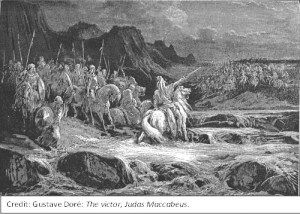
hanukkah_within_articleThe Jews refused to submit, and in the end the Syrian-Greeks resorted to more draconian decrees and eventually violent repression. But their plan had been sound: had they succeeded in stopping our adherence to those three basic precepts, they would have succeeded also in reducing Torah observance to an empty ritual, one that might have continued on for generations, but would have quickly become bereft of all meaning and spiritual significance. For this reason, the observance of Chanukah always includes one Sabbath, always passes through Rosh Chodesh, and is eight days long as a remembrance of the bris, the covenant between the Jew and his Creator.

Chanukah celebrates victory not only over our Grecian oppressors, but also over the Hellenists, those Jews who promoted a new syncretism of Judaism, wherein they hoped to intermingle Jewish practice with that which they found most attractive in Greek culture. The Maccabees recognized the absolute incompatibility between Greek ideology and Jewish philosophy, and they foresaw that ultimately one would have to prevail over the other. Without staunch defenders fighting for Jewish identity, the torch of Judaism would inevitably be extinguished and only the tree of foreign culture would remain.

ILLUMINATING THE GENERATIONS

Despite the victory of the Maccabees, the threat from Greece did not disappear. To this day it persists in its cultural assault against the values of Jewish tradition. The nine year old boy in America, or Britain, or even in Israel, who looks at the Chanukah candles and wonders what they mean, who sees no difference between the flames of the menorah and the twinkling lights of the tree, testifies to the victory of the Greeks.

But not every child has forgotten the lights. The rekindling of the menorah each year reminds us that the torch of Jewish tradition continues to illuminate generation after generation and dispel the darkness of apathy and assimilation. However much the ideological descendants of the Greeks strive to extinguish the lights, the eternal flame that burns within the soul of the Jewish people still shines on and on.

In my own observance of Chanukah, I rejoice that my own children have grown up not only with the lights of the menorah, but with a growing understanding of what they mean. I’m grateful that I’ve been able to give them what my parents were unable to give me: self-knowledge, the greatest weapon against cultural extinction.

Through the generations and across the world, the Jewish people have successfully adapted to living as guests among disparate societies, but only by retaining a strong sense of our history, the values of our heritage, and a familiarity with the culture that keeps our sense of identity alive and vibrant. Compromise these, and the Jew, together with his Judaism, will surely vanish. Preserve them, and we guarantee that the victory of the Hasmoneans over the Greeks will be renewed in every generation as a victory of the Jewish people over assimilation.

Originally published in the St. Louis Jewish Light and Aish.com.

Creating a Culture of Violence

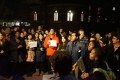
San-Bernardino-vigil-Mark-J.-Terrill-Associated-PressI wish there was no reason to repost this essay.  But with “random” violence becoming a cultural norm, we can’t run away from the root causes of radicalization, whether Muslim or otherwise.  President Obama may not be totally off the mark in his belief that the West created this problem — but our contribution is not what he thinks, and his policies are only adding fuel to the fire.

Zebadiah Carter describes himself living in “an era when homicide kills more people than cancer and the favorite form of suicide is to take a rifle up some tower and keep shooting until the riot squad settles it.” In 1980, this remark by the main character in a Robert Heinlein novel sounded like the science fiction that it was. Now it echoes like a prophecy.

Read the whole article here:
http://yonasongoldson.com/2015/05/18/remembering-the-boston-bombing/

Worst Day Ever?

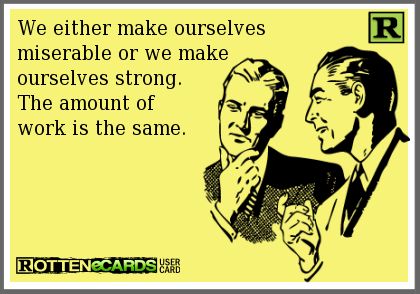
RottenEcardsWorst Day Ever?
by Chanie Gorkin

Today was the absolute worst day ever
And don’t try to convince me that
There’s something good in every day
Because, when you take a closer look,
The world is a pretty evil place.
Even if
Some goodness does shine through once in a while
Satisfaction and happiness don’t last.
And it’s not true that
It’s all in the mind and heart
Because
True happiness can be attained
Only if one’s surroundings are good
It’s not true that good exists
I’m sure that you can agree that
The reality
Creates
My attitude
It’s all beyond my control
And you’ll never in a million years hear me say
Today was a very good day

Now read it from bottom to top, the other way,
And see what I really feel about my day.

From Aish.com.


The End of Awe

grand-canyon-compressor“For thousands of years, it had been nature — and its [Creator] — that had had a monopoly on awe. It had been the icecaps, the deserts, the volcanoes and the glaciers that had given us a sense of finitude and limitation and had elicited a feeling in which fear and respect coagulated into a strangely pleasing feeling of humility, a feeling which the philosophers of the eighteenth century had famously termed the sublime.

“But then had come a transformation to which we were still the heirs…. Over the course of the nineteenth century, the dominant catalyst for that feeling of the sublime had ceased to be nature. We were now deep in the era of the technological sublime, when awe could most powerfully be invoked not by forests or icebergs but by supercomputers, rockets and particle accelerators. We were now almost exclusively amazed by ourselves.”

― Alain de Botton, The Pleasures and Sorrows of Work

The Boundaries of the World

wormhole 2This week, the world observed the 100th anniversary of Albert Einstein publishing his General Theory of Relativity.  The effects of his revelation extend far beyond what most of us imagine, as I outline in this excerpt from my book Proverbial Beauty:  Secrets for Success and Happiness from the Wisdom of the Ages.

Do not remove the boundaries of eternity, which were set in place by your forefathers (Proverbs 22:28).

Writing for Environmental Health Perspectives, Ron Chepesiuk cites research that exposure to artificial light can prevent trees from adjusting to seasonal variation, affecting the behaviors, foraging areas, and breeding cycles of insects, bats, turtles, birds, fish, rodents, and reptiles even in rural settings.  Urban light has caused disorientation in migrating birds, accounting for avian deaths estimated between 98 million and one billion each year.

The 24-hour day/night cycle, known as the circadian clock, affects physiologic processes in almost all organisms. These processes include brain wave patterns, hormone production, cell regulation, and other biologic activities. Disruption of the circadian clock is linked to several medical disorders in humans, including depression, insomnia, cardiovascular disease, and cancer, says Paolo Sassone-Corsi, chairman of the Pharmacology Department at the University of California, Irvine, who has done extensive research on the circadian clock. “Studies show that the circadian cycle controls from ten to fifteen percent of our genes,” he explains. “So the disruption of the circadian cycle can cause a lot of health problems.”

A meeting sponsored by the National Institute of Environmental Health Sciences (NIEHS) concluded that, although there is still no conclusive evidence, the correlation between altered patterns of light and dark in the modern world and dramatic increases in the risk of breast and prostate cancers, obesity, and early-onset diabetes appears more than coincidental.

And, of course, we can no longer see the stars.

Breaches in natural boundaries have taken many other forms as well:

  • In 1884, a farmer visiting the Cotton States Exposition in Louisiana brought back a few Venezuelan water hyacinths to decorate the fountain outside his home in Florida. Today, the aggressive purple flowers choke 126,000 acres of waterways.
  • Kudzu, a Japanese vine imported in 1876 to prevent erosion, is currently spreading through the southern United States and expanding at a rate of 150,000 acres a year.
  • The European rabbit, introduced to Australia in 1859, has reached a population of over 200 million, necessitating the construction of a 2000 mile long rabbit-proof-fence to prevent the wholesale destruction of farmlands.
  • In 1956, African bees brought over by Brazilian scientists to breed for honey production escaped their quarantine and gave rise to the noted “killer bee” scare.

The list goes on and on.  In the United States alone, containment costs of invasive species are estimated at $138 billion annually.

But the violation of natural boundaries has even more broad-reaching consequences, affecting not only the stability of our physical world but the integrity of the moral universe as well.  In his book Modern Times: the world from the twenties to the nineties, historian Paul Johnson analyzes the impact of Albert Einstein’s theory of relativity upon the way Western society began to look at the established values of the ages:

All at once, nothing seemed certain in the movements of the spheres… It was as though the spinning globe had been taken off its axis and cast adrift in a universe which no longer conformed to accustomed standards and measurement. At the beginning of the 1920s the belief began to circulate, for the first time at a popular level, that there were no longer any absolutes:  of time and space, of good and evil, of knowledge, above all of value.  Mistakenly but perhaps inevitably, relativity became confused with relativism.

No one was more distressed than Einstein by this public misapprehension.  He was bewildered by the relentless publicity and error which his work seemed to promote…

Einstein was not a practicing Jew, but he acknowledged a God.  He believed passionately in absolute standards of right and wrong… He wrote to [colleague Max] Born:  “You believe in a God who plays dice, and I in complete law and order in a world which objectively exists and which I, in  a wildly speculative way, am trying to capture.  I firmly believe, but I hope that someone will discover a more realistic way or rather a more tangible basis than it has been my lot to find.”

But Einstein failed to produce a unified theory, either in the 1920s or thereafter.  He lived to see moral relativism, to him a disease, become a social pandemic, just as he lived to see his fatal equation bring into existence nuclear warfare.  There were times, he said at the end of his life, when he wished he had been a simple watchmaker…

[T]he public response to relativity was one of the principal formative influences on the course of twentieth-century history.  It formed a knife, inadvertently wielded by its author, to help cut society adrift from its traditional moorings in the faith and morals of Judeo-Christian culture.

It’s hard not to be impressed by the prescience of King Solomon.  When civilization depended upon candlelight to hold back the darkness, the inexorable cycle of day and night forced us to conform to the natural order.  True, our lives have become more convenient and more comfortable, but once electric lighting pushes away the darkness of night, once central air conditioning and heating insulate us from the changing of the seasons, once cars and planes shrink the distance between faraway places, once electronic communication eliminates all delay in correspondence and information and, indeed, once science itself seems to provide justification that all boundaries are negotiable, is it not inevitable that society will begin to challenge moral boundaries as well?

There are no absolutes when every established norm is threatened by the inertia of change for the sake of change and an idealized vision of unrestricted freedom.  Once change becomes the new normal, human society has little hope of curbing the headlong rush into chaos and social disintegration into moral anarchy.

In the same way that we have to defend the integrity of natural and moral boundaries as a society, we have to guard the boundaries between ourselves and those around us when the order of society begins to crumble.  But no matter how much we try, we can never completely seal ourselves off from the influences of the culture in which we live.

I discovered this frightening truth on a trip to southern Asia, where a popular joke is repeated only half-jokingly:

In America people drive on the right side of the road.
In England, people drive on the left side of the road.
In India, it’s optional.

Only when society as a whole preserves its respect for the traditions that have been handed down through the ages will the structure of that society endure.  But if each generation believes that it can reject the standards of its forbears from a position of moral superiority, the next age of darkness can be found lurking right around the corner.

Terrorism Close to Home

Flickr_-_Israel_Defense_Forces_-_The_IDF_Honors_Its_ReservistsThis morning’s terrorist attack by a Palestinian who rammed his car into Israeli soldiers at a bus station struck a little closer to home.  Both of the injured soldiers had just drafted into the army and were friends of my son from the same Lone Soldier group.  They were released on leave a day before my son was, or he probably would have been standing right beside them.

At least one of them will be disabled for months:  the Guardian reports this as “light to moderate” injury.

The story in the Guardian led by stating that the attack took place in the “occupied West Bank,” implying a John-Kerryesque legitimacy, then went on to report that the “incident raises the number of Palestinians killed since 1 October to 98, including an Israeli Arab.”  In the interest of balance, the story did concede that, “More than half of them have been alleged perpetrators of stabbing, shooting and car ramming attacks aimed at Israeli civilians and security forces.”

However, the story neglected to mention that after ramming his car into the crowd, the Arab attacker was shot as he tried to stab one of his victims.

Allegedly.

Not the worst example of media bias by far, but shoddy journalism by any account.  Our children who put themselves in harm’s way to protect others from violence deserve much better.

The Heroism of Giving Thanks

Originally published in 2002 by the St. Louis Post-Dispatch and the Baltimore Sun.

Will Rogers couldn’t have said it better: No nation has ever had more, yet no nation has ever had less. And it’s easy to understand why the two go together.

The Talmud observes that the moment a person acquires $100, he immediately wants $200. The more we have, the more we want. And the more we believe in our own entitlement, the more likely we are to forget both our humble origins and our obligations to others.

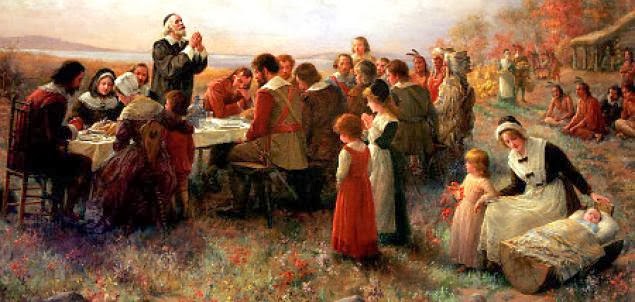
The-First-Thanksgiving-DinnerIt’s somewhat heartening, therefore, that Thanksgiving has retained so prominent a place in American culture, even if most of us rarely give a passing thought to the Puritan ideals that gave birth to the first Thanksgiving.

Who were the Pilgrims? The settlers who stepped off the Mayflower in 1620 were not adventurers or opportunists. They were devout Protestants seeking a pure, uncorrupted expression of the Christian values they had found wanting in their native England.

They paid a high price for their idealism: Half of them died during that first, brutal, Massachusetts winter. But summer brought hope, and out of hope they declared a festival to thank their Creator for their survival and for their hard-won religious freedom.

Political freedom was still a novel idea in Europe then, although the concept had existed for nearly 3,000 years, since the Jewish exodus from Egypt. The notion of religious freedom, introduced to the world somewhat later, was already 17 centuries old when the Pilgrims landed at Plymouth Rock.

3-Emperial-ELEPHANTSBack then, the Jewish nation had been at war not only with the Selucid Greeks, which controlled Israel, but also with itself. The Hellenist Jews found much in Greek culture that they admired and eagerly sought to incorporate into Jewish practice, while the majority of the Jews recognized the inherent incompatibility of Judaism, with its focus on the perfection of the soul, and Grecianism, with its self-worship of body and intellect. Behind the Hellenists, however, towered the full power of the Selucid Empire, before which the ideal of Jewish cultural purity seemed to have little hope of survival.

But the weak rose up against the strong and the many were vanquished by the few. Shouts of freedom echoed through the streets of Jerusalem as the Maccabees rekindled the lights of the Temple in purity, and the festival of Chanukah was established as “days of thanksgiving and praise to [the Almighty’s] great name.”

RamirezCartoon21

“This year we’re having goose instead. It was flaunting its wealth and showing off its golden eggs.”

The complacency of the Jews and their unwillingness to toil in the preservation of their own cultural values put them in danger of cultural extinction. The complacency of Christian Europe, in the eyes of the Puritans, led to a dilution and a depreciation of Christian values. And the ultimate realization of the Jews, like the realization of the Puritans centuries later, was that ideals not fought for and defended cease to remain ideals.

The true heroes in any society are those prepared to struggle for their ideals, those ready to sacrifice for a greater good, those who understand that nothing of value ever comes cheap or easy. When we take freedom for granted, we stand in danger of losing it. And the surest way of taking anything for granted is by failing to express appreciation.

Life begins with struggle. And when struggle ends, life ends with it. Indeed, it is that very struggle that makes life worth living. Both Thanksgiving and Chanukah remind us to be grateful not just for the success, but even for the struggle.

Especially for the struggle.


The Legacy of Woodrow Wilson

564f3cc7c10e0.imageOnce Iowa Democrats decided to rename the venerated event known as the Jefferson-Jackson dinner, it was only a matter of time before PC zealots would start demanding the purge of historical icons all across America.  After all, how in good conscience can a country continue to commemorate its most influential leaders if they failed to anticipate that the legal and universally-accepted institutions of their times would eventually be regarded as immoral by their great-grandchildren?

Now it’s Woodrow Wilson’s turn, as students at Princeton demand that the memory of their university’s former president be expunged from under the heavens because he supported segregation, a policy viewed by many as progressive a century ago, no matter what we may think of it now.

There is a deeper irony in their campaign, however.  In terms of political acumen, Woodrow Wilson has quite a bit in common with a much more contemporary figure, one who is revered by the very people who are protesting President Wilson’s racism and misogyny:  Barack Obama.

Read the whole article here.


The Ostrich Mentality

la-fg-israel-palestinians-stabbing-attack-2015-001More unprovoked murders today in Israel: this time the victims included men in the act of prayer.

The approach taken by the Obama administration and much of European leadership, differentiating between terrorism and Islam so not to further alienate the Muslim world, might sound plausible.  But the incontrovertible evidence from Paris, Beirut, and Tel Aviv is that it’s not working.  Ayaan Hirsi Ali makes a case no thinking person can refute.

But, of course, that’s the point:  people aren’t thinking; they’re feeling.  If only the rich and powerful Western nations would humble themselves before the oppressed peoples of the third world, then there would be peace.  If only the intransigent Israelis would stop their illegal occupation, then there would be peace.  If only the culture of white supremacy in America would confess and atone for its evil ways, then there would be peace.

From the United Nations to the European Union to the White House to many of the elite universities around the country, Utopian ideologues bury their heads in the sand and ignore reality so they can persist in their chants of kumbaya and we are the world, reaching out to embrace people who want nothing but to watch the world burn.

In every aspect of our lives we are becoming more confused:  we alienate our friends while we appease enemies who want to kill us; we disdain the blessings we have while chasing shadows in pursuit of happiness; we preach tolerance while attempting to silence all who disagree with us; we dream of a perfect world while we stand idly by and let madmen tear down the world our fathers and grandfathers worked so hard to build.

The chaos of our times didn’t start this week in Paris.  It won’t end there, either, unless we open our eyes and start confronting the moral anarchy that is eating away at the heart of civilization.

Are you Smarter than a Pigeon?

Screen-Shot-2015-11-17-at-11.19.28-AMIn the name of science, I’d like to propose a new study to investigate how researchers choose the topics they study.  If my proposal finds acceptance, Jessica Stagner of the University of Florida will almost certainly figure prominently in the investigation.

Professor Stagner and her colleagues hoped to find support for evidence indicating that gamblers feel the same thrill of excitement when they almost win as they do when they actually win.  To do so, they created an experiment in which pigeons had to peck at colored markers in order to receive hidden rewards.

That’s right:  Pigeons.

And what was their conclusion?  Pigeons are smarter than people.

Read the whole article here.