Home » Posts tagged 'Groupthink' (Page 4)
Tag Archives: Groupthink

A View from the Frontlines
 Reporter Hunter Stuart describes how a strong dose of reality forced him to reconsider his biases and preconceptions.
In the summer of 2015, just three days after I moved to Israel for a one-and-a-half year stint freelance reporting in the region, I wrote down my feelings about the Israeli-Palestinian conflict. A friend of mine in New York had mentioned that it would be interesting to see if living in Israel would change the way I felt about it. My friend probably suspected that things would look differently from the front-row seat, so to speak.
Boy was he right.

Walking the Talk
 If Diogenes couldn’t find an honest man 24 centuries ago in ancient Greece, it’s hard to imagine his search would prove more fruitful in modern-day Washington, D.C. or, lamentably, in modern-day America.
It’s not hard to understand why. In our age of personal gratification, truth has become more than merely inconvenient. It has become an utter nuisance.
Conservatives have been eager – and correctly so – to shine the light of hypocrisy on Sally Yates, the acting Attorney General fired by Donald Trump last week for refusing to enforce his recent executive order on refugees. Ms. Yates might have argued against the order’s constitutionality; instead, she based her decision primarily on personal bias.
Celebrated by the left for her stand on principle, what Ms. Yates really did was to violate her oath of office by failing to fulfill her duties. It’s her job to uphold the law, not her individual values. If conscience prevented her from performing her duties, she would have resigned in protest. But that would have required true principle. So much easier to merely participate in another round of partisan gamesmanship.
This brings us back to Kim Davis, the Kentucky clerk who refused to grant marriage licenses to same-sex couples back in 2015. She too claimed to stand on principle by refusing to honor her oath of office.
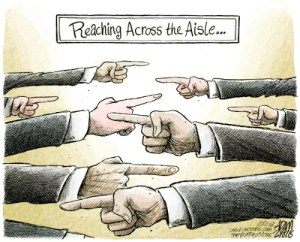 So why are the same voices that castigated Ms. Davis hailing Sally Yates as a hero? And where were the critics of Ms. Yates when Kim Davis was making herself a martyr in name only?
Jedediah Bila posed that very question on The View, prompting Whoopi Goldberg to go ballistic and invoke the popular refrain, it’s not the same thing.
Nowadays, principle is just a synonym for equivocation.

In Search of Journalistic Integrity
 What are the hottest news topics of the New Year?
I turned to Google News to find out. By adding “2017” in my computer’s search bar, I created my own (small and unscientific) database profiling some of the most reported current events topics.
One might expect – naively, to be sure – that the most pressing issues of the day would populate the brightest constellations of reportage across the firmament of internet news. So let’s take a look at which topics got the most hits:
- Vladimir Putin: 15.6 million
- Terrorism: 24.7 million
- Climate change: 29 million
- Gay: 41.5 million
- Israel: 74.4 million
Now what can we make of all this?

Peace in our Mind
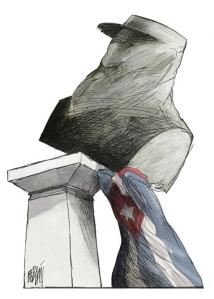 Two decades ago, Thomas Friedman suggested that someone should write a book called The Dictator Diet. Surely there must be some secret to the longevity of strongmen like Muammar Gaddafi, Yasser Arafat, and Fidel Castro. Like horror-movie mutations of the Eveready bunny, they just kept going and going and going.
Well, the last of them is gone at last. Adios, Mr. Castro. We wish we never knew ye.
But imagine if it had been different. What if Fidel had been a friend instead of a nuisance, if Cuba had been an ally instead of a thorn in America’s side?
It’s not such a wild notion.

Donald Trump has finally gone too far
 Perhaps we can forgive the president-elect for his crassness, his coarseness, his ultra-nationalist rhetoric, his mockingly superior tone, and for dragging the electoral process deeper into the mud than anytime in the last century.
But now he has officially gone too far.
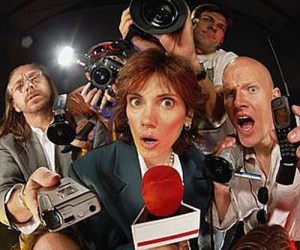
Donald Trump has committed the unpardonable sin of not telling the press where he went for dinner last Tuesday evening.
By doing so, reports the Washington Post, Mr. Trump has “dispensed with generations-old traditions and formalities,” adopting a “combative approach to press relations” in a way that shows “he clearly doesn’t respect the media.”
Gee, is this the same media that rallied all its collective forces to discredit Donald Trump as a candidate and convince the country that a humiliating electoral defeat to Hillary Clinton awaited him come November 8? Might that have something to do with his perceived lack of respect?
But that’s not even the real issue.
More significant is the sense of entitlement the media feels to invade the private lives of every public figure, and the selective metric they apply when they do so. They grudgingly accord scant airtime and column space to stories that don’t fit their ideological agenda, then cry foul when they’re denied access to the not-yet-president’s family meal and frame the perceived offense as a threat to national security.
If the election results taught us anything, it’s that the media has become so skewed in its reporting that it can’t even trust itself. Maybe if reporters learn that lesson they’ll find themselves more welcome beside the presidential dinner table.

How we move forward
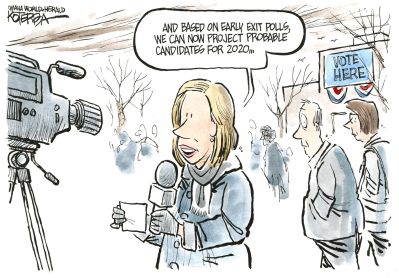 Too many voters held their noses yesterday as they entered the polling booth to vote for the candidate they considered least toxic. A smaller number could only make peace with their conscience by voting for some unexceptional third-party candidate. Then there were those who couldn’t bring themselves to vote at all.
Will the country survive this winter of our discontent? Only time will tell. But the question that lingers in the aftermath of electoral acrimony is this: are we going to start this all over again in two more years?
Sadly, we just might. Back in January, David Gelertner proposed in the Weekly Standard that the problem with the political left is that liberalism has become their new religion. For most people, religion is not a rational but an emotional commitment that emerges from some amorphous inner voice or feeling. And when people cannot defend their religious beliefs intellectually, they lash out with disproportionate ferocity at anyone who challenges those beliefs. Mr. Gelertner argues that the irrational dogmatism of many liberals bears less resemblance to political discourse and more to the religious fervor of blind faith.
He’s right, of course. But he’s wrong when he contends that this is overwhelmingly a phenomenon of the left.

Rejecting the new Age of Inevitability
 Isn’t it great to live in an age when machines can do anything? Cars drive themselves, jetliners land themselves, and smartphones do just about everything but tuck us into bed.
Recognition software can read our moods and even catch us telling lies. (That’s a good thing, right?) Programs can analyze our handwriting and predict our likes, dislikes, and likely actions by tracking our digital footprints. Soon, Amazon may be filling orders for us that we haven’t even placed yet.
In the workplace, software programs may start deciding who gets hired or promoted based on models constructed from data gathered about the highest performing employees. This may include variables based on medical history, psychological markers, and virtual clues to everything about us including age, gender, political leanings, and sexual preference.
In a recent Ted Talk, Zeynep Tufekci acknowledges that these programs may make decisions more objectively than humans do. But she cautions that machines trained to infer and predict are only as good as their programming, and will of necessity reflect the biases of their programmers — which could mean compounding, not eliminating, bias.
What’s more, the algorithms that produce this kind of “machine learning” don’t allow for human insight and intuition. It’s all statistical analysis, which turns probabilities into absolutes with no assessment by human reasoning and without allowing room for appeal to a higher authority.
The more troubling issue is our willingness to abdicate the responsibility implicit in free choice. In a culture that has long conflated judgment with judgmentalism, it’s hardly surprising to find how eager people are to reduce every decision to a binary option and thereby eliminate all shades of gray from the mix. And if that’s not enough, we can simply block any information that doesn’t conform to our way of thinking.

My Interview with Bill Martinez
 Listen in on my conversation about political correctness and the culture wars with nationally syndicated radio host Bill Martinez on 10/19.

Political Correctness: the root of all evil

After last week’s wackiness at James Madison University, it’s time to revisit this post from last April. I fear there will be too many opportunities to do so.
A letter to the future president of the United States:
If you want to fix the country, you can start with the root cause of all that ails our country:
Political Correctness.
The truth is that political correctness is not a new idea at all; it is simply the new label for an old, established moral postulate once accepted by all.
The word civility shares its linguistic root with the word civilization. It means taking into consideration the comfort of others before expressing what I think or doing what I want. It means remembering that other people have rights before I assert my own. It means reflecting upon how my actions are going to affect my community and recognizing that I have a responsibility to a society that is more than the sum of autonomous individuals.
So what was wrong with the term civility that the concept needed rebranding as political correctness? Most likely, it was the connotation of political ideology that spawned this illegitimate offspring of cultural nobility.

A Zoo with a View
 In the 1920s, comedian Robert Benchley commented that there are two categories of people in the world: people who divide people into categories and people who don’t. He went on to remark that, “Both classes are extremely unpleasant to meet socially, leaving practically no one in the world whom one cares very much to know.”
Groucho Marx may have been thinking the same thing when he famously quipped that he wouldn’t want to belong to any club that would have him as a member.
In all seriousness, it may be high time that we took these humorists and their absurdist observations a bit more seriously.
My first serious exposure to absurdism was back in my sophomore year at the University of California, when my English professor introduced our class to playwright Edward Albee. I was immediately fascinated by The Zoo Story, although I wasn’t quite worldly enough to appreciate the subtext of class warfare and social malaise.
Time would solve that problem. But I was still able to recognize the hidden threads of realism sewn together in a garment of tragicomic incongruity.
 Yonason Goldson